Within Formations
How a Star Became Part of a UFO
A pilot once grouped an aircraft's colored lights with a bright star, creating a convincing but physically impossible lighting pattern.
On this page
- The aircraft and star misidentification
- Why angular alignment overrides true distance
- Clues that can separate celestial and aircraft lights
Page outline Jump by section
Introduction
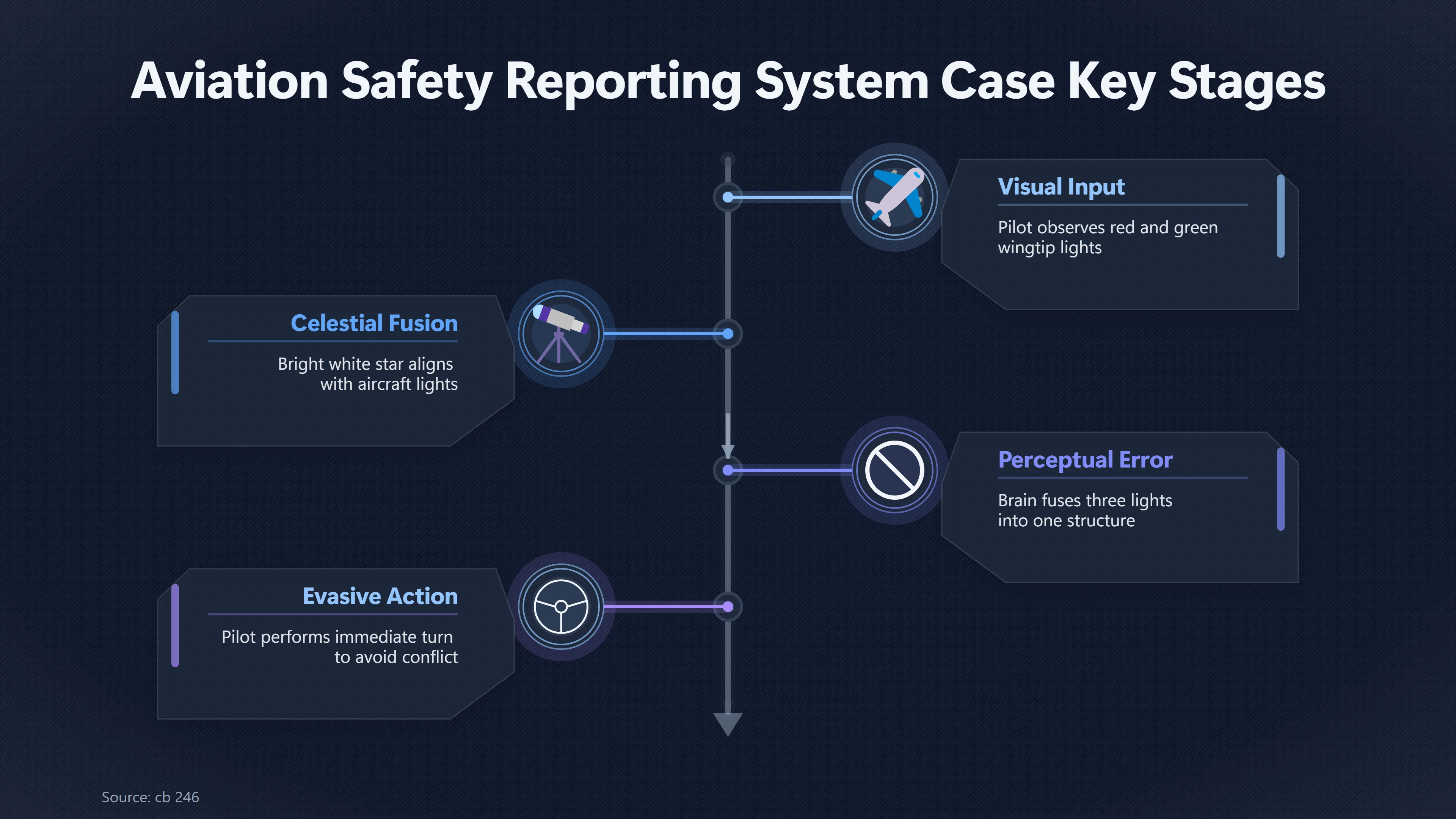
A convincing “UFO” does not always require an unfamiliar light. Sometimes the stranger effect comes from ordinary lights being assigned to the wrong object. A particularly revealing aviation case involved a pilot who saw the red and green position lights of another aircraft while a bright white star happened to lie in just the right apparent position beside them. The three lights were perceived as belonging to one nearby aircraft, producing a threatening configuration that did not physically exist. The pilot made an evasive turn before the mistake became clear.[Aviation Safety Reporting System]asrs.arc.nasa.govcb 246Aviation Safety Reporting SystemCALLBACK 246December 1, 1999…
The case is important because it isolates a specific mechanism behind some reports of structured or formation-like lights: angular alignment can temporarily override enormous differences in true distance. A star can be effectively at astronomical distance while aircraft lights are kilometres away, yet all three arrive at the observer simply as directions in the visual field. Under a dark, reference-poor sky, the brain can fuse those directions into one plausible object.
The aircraft-and-star misidentification
The incident appears in the December 1999 issue of NASA’s Aviation Safety Reporting System (ASRS) CALLBACK bulletin, in an article about parallax effects during night flying. According to the first officer’s report, the crew believed that they were facing an imminent traffic conflict. The perceived object appeared close enough to prompt the first officer to override the autopilot and begin an immediate left turn.[Aviation Safety Reporting System]asrs.arc.nasa.govcb 246Aviation Safety Reporting SystemCALLBACK 246December 1, 1999…
What the observer thought he was seeing was not simply an aircraft at the wrong distance. The apparent aircraft had been assembled perceptually from sources at radically different ranges. There really were green and red wingtip lights belonging to another aeroplane. But, as the pilot subsequently recognised, a bright white star had appeared to occupy the position of another light on that same supposed aircraft.[Aviation Safety Reporting System]asrs.arc.nasa.govcb 246Aviation Safety Reporting SystemCALLBACK 246December 1, 1999…
That detail makes the episode unusually useful for understanding UFO and UAP reports involving patterns of lights. The observer was not inventing luminous points that were absent from the sky. Every visible component could be real while the inferred object connecting those components was wrong. The error occurred at the stage where separate lights were interpreted as parts of one physical structure.
The consequences also show how compelling such an interpretation can become in real time. The evasive manoeuvre was abrupt enough to throw unrestrained people about the cabin; NASA’s summary records minor passenger complaints and a subsequent aircraft inspection for overstress, although no discrepancy was found. The pilot described his response as instinctive because he believed the traffic was only a few thousand feet away.[Aviation Safety Reporting System]asrs.arc.nasa.govcb 246Aviation Safety Reporting SystemCALLBACK 246December 1, 1999…
This was therefore more than somebody casually mistaking a star for an aeroplane. A trained aviation observer saw genuine aircraft lighting, correctly recognised at least part of what was present, but incorrectly incorporated an unrelated celestial light into the aircraft’s apparent geometry.
Why angular alignment overrides true distance
The physical arrangement sounds impossible once the sources are identified. An aircraft and a star plainly cannot carry lights on the same airframe. But the eye does not initially receive labels saying “aircraft, several kilometres away” and “star, many light-years away”. It receives light from particular directions.
That distinction between angular position and physical position is the heart of the case.
Imagine three luminous points projected onto the observer’s view:
- a red aircraft position light;[faa.gov]faa.govA C 20-30BA C 20-30B * a green aircraft position light;[faa.gov]faa.govA C 20-30BA C 20-30B
- a bright star lying close to the apparent aircraft.
If their angular spacing resembles the spacing expected from lights on one object, the pattern itself offers a plausible interpretation. The star’s enormous actual distance does not prevent it from appearing immediately beside the aircraft lights because objects at completely different ranges can occupy neighbouring lines of sight.
Parallax normally helps reveal such differences. It is the apparent displacement of one object relative to another when the observer’s viewpoint changes. The European Space Agency illustrates the principle with the familiar finger-against-a-distant-background example: nearby objects shift more strongly as viewpoint changes, whereas very distant objects shift far less.[European Space Agency]esa.intEuropean Space Agency ESAEuropean Space AgencyESA - Parallax… NASA describes the same geometry as an apparent positional shift produced by observing from different vantage points.[StarChild]starchild.gsfc.nasa.govStar Child ParallaxStar Child Parallax
For an observer aboard a moving aircraft, this can create particularly misleading relative motion. NASA’s ASRS bulletin explicitly warns that distant fixed objects such as stars or planets can appear close or moving when the observer’s own position changes. It notes that Venus has repeatedly caused aviation confusion, including being mistaken for aircraft position lights.[Aviation Safety Reporting System]asrs.arc.nasa.govcb 246Aviation Safety Reporting SystemCALLBACK 246December 1, 1999…
The vulnerability increases at night because many of the visual references that normally establish distance are absent. FAA research into night approaches has found that reduced visual cues can produce substantial errors in perceived geometry and that relative motion parallax may become an ineffective distance cue under such conditions.[Federal Aviation Administration]faa.govFederal Aviation AdministrationOffice of Aerospace Medicine Technical Reports | Federal Aviation AdministrationMarch 1, 1978… The FAA’s current aeronautical guidance likewise warns that dark scenes containing stars and scattered lights can produce false spatial interpretations, while an isolated stationary light can appear to move through the autokinetic illusion.[Federal Aviation Administration]faa.govFederal Aviation Administration Chapter 8. Medical Facts for PilotsFederal Aviation AdministrationChapter 8. Medical Facts for PilotsJanuary 8, 2015…
The aircraft-and-star case therefore does not require the observer to have poor eyesight or no aviation experience. It exploits an intrinsically difficult visual situation: moving observer, point-like lights, darkness, limited depth information and a configuration that happens to support a coherent interpretation.

Why the pattern looked like an aircraft
There was another reason the illusion was persuasive: two of the lights really did carry meaningful aviation information.
Standard aeroplane position lighting places red on the aircraft’s left side, green on its right and white towards the rear. US certification rules specify the red and green lights laterally separated on the aeroplane, with an aft-facing white light; the FAA also requires position lights to be illuminated during night operations.[Legal Information Institute]law.cornell.eduLegal Information Institute14 CFR § 25.1385 - Position light system installation. | Electronic Code of Federal Regulations (e-CFR) | US L…
Those colours therefore form a familiar spatial pattern to pilots. FAA safety guidance explains that the combination of red and green lights can tell an observer about another aircraft’s orientation and whether it may be approaching.[Federal Aviation Administration]faa.govFederal Aviation Administration FAA Safety BriefingFederal Aviation AdministrationFAA Safety Briefing - January February 2025December 31, 2024…
In the ASRS incident, the presence of genuine red and green aircraft lights gave the scene a strong interpretive anchor. The white star did not have to look inherently aircraft-like. It merely had to appear where an additional light on the already-recognised aircraft seemed plausible.
That is a more subtle failure mode than simply asking whether a witness “mistook a star for a UFO”. The better question is whether one celestial light was incorporated into an otherwise genuine aircraft-light configuration.
For investigations of reported triangles, V-shapes or unusually large illuminated craft, that distinction matters. Seeing three convincing vertices establishes three apparent directions in the sky. It does not, by itself, establish that all three sources share the same range or that a solid structure connects them.
Clues that can separate celestial and aircraft lights
The strongest way to test a suspected fused-light configuration is to stop treating the lights as a unit and examine each one independently. The ASRS case suggests several especially useful checks.
Watch relative spacing through a change of viewpoint. If all lights are physically fixed to one aircraft, their angular relationships should evolve in a way consistent with a single rigid object, allowing for perspective. If one point is a distant star, observer motion and aircraft motion can gradually make that point drift out of the supposed structure. This is exactly the kind of distance-dependent behaviour that parallax describes.[European Space Agency]esa.intEuropean Space Agency ESAEuropean Space AgencyESA - Parallax…
Compare the colours and flashes with normal aircraft lighting. Red and green steady position lights, together with white or red anti-collision lighting, strongly justify checking an aircraft explanation before treating the pattern as anomalous. Aircraft lighting does vary by viewing angle, and some lights may disappear as the aircraft turns, so investigators should not assume that every expected lamp must remain continuously visible.[Legal Information Institute]law.cornell.eduLegal Information Institute14 CFR § 23.2530 - External and cockpit lighting. | Electronic Code of Federal Regulations (e-CFR) | US Law |…
Do not infer common motion too quickly. From a moving cockpit, an effectively fixed celestial source can acquire apparent motion relative to the observer. Conversely, an aircraft travelling along a suitable line of sight can show surprisingly little angular displacement. Apparent shared movement over a short interval is therefore weaker evidence of physical connection than it first appears. NASA’s aviation report specifically identifies observer movement and parallax as the source of such misleading impressions.[Aviation Safety Reporting System]asrs.arc.nasa.govcb 246Aviation Safety Reporting SystemCALLBACK 246December 1, 1999…
Use independent positional information where available. Aircraft tracks, observer location and heading, exact time, celestial positions and longer video sequences can test whether the lights could have occupied the reported lines of sight independently. The critical question is not merely whether a star or aircraft was “in the area”, but whether its predicted angular position matches the particular light in the reported configuration.
Be cautious with short recordings. A few seconds of footage may preserve the very alignment responsible for the illusion without lasting long enough for relative motion to break it. The geometry becomes much more diagnostic when the observer or aircraft changes position enough for the supposedly connected lights to separate.
The larger lesson from one misplaced star
The NASA case gives an unusually clean warning about interpreting formations of lights. A reported pattern can be visually accurate while its inferred physical structure is false. The witness may correctly report three lights, their colours, their approximate spacing and their apparent movement, yet still be wrong about the single most important conclusion: that those lights belong together.
That is why the episode is particularly relevant to UFO and UAP reports describing enormous illuminated craft. An apparently coherent triangle, line or other formation should initially be treated as a set of angular observations, not automatically as the outline of one object. Establishing a physical craft requires evidence that the individual lights share distance and motion, not merely that they occupy suggestive positions in the sky.
The ASRS first officer’s experience demonstrates the point in unusually concrete terms. Two lights belonged to an aircraft; another belonged to the night sky. For a brief but operationally significant interval, perspective made all three appear to describe one threatening object.[Aviation Safety Reporting System]asrs.arc.nasa.govcb 246Aviation Safety Reporting SystemCALLBACK 246December 1, 1999…
Amazon book picks
Further Reading
Books and field guides related to How a Star Became Part of a UFO. Use these as the next step if you want deeper reading beyond the article.
The UFO Handbook: A Guide to Investigating, Evaluating, and R...
An explanation of the usual reasons for confusing IFOs (identified flying objects) with UFOs and a survey of the tools used to investigat...
Sensation and Perception
. Bruce Goldstein's SENSATION AND PERCEPTION, the best-seller which has helped over 150,000 students understand the ties between how we s...
Visual Intelligence: How We Create What We See
A unique, illustrated popular study reveals the way the human eye acts on the visual world not just to represent but to create the things...
Human Factors in Aviation
Since the 1950s, a number of specialized books dealing with human factors has been published, but very little in aviation. Human Factors...
eBay marketplace picks
Marketplace Samples
Live-tested eBay searches with available results related to this page.
Selected fromUFO poster oneBay.co.uk.

Current eBay listing
VINTAGE UFO FLYING SAUCERS COMIC ADVERTISING A2 POSTER PRINT
Current eBay listing
I Want To Believe UFO Poster Giclée Fine Art Heavyweight Print
Endnotes
1.
Source: asrs.arc.nasa.gov
Title: cb 246
Link:https://asrs.arc.nasa.gov/publications/callback/cb_246.htm
Source snippet
Aviation Safety Reporting SystemCALLBACK 246December 1, 1999...
Published: December 1, 1999
2.
Source: starchild.gsfc.nasa.gov
Title: Star Child Parallax
Link:https://starchild.gsfc.nasa.gov/docs/StarChild/questions/parallax.html
3.
Source: faa.gov
Link:https://www.faa.gov/data_research/research/med_humanfacs/oamtechreports/1970s/1978/197815
Source snippet
Federal Aviation AdministrationOffice of Aerospace Medicine Technical Reports | Federal Aviation AdministrationMarch 1, 1978...
Published: March 1, 1978
4.
Source: faa.gov
Title: Federal Aviation Administration Chapter 8. Medical Facts for Pilots
Link:https://www.faa.gov/air_traffic/publications/atpubs/aim/aim0801.html
Source snippet
Federal Aviation AdministrationChapter 8. Medical Facts for PilotsJanuary 8, 2015...
Published: January 8, 2015
5.
Source: faa.gov
Title: Federal Aviation Administration Chapter 8. Medical Facts for Pilots
Link:https://www.faa.gov/Air_traffic/publications/atpubs/aim_html/chap8_section_1.html
6.
Source: faa.gov
Title: Federal Aviation Administration Chapter 4. Air Traffic Control
Link:https://www.faa.gov/Air_traffic/publications/atpubs/aim_html/chap4_section_3.html
7.
Source: faa.gov
Title: Federal Aviation Administration FAA Safety Briefing
Link:https://www.faa.gov/sites/faa.gov/files/JanFeb2025.pdf
Source snippet
Federal Aviation AdministrationFAA Safety Briefing - January February 2025December 31, 2024...
Published: December 31, 2024
8.
Source: faa.gov
Title: Report Safety Issues | Federal Aviation Administration
Link:https://www.faa.gov/aircraft/safety/report
9.
Source: nasa.gov
Title: Aviation Safety Reporting System Overview
Link:https://www.nasa.gov/human-systems-integration-division/aviation-safety-reporting-system-overview/
10.
Source: ssd.jpl.nasa.gov
Link:https://ssd.jpl.nasa.gov/horizons/manual.html
11.
Source: faa.gov
Title: Runway Status Lights | Federal Aviation Administration
Link:https://www.faa.gov/air_traffic/technology/rwsl
12.
Source: space.com
Title: What Is Parallax?
Link:https://www.space.com/30417-parallax.html
13.
Source: faa.gov
Title: A C 00-46F
Link:https://www.faa.gov/regulations_policies/advisory_circulars/index.cfm/go/document.information/documentID/1039459
14.
Source: imagine.gsfc.nasa.gov
Title: nearest star info
Link:https://imagine.gsfc.nasa.gov/features/cosmic/nearest_star_info.html
15.
Source: imagine.gsfc.nasa.gov
Link:https://imagine.gsfc.nasa.gov/ask_astro/stars.html
16.
Source: nasa.gov
Title: NAS A’s New Horizons Conducts the First Interstellar Parallax Experiment
Link:https://www.nasa.gov/solar-system/nasas-new-horizons-conducts-the-first-interstellar-parallax-experiment/
17.
Source: astrobiology.nasa.gov
Title: know thy star know thy planet
Link:https://astrobiology.nasa.gov/news/know-thy-star-know-thy-planet/
18.
Source: science.nasa.gov
Title: three steps to measuring the hubble constant
Link:https://science.nasa.gov/asset/hubble/three-steps-to-measuring-the-hubble-constant/
19.
Source: asrs.arc.nasa.gov
Title: cb 455
Link:https://asrs.arc.nasa.gov/publications/callback/cb_455.html
20.
Source: faa.gov
Title: Chapter 2. Aeronautical Lighting and Other Airport Visual Aids
Link:https://www.faa.gov/air_traffic/publications/atpubs/AIM/aim0201.html
21.
Source: faa.gov
Link:https://www.faa.gov/air_traffic/publications/atpubs/aim/aim0404.html
22.
Source: imagine.gsfc.nasa.gov
Link:https://imagine.gsfc.nasa.gov/descriptions/parallax.html
23.
Source: faa.gov
Title: Aeronautical Information Manual
Link:https://www.faa.gov/air_traffic/publications/atpubs/aim/index.htm
24.
Source: faa.gov
Link:https://www.faa.gov/air_traffic/publications/ATpubs/ATC/atc0302.html
25.
Source: science.nasa.gov
Title: identifying ufos and uaps
Link:https://science.nasa.gov/solar-system/skywatching/night-sky-network/identifying-ufos-and-uaps/
26.
Source: science.nasa.gov
Title: stellar parallax
Link:https://science.nasa.gov/asset/hubble/stellar-parallax/
27.
Source: science.nasa.gov
Title: depth perception in space
Link:https://science.nasa.gov/resource/depth-perception-in-space/
28.
Source: asrs.arc.nasa.gov
Title: cb 322
Link:https://asrs.arc.nasa.gov/publications/callback/cb_322.htm
29.
Source: pwg.gsfc.nasa.gov
Link:https://pwg.gsfc.nasa.gov/stargaze/Saberr.htm
30.
Source: faa.gov
Title: A C 20-30B
Link:https://www.faa.gov/airports/resources/advisory_circulars/index.cfm/go/document.information/documentNumber/20-30B
31.
Source: faa.gov
Title: A C 20-74
Link:https://www.faa.gov/regulations_policies/advisory_circulars/index.cfm/go/document.information/documentID/22032
32.
Source: faa.gov
Link:https://www.faa.gov/air_traffic/publications/atpubs/aim_html/chap7_section_6.html
33.
Source: faa.gov
Link:https://www.faa.gov/data_research/research/med_humanfacs/oamtechreports/1970s/1977/197712
34.
Source: faa.gov
Link:https://www.faa.gov/air_traffic/publications/atpubs/aip_html/chap7_section_6.html
35.
Source: faa.gov
Link:https://www.faa.gov/air_traffic/publications/atpubs/aip_html/part2_enr_section_1.15.html
36.
Source: faa.gov
Link:https://www.faa.gov/air_traffic/publications/atpubs/aip_html/chap2_section_1.html
37.
Source: faa.gov
Link:https://www.faa.gov/air_traffic/publications/ATpubs/AIM_html/chap7_section_7.html
38.
Source: faa.gov
Link:https://www.faa.gov/air_traffic/publications/atpubs/aip_html/part2_enr_section_1.12.html
39.
Source: faa.gov
Link:https://www.faa.gov/air_traffic/publications/atpubs/aip_html/part2_enr_section_1.1.html
40.
Source: faa.gov
Link:https://www.faa.gov/Air_traffic/publications/atpubs/aim_html/chap2_section_1.html
41.
Source: faa.gov
Title: Chapter 3. Airport Traffic Control
Link:https://www.faa.gov/air_traffic/publications/atpubs/atc_html/chap3_section_2.html
42.
Source: faa.gov
Link:https://www.faa.gov/air_traffic/publications/atpubs/aip_html/chap2_section_2.html
43.
Source: faa.gov
Link:https://www.faa.gov/air_traffic/publications/atpubs/aim_html/chap2_section_3.html
44.
Source: faa.gov
Link:https://www.faa.gov/air_traffic/publications/atpubs/pcg_html/glossary-a.html
45.
Source: faa.gov
Link:https://www.faa.gov/air_traffic/publications/atpubs/aip_html/part3_ad_1.1.html
46.
Source: faa.gov
Link:https://www.faa.gov/air_traffic/publications/atpubs/aim_html/chap4_section_4.html
47.
Source: faa.gov
Link:https://www.faa.gov/air_traffic/publications/atpubs/atc_html/chap7_section_2.html
48.
Source: faa.gov
Link:https://www.faa.gov/air_traffic/publications/atpubs/atc_html/chap2_section_1.html
49.
Source: asrs.arc.nasa.gov
Link:https://asrs.arc.nasa.gov/publications/callback.html?platform=hootsuite
50.
Source: asrs.arc.nasa.gov
Link:https://asrs.arc.nasa.gov/overview/outputs.html
51.
Source: asrs.arc.nasa.gov
Title: cb 558
Link:https://asrs.arc.nasa.gov/publications/callback/cb_558.html
52.
Source: asrs.arc.nasa.gov
Title: cb 555
Link:https://asrs.arc.nasa.gov/publications/callback/cb_555.html
53.
Source: asrs.arc.nasa.gov
Title: cb 220
Link:https://asrs.arc.nasa.gov/publications/callback/cb_220.htm
54.
Source: asrs.arc.nasa.gov
Title: cb 271
Link:https://asrs.arc.nasa.gov/publications/callback/cb_271.htm
55.
Source: asrs.arc.nasa.gov
Title: cb 530
Link:https://asrs.arc.nasa.gov/publications/callback/cb_530.html
56.
Source: asrs.arc.nasa.gov
Title: cb 321
Link:https://asrs.arc.nasa.gov/publications/callback/cb_321.htm
57.
Source: spacemath.gsfc.nasa.gov
Link:https://spacemath.gsfc.nasa.gov/transits/TRACEmerc.html
58.
Source: esa.int
Title: European Space Agency ESA
Link:https://www.esa.int/Science_Exploration/Space_Science/Gaia/Parallax
Source snippet
European Space AgencyESA - Parallax...
59.
Source: law.cornell.edu
Link:https://www.law.cornell.edu/cfr/text/14/25.1385
Source snippet
Legal Information Institute14 CFR § 25.1385 - Position light system installation. | Electronic Code of Federal Regulations (e-CFR) | US L...
60.
Source: law.cornell.edu
Link:https://www.law.cornell.edu/cfr/text/14/23.2530
Source snippet
Legal Information Institute14 CFR § 23.2530 - External and cockpit lighting. | Electronic Code of Federal Regulations (e-CFR) | US Law |...
61.
Source: atsb.gov.au
Link:https://www.atsb.gov.au/taxonomy/term/343?page=1
62.
Source: GOV.UK
Title: cessna 172m skyhawk g bhcc 24 january 2006
Link:https://www.gov.uk/aaib-reports/cessna-172m-skyhawk-g-bhcc-24-january-2006
Published: january 2006
63.
Source: astro.unl.edu
Link:https://astro.unl.edu/naap/distance/parallax.html
64.
Source: skybrary.aero
Link:https://skybrary.aero/index.php/articles/visual-references
65.
Source: aopa.org
Title: Night Flying
Link:https://www.aopa.org/training-and-safety/students/crosscountry/skills/night-flying
66.
Source: en.wikisource.org
Link:https://en.wikisource.org/wiki/1911_Encyclop%C3%A6dia_Britannica/Parallax
67.
Source: en.wikisource.org
Link:https://en.wikisource.org/wiki/1911_Encyclop%C3%A6dia_Britannica/Star
Additional References
68.
Source: youtube.com
Link:https://www.youtube.com/watch?v=3L9Yd_xwGvg
Source snippet
The SHOCKING Math Error Behind Viral UFO Videos | Mick West...
69.
Source: ntsb.gov
Link:https://www.ntsb.gov/advocacy/safety-alerts/Pages/safetyalerts.aspx
70.
Source: ecfr.gov
Link:https://www.ecfr.gov/current/title-14/chapter-I/subchapter-D/part-61/subpart-G/section-61.167
71.
Source: ecfr.gov
Link:https://www.ecfr.gov/current/title-14/chapter-I/subchapter-D/part-68/section-68.3
72.
Source: ecfr.gov
Link:https://www.ecfr.gov/current/title-42/chapter-I/subchapter-G/part-84/subpart-L/section-84.196
73.
Source: youtube.com
Title: Investigating The Pentagon UFO Videos
Link:https://www.youtube.com/watch?v=NUebtejcoCk
Source snippet
[Drones]({{ 'drones/' | relative_url }}) And UFOs. Why Some (But Not All) UFO Sightings Can Be Explained By Unmanned Aviation...
74.
Source: youtube.com
Title: UFO Videos Explained: Mick West’s Expert Analysis
Link:https://www.youtube.com/watch?v=-_4QF__92q0
Source snippet
Raytheon ATFLIR expert discusses Navy gimbal UFO/UAP video with Mick West...
75.
Source: ecfr.gov
Link:https://www.ecfr.gov/current/title-5/chapter-I/subchapter-B/part-731/subpart-B/section-731.202
76.
Source: youtube.com
Title: The SHOCKING Math Error Behind Viral UFO Videos | Mick West
Link:https://www.youtube.com/watch?v=ypfbhfEXnBo
Source snippet
UFO Videos Explained: Mick West's Expert Analysis...
77.
Source: ecfr.gov
Link:https://www.ecfr.gov/current/title-48/subpart-31.1