Within UFO Identifications
Why Satellite Flares Seem to Appear From Nothing
Reflected sunlight can make an otherwise invisible satellite suddenly brighten and vanish as its geometry changes.
On this page
- How reflected sunlight creates satellite flares
- Why brightness can change within seconds
- Matching flashes to predicted orbital geometry
Page outline Jump by section
Introduction
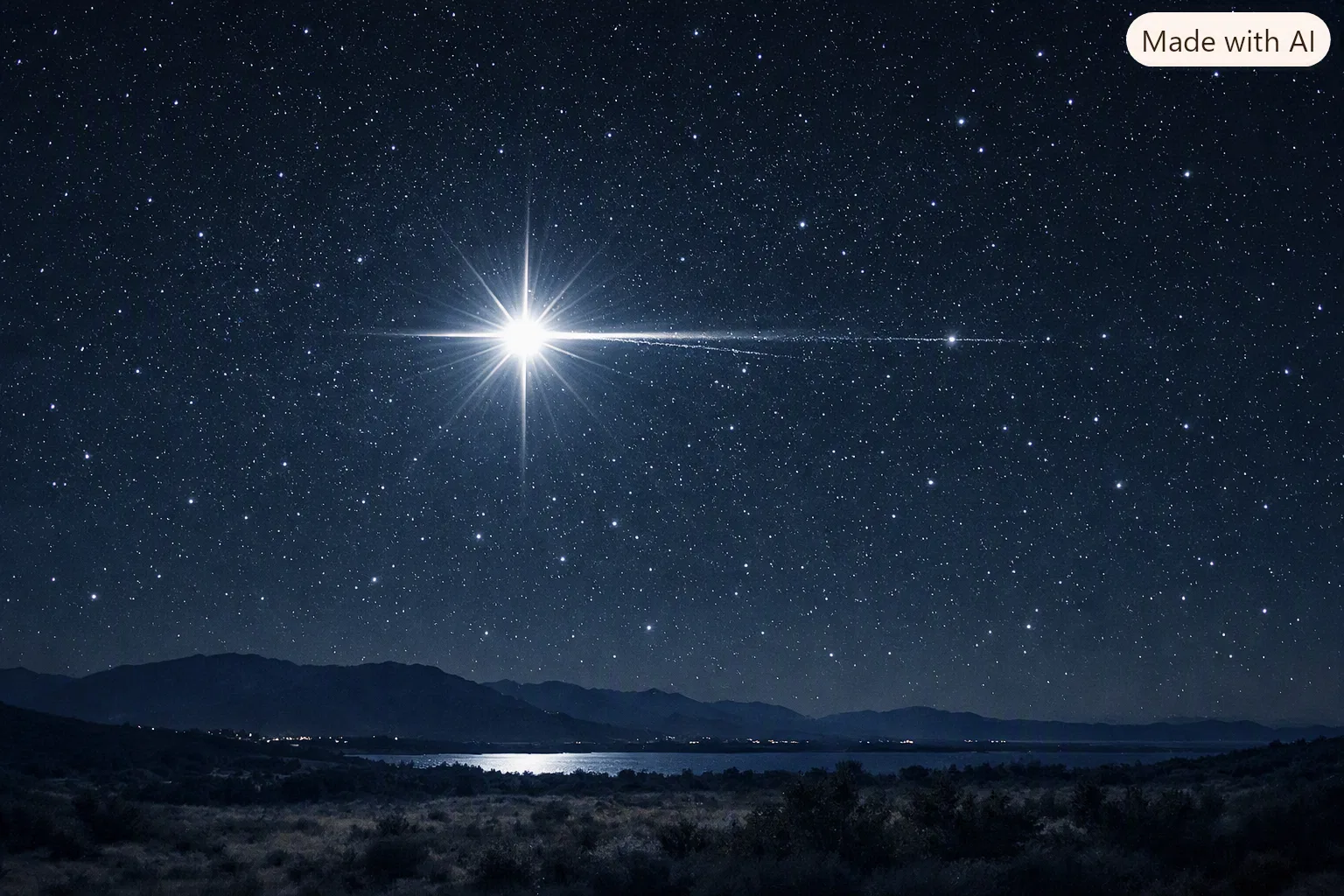
A satellite flare can seem to appear from nowhere because the satellite itself may be too faint to see until, for a few seconds or even a fraction of a second, one of its surfaces reflects sunlight almost directly towards the observer. The spacecraft has not suddenly switched on, accelerated into view or entered the atmosphere. What has changed is the geometry between the Sun, the satellite and the person watching.
This makes satellite flares particularly effective generators of UFO or UAP reports. A dim or invisible moving object can abruptly become as bright as a planet, then fade below naked-eye visibility before the observer has time to establish its direction or speed. Some reflections are predictable when a satellite’s orbit and orientation are known; others come from rotating or uncontrolled spacecraft whose reflective surfaces momentarily line up by chance. Modern research on Starlink, OneWeb and older satellites shows that these brightness changes are a routine consequence of spacecraft optics rather than evidence of anomalous propulsion or illumination.[A&A]aanda.orgaa59054 26Specular reflection (also called regular reflection) corresponds to light…
How reflected sunlight creates a satellite flare
Satellites are visible at night mainly because they reflect sunlight. For much of a pass, however, that reflected light may be spread broadly in many directions and the spacecraft may remain extremely faint. A flare occurs when reflection becomes much more concentrated.
The crucial distinction is between diffuse reflection and specular reflection. A diffusely reflecting surface scatters incoming sunlight over a wide range of directions. A specular surface behaves more like a mirror: light arriving from one direction is preferentially reflected along another tightly defined direction. Satellite solar arrays, antennas, chassis panels, thermal materials and other flat surfaces can all contribute. Modern satellite-brightness modelling therefore has to consider not just distance and illumination, but the reflectivity and orientation of individual spacecraft surfaces.[A&A]aanda.orgaa59054 26Specular reflection (also called regular reflection) corresponds to light…
The observer does not need to be looking at a literal polished mirror. A surface only has to possess a sufficiently strong specular component. When its reflection cone sweeps across the observer’s position, the apparent brightness can rise dramatically.
That geometry explains the apparently impossible sequence:
- The satellite approaches while remaining below the observer’s visibility threshold.
- Its orbital motion, attitude or rotation brings a reflective surface towards the correct Sun-satellite-observer angle.
- Reflected sunlight is briefly concentrated towards the observer.
- The satellite suddenly becomes conspicuous.
- Seconds later, the alignment passes and the object fades below visibility again.
Nothing has materialised or vanished. Only a narrow beam-like concentration of reflected sunlight has crossed the observer.
A useful historical example was the first-generation Iridium communications constellation. Its satellites carried three large, highly reflective main mission antennas whose orientation was accurately controlled. Sunlight striking one of those panels at the correct angle produced famously brilliant, predictable Iridium flares. CelesTrak described typical events as satellites climbing from barely visible to peak brightness over roughly 10–15 seconds before fading again; favourable events could reach about magnitude –8, vastly brighter than ordinary stars.[CelesTrak]celestrak.orgit is reasonably easy to predict when and where theseNarrative: Visual Observing with STK IIDecember 11, 2006 — The flares occur when the Sun reflects off the Iridium satellites' Ma…
For someone who did not know a flare was due, that behaviour closely matched a recurring UFO-report pattern: a brilliant light abruptly appearing in an otherwise empty piece of sky and then apparently extinguishing itself.
Why brightness can change within seconds
The rapidity of a flare is partly a consequence of scale. A satellite in low Earth orbit is travelling at several kilometres per second, so even a modest change in orbital position can alter its reflection geometry substantially. If the bright specular region is narrow, an observer may remain inside it only briefly.
The old Iridium constellation made this especially easy to understand because its orientation was stable. Heavens-Above explains that the flares resulted from sunlight reflected from the spacecraft’s three main mission antennas. Because both the orbit and spacecraft attitude were sufficiently well known, the time and place of a bright reflection could be calculated in advance.[Heavens-Above]heavens-above.comFrequently asked questions (FAQ)Iridium flares. What is an Iridium flare? An Iridium flare is caused by the sun being reflec…
This predictability had an important consequence: observers kilometres apart could see very different events. A person near the centre of the reflection geometry might see an exceptionally bright flare, while somebody only a short distance away could see a much weaker one. Contemporary observing guides consequently gave not just the flare time but the geographical position of maximum brightness.[Sky & Telescope]skyandtelescope.orgSky & TelescopeHow to Catch an Iridium FlareThe site also will tell you how bright the flare should appear (in magnitudes), and where to…
The classic Iridium era is largely historical. The first-generation spacecraft that produced the famous regular flares were replaced by Iridium NEXT satellites; Heavens-Above noted during the transition that the newer design was not expected to reproduce the old flare behaviour.[Heavens-Above]heavens-above.comIridium Demise.aspxThe end of Iridium flares?15 May 2018 — Unfortunately, the new satellites are not expected to produce flares, so it looks li… But the underlying mechanism did not disappear with Iridium. Flat spacecraft surfaces continue to produce specular reflections.
Modern Starlink observations provide a useful comparison. Research published in 2024 found that the Earth-facing side of some Starlink spacecraft can produce extreme brightening when a satellite is low in the sky and situated near the solar azimuth — roughly the direction of the Sun below the observer’s horizon. In that configuration, sunlight can strike the spacecraft at a grazing angle and be reflected towards the observer. The researchers recorded flares far brighter than the satellites’ usual brightness variation.[arXiv]arxiv.orgThis paper…Read more…
This geometry helps explain why some satellite-related UAP reports are concentrated around particular parts of the sky rather than distributed randomly. The observer may repeatedly be looking through a region where successive satellites enter favourable reflection geometry.
Brightness can change still faster if the spacecraft is rotating. The University of Arizona’s Spacewatch programme notes that a tumbling satellite may alternately present highly reflective and poorly reflective surfaces, producing repeated bright-faint-bright behaviour. Amateur satellite observers have long used such recurring flashes to study spacecraft rotation.[SPACEWATCH®]spacewatch.lpl.arizona.eduSPACEWATCH®Tumbling SatellitesSPACEWATCH®Tumbling Satellites
Some flashes are extremely brief. A high-speed astronomical survey using the W-FAST telescope found numerous roughly 0.1–0.3-second optical flares that were attributable largely or entirely to sunlight glinting from satellites in geosynchronous and graveyard orbits. Because the object between flashes could be too faint to detect, an individual glint could resemble a point-like astronomical transient rather than an obvious moving satellite.[arXiv]arxiv.orgarXiv A high-rate foreground of sub-second flares from geosynchronous satellitesarXiv A high-rate foreground of sub-second flares from geosynchronous satellites
A separate study examining Zwicky Transient Facility observations found about 73,000 individual glint events between November 2019 and December 2021, associated with more than 300 satellites across orbits ranging from low Earth to geostationary. Individual flashes could last from about a tenth of a second down towards the millisecond range.[arXiv]arxiv.orgarXiv Impact of satellite glints on the transient science on ZTF scalearXiv Impact of satellite glints on the transient science on ZTF scale These observations demonstrate why “it was visible only for an instant” is not, by itself, evidence against a satellite explanation.
The Iridium era versus today’s less predictable flares
The history of satellite flares is useful because it shows how the same physical mechanism can produce very different identification problems.
First-generation Iridium flares were unusually investigator-friendly. Their reflective antennas had known geometry, their spacecraft maintained predictable attitudes and dedicated websites could tell an observer where to look and when. By the late 1990s amateur observers were routinely calculating and photographing events that, seen without that information, could look startlingly artificial or unexplained. Reporting at the time noted that some flares could momentarily resemble an aircraft landing light seen head-on.[WIRED]wired.comIridium Upstages the StarsIridium Upstages the Stars
Many present-day flares are messier. Satellite fleets use different shapes, coatings and pointing strategies, while defunct satellites and rocket bodies may rotate unpredictably. A simple orbit track tells an investigator where an object should have been, but not necessarily exactly how bright it should have looked at a particular second.
Recent OneWeb research illustrates the limitation. A 2026 study modelled observations of more than 300 satellites using their orbital geometry and both diffuse and specular reflection. The models reproduced average brightness reasonably well but could not fully account for the observed brightness variations. The authors concluded that realistic modelling also requires the spacecraft’s actual shape, changing attitude and other illumination effects.[arXiv]arxiv.orgOpen source on arxiv.org.
That distinction matters when investigating a report. Failure of a simple satellite-visibility prediction does not prove that the object was not a satellite. A pass calculator may correctly place the spacecraft below naked-eye brightness on average while missing a short-lived specular flash.
Nor are flares limited to operational satellites. Once attitude control is lost, a spacecraft can tumble, turning its solar panels or metallic components into intermittent mirrors. Its orbit may remain predictable while the exact timing of individual flashes becomes much harder to forecast.[Satellites Above]satobs.orgOpen source on satobs.org.

When satellite flares become UAP reports
The connection is no longer hypothetical. Researchers have reconstructed modern aviation UAP reports in which satellite illumination geometry was central to the explanation.
On 10 August 2022, five pilots aboard two commercial flights over the Pacific reported several bright objects and recorded photographs and video. A 2024 case study reconstructed the sighting using aircraft Automatic Dependent Surveillance–Broadcast data, satellite orbital elements and the position of a recently launched Starlink train. The investigators concluded that the observed objects corresponded to those satellites.[arXiv]arxiv.orgOpen source on arxiv.org.
Brightness was a particularly important part of the puzzle. A companion analysis examined whether Starlink surfaces could actually produce the extraordinary appearance reported by the pilots. The photographed formation was estimated at around magnitude –4, comparable to Venus. Modelling showed that specular sunlight reflected from the nadir-facing side of the spacecraft could account for the observed brightness when the aircraft, satellites and Sun occupied the reconstructed geometry.[arXiv]arxiv.orgThis paper…Read more…
This case is useful because experienced observers were involved. Airline pilots are familiar with aircraft lights and ordinary traffic, yet that experience does not automatically provide intuition for the illumination geometry of orbiting spacecraft. A cluster of satellites that repeatedly brightens near the horizon can therefore look less like a conventional satellite train and more like several objects appearing, disappearing or manoeuvring in the same region.
Satellite flares are especially liable to misidentification when several conditions coincide: the base satellite is invisible between flashes; the observer lacks an obvious reference for distance; the flare occurs low on the horizon; several satellites cross the same favourable reflection region; or a camera captures only the bright interval. Under those circumstances, what is physically one continuous orbital pass may be perceived as a series of separate luminous objects.
Matching flashes to predicted orbital geometry
A good satellite-flare identification depends on geometry rather than superficial resemblance. “It looked like a satellite” is weak evidence; reproducing the object’s position and illumination at the reported time is much stronger.
The most useful starting data from a sighting are the exact time, observer location, viewing direction and elevation, duration, and any stars or planets visible in photographs. Investigators can then compare those details with satellite ephemerides — calculated positions derived from orbital data.
For a straightforward satellite pass, the first question is whether a catalogued spacecraft occupied the correct part of the sky at the correct time. For a flare, a second question is essential: could the spacecraft have been sunlit and could its known or plausible surfaces have reflected sunlight towards the observer?
The 2022 pilot case demonstrates the method. Researchers did not simply find that Starlink satellites were somewhere above the Pacific. They reconstructed the pilots’ positions, matched background stars in the imagery, calculated the Starlink train’s location and then tested whether the required reflection geometry could produce the measured brightness.[arXiv]arxiv.orgOpen source on arxiv.org.
Historical Iridium observations provide an even cleaner demonstration. Because spacecraft attitude was maintained and the reflecting antennas had known orientations, flare predictions could specify not merely a satellite pass but when maximum reflected brightness should occur for a particular location.[Heavens-Above]heavens-above.comFrequently asked questions (FAQ)Iridium flares. What is an Iridium flare? An Iridium flare is caused by the sun being reflec…
Modern identification is often less exact because spacecraft attitude data are not always publicly available. Nevertheless, several clues can strengthen a flare interpretation:
- A smooth rise and fall in brightness is consistent with the observer moving into and then out of a specular reflection region.
- Repeated flashes along one track can indicate a rotating spacecraft.
- Several brightenings in the same restricted sky region may result from different satellites encountering similar Sun-observer geometry.
- A flare near the solar azimuth while the Sun is below the horizon is particularly relevant to the extreme Starlink geometry documented in recent studies.[arXiv]arxiv.orgThis paper…Read more…
- A satellite predicted to be present but normally too faint to see should not be discarded automatically, because specular reflection can raise its instantaneous brightness by several magnitudes.[arXiv]arxiv.orgarXiv Satellite Optical BrightnessarXiv Satellite Optical Brightness
Investigators should also check whether the satellite would actually have been illuminated by the Sun. A spacecraft deep inside Earth’s shadow cannot produce a direct solar flare, although brightness models can include weaker indirect illumination such as Earth-reflected light.[arXiv]arxiv.orgarXiv Satellite Optical BrightnessarXiv Satellite Optical Brightness
Why “appeared from nowhere” is the key clue, not an objection
A sudden appearance can initially make a satellite explanation seem implausible. Familiar satellites such as the International Space Station usually look like continuously moving points that gradually cross the sky. Flares behave differently precisely because visibility is controlled by reflection geometry rather than simply by whether the spacecraft is overhead.
That distinction is the main diagnostic lesson. A satellite can be physically present throughout an observation while optically detectable for only a tiny part of it. At other times its diffuse reflected light may remain below the eye or camera’s threshold. As a specular reflection sweeps across the observer, its brightness can suddenly exceed that threshold; when the geometry shifts again, it seems to switch off.
Astronomers now encounter the same problem in automated surveys. Very short satellite glints can masquerade as genuine astronomical flashes because the spacecraft itself may not be visible in neighbouring exposures. Research on geosynchronous and other satellites has therefore treated glints as a significant foreground contaminant in searches for real transient objects.[arXiv]arxiv.orgarXiv A high-rate foreground of sub-second flares from geosynchronous satellitesarXiv A high-rate foreground of sub-second flares from geosynchronous satellites
For UFO and UAP investigation, the parallel is straightforward. A light that appears abruptly, shines intensely and vanishes does not require an object capable of instantaneous arrival or departure. Before invoking unusual behaviour, investigators have to test whether an ordinary satellite was already there and whether sunlight could briefly have made it visible.
That is why satellite flares remain an important IFO mechanism even after the demise of the famous first-generation Iridium constellation. The hardware has changed, and modern constellations produce different patterns, but the underlying physics is unchanged: an otherwise inconspicuous object can become spectacular for the few moments when orbital geometry turns part of a spacecraft into a mirror.
Amazon book picks
Further Reading
Books and field guides related to Why Satellite Flares Seem to Appear From Nothing. Use these as the next step if you want deeper reading beyond the article.
NightWatch: A Practical Guide to Viewing the Universe
A practical guide to viewing the universe.
The Backyard Astronomer's Guide
Discusses the practical aspects of stargazing, including how to choose appropriate equipment, contending with light pollution, taking suc...
Celestial Objects for Modern Telescopes
Based on field notes made by the author during his own career as an amateur astronomer, this unique guide covers both the traditional and...
Turn Left at Orion
With over 100,000 copies sold since first publication, this is one of the most popular astronomy books of all time. It is a unique guideb...
eBay marketplace picks
Marketplace Samples
Live-tested eBay searches with available results related to this page.
Selected fromsatellite model oneBay.co.uk.

Endnotes
1.
Source: arxiv.org
Title: arXiv Satellite Optical Brightness
Link:https://arxiv.org/abs/2305.11123
2.
Source: celestrak.org
Title: it is reasonably easy to predict when and where these
Link:https://celestrak.org/publications/Visual-Observing/Part2/Narrative2.pdf
Source snippet
Narrative: Visual Observing with STK IIDecember 11, 2006 — The flares occur when the Sun reflects off the Iridium satellites' Ma...
Published: December 11, 2006
3.
Source: heavens-above.com
Link:https://www.heavens-above.com/faq.aspx
Source snippet
Frequently asked questions (FAQ)Iridium flares. What is an Iridium flare? An Iridium flare is caused by the sun being reflec...
4.
Source: heavens-above.com
Title: Iridium Demise.aspx
Link:https://heavens-above.com/IridiumDemise.aspx
Source snippet
The end of Iridium flares?15 May 2018 — Unfortunately, the new satellites are not expected to produce flares, so it looks li...
Published: May 2018
5.
Source: arxiv.org
Link:https://arxiv.org/pdf/2405.13091
Source snippet
This paper...Read more...
6.
Source: arxiv.org
Title: arXiv Extreme Flaring of Starlink Satellites
Link:https://arxiv.org/abs/2405.13091
7.
Source: spacewatch.lpl.arizona.edu
Title: SPACEWATCH®Tumbling Satellites
Link:https://spacewatch.lpl.arizona.edu/fmo-project/how-find/tutorial/tumbling-satellites
8.
Source: arxiv.org
Title: arXiv A high-rate foreground of sub-second flares from geosynchronous satellites
Link:https://arxiv.org/abs/2011.03497
9.
Source: arxiv.org
Title: arXiv Impact of satellite glints on the transient science on ZTF scale
Link:https://arxiv.org/abs/2202.05719
10.
Source: wired.com
Title: Iridium Upstages the Stars
Link:https://www.wired.com/1999/02/iridium-upstages-the-stars
11.
Source: arxiv.org
Link:https://arxiv.org/abs/2603.21859
12.
Source: arxiv.org
Link:https://arxiv.org/abs/2403.08155
13.
Source: arxiv.org
Link:https://arxiv.org/html/2603.21859v1
14.
Source: arxiv.org
Link:https://arxiv.org/pdf/2405.12007
15.
Source: aanda.org
Title: aa59054 26
Link:https://www.aanda.org/articles/aa/full_html/2026/05/aa59054-26/aa59054-26.html
Source snippet
Specular reflection (also called regular reflection) corresponds to light...
16.
Source: skyandtelescope.org
Link:https://skyandtelescope.org/stargazing-and-observing/celestial-objects-to-watch/observing-iridium-flares/
Source snippet
Sky & TelescopeHow to Catch an Iridium FlareThe site also will tell you how bright the flare should appear (in magnitudes), and where to...
17.
Source: satobs.org
Link:https://www.satobs.org/tumble/tumbleintro.html
18.
Source: skyandtelescope.org
Title: starlink flares can fool anyone even airline pilots
Link:https://skyandtelescope.org/astronomy-news/starlink-flares-can-fool-anyone-even-airline-pilots/
19.
Source: vimeo.com
Link:https://vimeo.com/37178525
20.
Source: Wikipedia
Title: Satellite flare
Link:https://en.wikipedia.org/wiki/Satellite_flare
Additional References
21.
Source: youtube.com
Title: M.A.S.T. Capture
Link:https://www.youtube.com/watch?v=uzqO7uYlMiI
Source snippet
Satellite flares specular reflection UFO Shocking video reveals US military's direct hit on glowing UFO...
22.
Source: nasa.gov
Link:https://www.nasa.gov/wp-content/uploads/2019/11/earth_at_night_508.pdf
23.
Source: solarsystem.nasa.gov
Link:https://solarsystem.nasa.gov/sitemaps/resources_sitemap.xml
24.
Source: twanight.org
Link:https://twanight.org/gallery/a-tumbling-satellite/
25.
Source: reddit.com
Link:https://www.reddit.com/r/askastronomy/comments/flwizx/are_iridium_flares_still_possible_to_see/
26.
Source: reddit.com
Link:https://www.reddit.com/r/Astronomy/comments/czgqfi/can_anyone_please_explain_these_flashes_of_light/
27.
Source: uapsightings.org
Link:https://uapsightings.org/common-uap-misidentifications/
28.
Source: facebook.com
Link:https://www.facebook.com/groups/seestar/posts/997934413018841/
29.
Source: reddit.com
Link:https://www.reddit.com/r/space/comments/xnpx5d/last_of_the_iridium_flashes_i_captured_the_once/
30.
Source: flatearth.ws
Link:https://flatearth.ws/iridium-flare