Within Reentry
What the 2021 Falcon 9 Reentry Looked Like
The 2021 Falcon 9 upper-stage reentry combined slow motion, a shallow path and continuing fragmentation in a textbook debris-train display.
On this page
- The slow moving cascade seen across the Pacific Northwest
- Why its speed and fragmentation differed from a meteor
- Which visible features point toward orbital debris
Page outline Jump by section
Introduction
On the evening of 25 March 2021, observers across the Pacific Northwest saw a striking procession of bright objects moving together through the night sky. It was not a meteor shower, an aircraft formation or a single structured craft. NASA subsequently identified the event as the atmospheric reentry of a SpaceX Falcon 9 upper stage: a large artificial object breaking into many incandescent pieces as it crossed the atmosphere at a shallow angle.[ARES]ares.jsc.nasa.govOpen source on nasa.gov.

The event is particularly useful for understanding UFO and UAP reports because it displayed several features that can make orbital debris look organised: numerous lights travelling in the same direction, roughly parallel motion, persistent glowing trails, repeated fragmentation and an unusually long passage across the sky. Those features can create an impression of one enormous object carrying multiple lights. In reality, the 2021 Falcon 9 provided an unusually clear example of a debris train — many fragments sharing the momentum and trajectory of the spacecraft from which they had just separated.
The slow-moving cascade across the Pacific Northwest
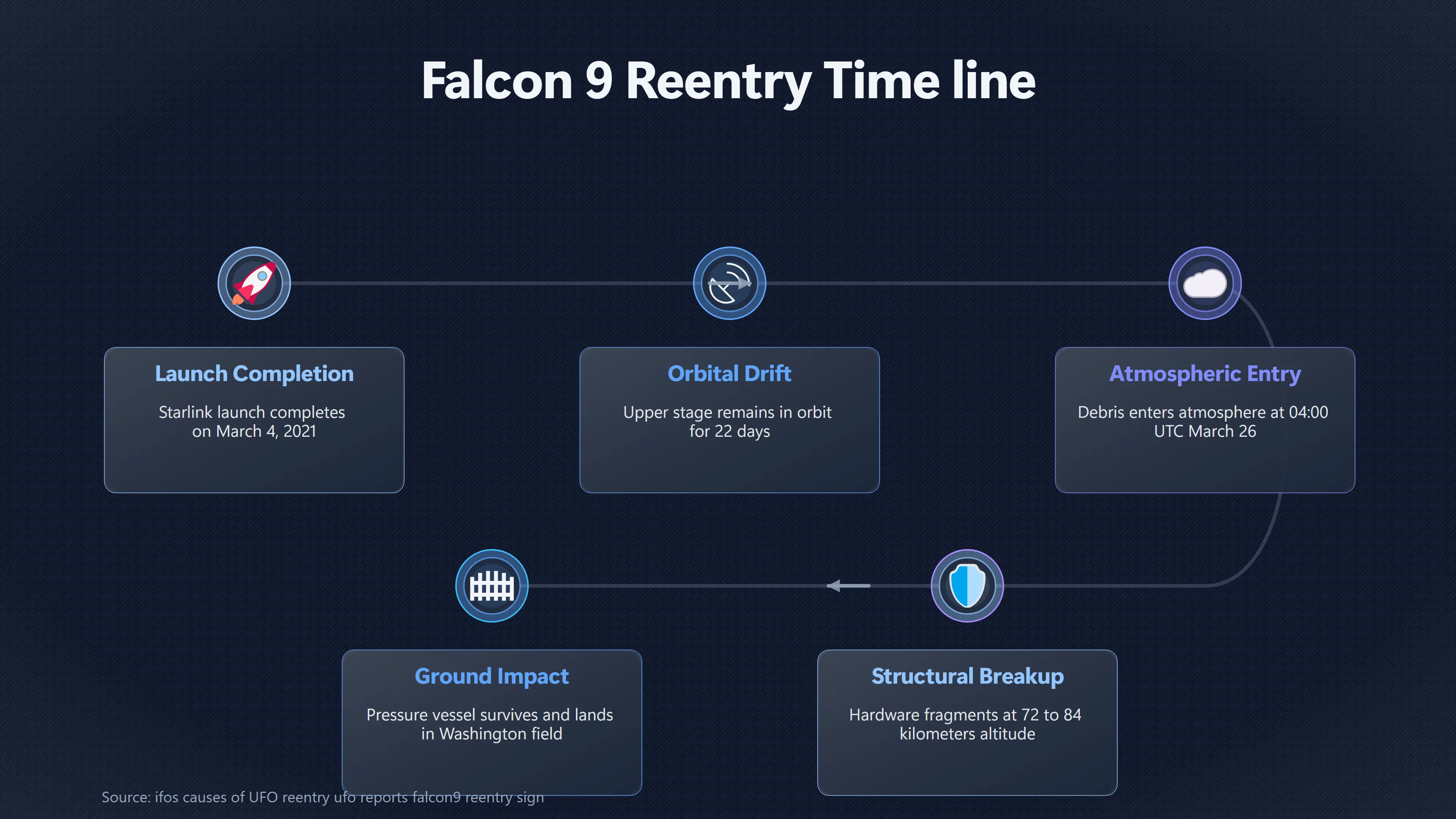
The object responsible for the display was the Falcon 9 second stage associated with a 4 March 2021 Starlink launch. Astrophysicist Jonathan McDowell identified the stage as having failed to perform its intended deorbit burn after completing its launch task. Instead of being deliberately sent towards disposal, it remained in orbit for another 22 days before atmospheric drag finally brought it down. Its reentry was observed at about 04:00 UTC on 26 March, corresponding to roughly 21:00 local time on 25 March in the Pacific Northwest.[AFP Fact Check]afp.comOpen source on afp.com.
That history matters because the spectacle was not an instantaneous explosion. The upper stage approached the denser atmosphere while still travelling at orbital velocity, then progressively encountered stronger heating and aerodynamic forces. NASA’s event record describes what witnesses saw as a long-lasting, slow-moving cascade of many fragments, with additional fragmentation occurring while the debris continued across the sky. Reports extended across Washington and Oregon and much farther afield.[ARES]ares.jsc.nasa.govOpen source on nasa.gov.
Video accounts consequently showed something quite different from the stereotypical shooting star. There was no single brilliant point flashing across the sky and disappearing almost immediately. Instead, numerous luminous pieces remained grouped together as they moved along a broadly common path. Contemporary reports captured the confusion this generated: observers initially wondered whether they were seeing a meteor, an aircraft accident or some other unusual event before the Falcon 9 identification circulated.[The Washington Post]washingtonpost.comOpen source on washingtonpost.com.
The apparent organisation of the lights was real, but its interpretation could easily be wrong. The fragments were related because they had recently been parts of the same rocket stage. After breakup they inherited broadly similar velocities, so from a distant observer’s viewpoint they continued travelling together. They did not need to be physically connected, powered independently or maintaining formation for the resulting display to resemble a coherent procession.
That distinction is central to evaluating reports of apparent structured craft. Several lights maintaining similar bearings and speeds are not, by themselves, evidence that the lights mark different points on one vehicle.
Why it did not behave like an ordinary meteor
NASA highlighted two particularly diagnostic aspects of the Falcon 9 event: its relatively slow apparent motion and flat trajectory. The agency contrasted those characteristics with the shorter duration and generally steeper appearance associated with meteor events.[ARES]ares.jsc.nasa.govOpen source on nasa.gov.
The Aerospace Corporation makes the same distinction in its guidance for identifying reentries. Human-made orbital debris is typically moving approximately parallel to the Earth’s surface at around 7 km/s as it begins reentry. Although that is extraordinarily fast in everyday terms, the great distance of the object and its long, shallow passage through the upper atmosphere can make its angular motion across an observer’s sky look comparatively stately. Reentering hardware also commonly fragments, creating numerous bright objects that continue along related trajectories.[The Aerospace Corporation]aerospace.orgOpen source on aerospace.org.
This produces a useful observational contrast. A typical meteor enters the atmosphere on a natural trajectory and is commonly perceived as a rapid streak lasting only seconds. A large orbital object undergoing destructive reentry can remain luminous much longer while travelling across an extensive atmospheric path. The result may look less like a conventional shooting star and more like a slowly advancing formation.
The underlying breakup physics reinforce that difference. NASA’s Orbital Debris Program Office says reentering spacecraft typically undergo their principal structural breakup at roughly 72–84 kilometres altitude, with 78 kilometres used as a nominal value. After breakup, individual components continue descending and heating; their survival depends partly on their materials, construction, mass and shape.[orbitaldebris.jsc.nasa.gov]nasa.govOpen source on nasa.gov. ESA similarly describes major structural breakup at roughly 75–80 kilometres, followed by continued heating and deceleration of the resulting fragments.[European Space Agency]esa.intOpen source on esa.int.
Consequently, the visible Falcon 9 train was not simply one object acquiring a fiery tail. It was an evolving breakup process. Different pieces could brighten, fade, separate and fragment again while continuing generally along the original flight path. That continuing evolution is one of the strongest clues that a spectacular formation is debris rather than a stable craft.
Later instrumented observations of another Falcon 9 upper-stage reentry help show how physically complex such a display can be. A 2025 reentry studied with 43 meteor cameras and radar produced reconstructable emissions from 30 fragments, with optical detections extending from about 85 kilometres down to 36 kilometres altitude. Researchers found distinct fragment families rather than a single luminous body. Although that was a different Falcon 9 event, it provides modern instrumental confirmation of the fragmentation process that the Pacific Northwest witnesses saw so dramatically in 2021.[arXiv]arxiv.orgOpen source on arxiv.org.
Which visible features point towards orbital debris
No single visual feature proves that an unfamiliar light display is a reentry. The Falcon 9 case is useful because several indicators appeared together, producing a recognisable pattern.
A long duration. The display persisted long enough for people across a wide region to watch, record and discuss it. That is much more characteristic of a substantial orbital reentry than the brief flash most observers associate with a meteor. NASA explicitly described the event as long-lasting.[ARES]ares.jsc.nasa.govOpen source on nasa.gov.
Shallow movement across the sky. Rather than appearing to plunge steeply towards the ground, the debris followed a comparatively flat apparent path. That reflected its orbital origin: reentering space hardware initially carries enormous horizontal velocity.[ARES]ares.jsc.nasa.govOpen source on nasa.gov.
Many lights sharing one direction. The fragments formed a cluster or procession instead of immediately dispersing in unrelated directions. This is a natural consequence of breakup during flight. Each newly separated piece initially retains much of the parent body’s velocity.
Independent luminous trails. Individual fragments could generate their own glowing wakes. Multiple bright points with tails therefore need not represent propulsion systems, exhaust plumes or lights mounted on a larger invisible structure. They can be separate pieces undergoing intense aerodynamic heating.
Continuing fragmentation. NASA specifically noted that additional pieces became visible as the cascade progressed.[ARES]ares.jsc.nasa.govOpen source on nasa.gov. A formation that sheds new luminous points, changes brightness irregularly or produces subsidiary trails is especially compatible with disintegrating hardware.
Different behaviour among fragments. Once separated, components do not all respond identically. NASA notes that reentry survival depends strongly on material properties, while ESA describes fragments continuing through different phases of heating and deceleration after the main structure breaks apart.[orbitaldebris.jsc.nasa.gov]nasa.govOpen source on nasa.gov. This means some pieces can disappear rapidly while tougher components remain visible farther along the trajectory.
Together, these effects can create a misleading impression of complexity. An observer may see bright points at the front, others trailing behind and smaller lights appearing between them. Human perception can readily treat that arrangement as a single object with illuminated extremities or windows, even though the actual physical configuration is a loose three-dimensional stream of debris viewed from many kilometres away.
Surviving hardware confirmed the nature of the event
The Falcon 9 case has an evidential advantage that many ambiguous sky sightings lack: pieces of the object did not all disappear in the atmosphere.
After the reentry, a farmer in Grant County, Washington, discovered a large object in a field. Authorities identified it as a composite-overwrapped pressure vessel, or COPV, associated with the Falcon 9 upper stage. The approximately 1.5-metre vessel had survived the atmospheric passage and left an impact mark in the ground.[copernical.com]copernical.comOpen source on copernical.com.
The Aerospace Corporation had already been modelling the upper-stage breakup and its possible debris footprint when surviving material was found in Grant County. Its reconstruction placed the reported observations along the stage’s reentry ground track from Oregon into Washington.[The Aerospace Corporation]aerospace.orgOpen source on aerospace.org.
That physical recovery makes the event unusually valuable as a reference case. The chain of evidence does not rest simply on somebody deciding that a strange video “looks like” space debris. There was a known orbital object, a documented reentry time, sightings along its ground track, the characteristic visual behaviour of fragmenting spacecraft and recovered hardware consistent with the rocket stage.
It also demonstrates an important point about the visible lights themselves. A bright fragment need not represent an entire spacecraft-sized object. Some components disappear through melting and ablation; others are protected long enough to reach lower altitudes; particularly robust components may survive to the surface. NASA notes that materials such as titanium and stainless steel are substantially more resistant to reentry destruction than lower-melting-point materials such as aluminium.[orbitaldebris.jsc.nasa.gov]nasa.govOpen source on nasa.gov. The lights in a debris train can therefore represent objects with very different sizes, compositions and remaining lifetimes.
What the Falcon 9 case adds to UAP identification
The strongest lesson from the 2021 event is not that every procession of lights is space debris. It is that apparent structure must be tested against motion, duration and fragmentation before it is treated as evidence of an actual structured craft.
A witness seeing the Falcon 9 without knowing its distance could reasonably describe a huge collection of lights crossing the sky together. Video alone might preserve the spectacular appearance while removing important depth cues. Because every fragment originated with the same rocket stage, their correlated motion would reinforce the impression that they belonged to one object. Yet the recovered debris and orbital reconstruction show that the perceived “formation” arose from fragmentation, not from a craft whose outline connected the luminous points.[ARES]ares.jsc.nasa.govOpen source on nasa.gov.
This is why the most useful test of a suspected debris train is often chronological rather than purely visual. Investigators can establish the sighting’s precise time, location and direction of travel and compare those details with tracked rocket bodies and predicted or confirmed reentries. Scientific work on Falcon 9 observations has shown that ground-based fireball-camera measurements can even be used to reconstruct trajectories of artificial objects, while researchers have warned that artificial reentries can interfere with the interpretation of natural fireball observations.[arXiv]arxiv.orgOpen source on arxiv.org.
The March 2021 Falcon 9 therefore provides a particularly strong reference signature for atmospheric reentries that resemble structured craft: slow apparent passage, a shallow trajectory, multiple co-moving lights, persistent trails and progressive fragmentation. When those characteristics occur together — especially at a time and place matching a decaying orbital object — a visually extraordinary formation can have a straightforward physical explanation.
Amazon book picks
Further Reading
Books and field guides related to What the 2021 Falcon 9 Reentry Looked Like. Use these as the next step if you want deeper reading beyond the article.
Fundamentals of Astrodynamics
Rating: 4.5/5 from 12 Google Books ratings
Teaching text developed by U.S. Air Force Academy and designed as a first course emphasizes the universal variable formulation. Develops...
Space Debris: Models and Risk Analysis
In Space Debris Models and Risk Analysis the authors will provide the reader with a comprehensive background to understand the various so...
Orbital Mechanics for Engineering Students
Orbital Mechanics for Engineering Students, Second Edition, provides an introduction to the basic concepts of space mechanics. These incl...
The Space Barons
The historic quest to rekindle the human exploration and colonization of space led by two rivals and their vast fortunes, egos, and visio...
eBay marketplace picks
Marketplace Samples
Live-tested eBay searches with available results related to this page.
Selected fromFalcon 9 model oneBay.co.uk.
Endnotes
1.
Source: ares.jsc.nasa.gov
Link:https://ares.jsc.nasa.gov/meteorite-falls/events/yakima-wa-debris-de-orbit
2.
Source: reentry.esoc.esa.int
Link:https://reentry.esoc.esa.int/
3.
Source: conference.sdo.esoc.esa.int
Link:https://conference.sdo.esoc.esa.int/proceedings/neosst2/paper/19
4.
Source: aerospace.org
Link:https://aerospace.org/article/what-does-reentry-look-like
5.
Source: conference.sdo.esoc.esa.int
Link:https://conference.sdo.esoc.esa.int/proceedings/sdc7/paper/410
Additional References
6.
Source: youtube.com
Title: Was It A Falcon 9 Rocket Burning Up On Re-Entry?? You Decide!!
Link:https://www.youtube.com/watch?v=Pow7c6ZWXl8
Source snippet
Falcon 9 upper stage reentry Pacific Northwest March 25 2021 debris OMSI talks about streaking light from rocket debris seen across Pacif...
7.
Source: youtube.com
Link:https://www.youtube.com/watch?v=JqJOzw8PB1c
Source snippet
Streak of lights over Pacific Northwest likely Falcon 9 rocket debris...
8.
Source: youtube.com
Title: Space X Falcon 9 Rocket Debris Lights Up The Sky Over Chilliwack BC
Link:https://www.youtube.com/watch?v=qBJhprHQxKw
Source snippet
Was It A Falcon 9 Rocket Burning Up On Re-Entry?? You Decide...
9.
Source: youtube.com
Title: Rocket debris lights up skies over the Pacific Northwest
Link:https://www.youtube.com/watch?v=nP9JP4ulkFQ
Source snippet
SpaceX Falcon 9 Rocket Debris Lights Up The Sky Over Chilliwack BC...