Within Haze
When Haze Turns Landing Lights Into Glowing Blobs
Scattered light around a bright aircraft lamp can create a diffuse halo that makes the source appear larger and less mechanically defined.
On this page
- How haze spreads light around bright point sources
- Why halos obscure nearby aircraft edges
- How apparent light size can mislead witnesses
Page outline Jump by section
Introduction
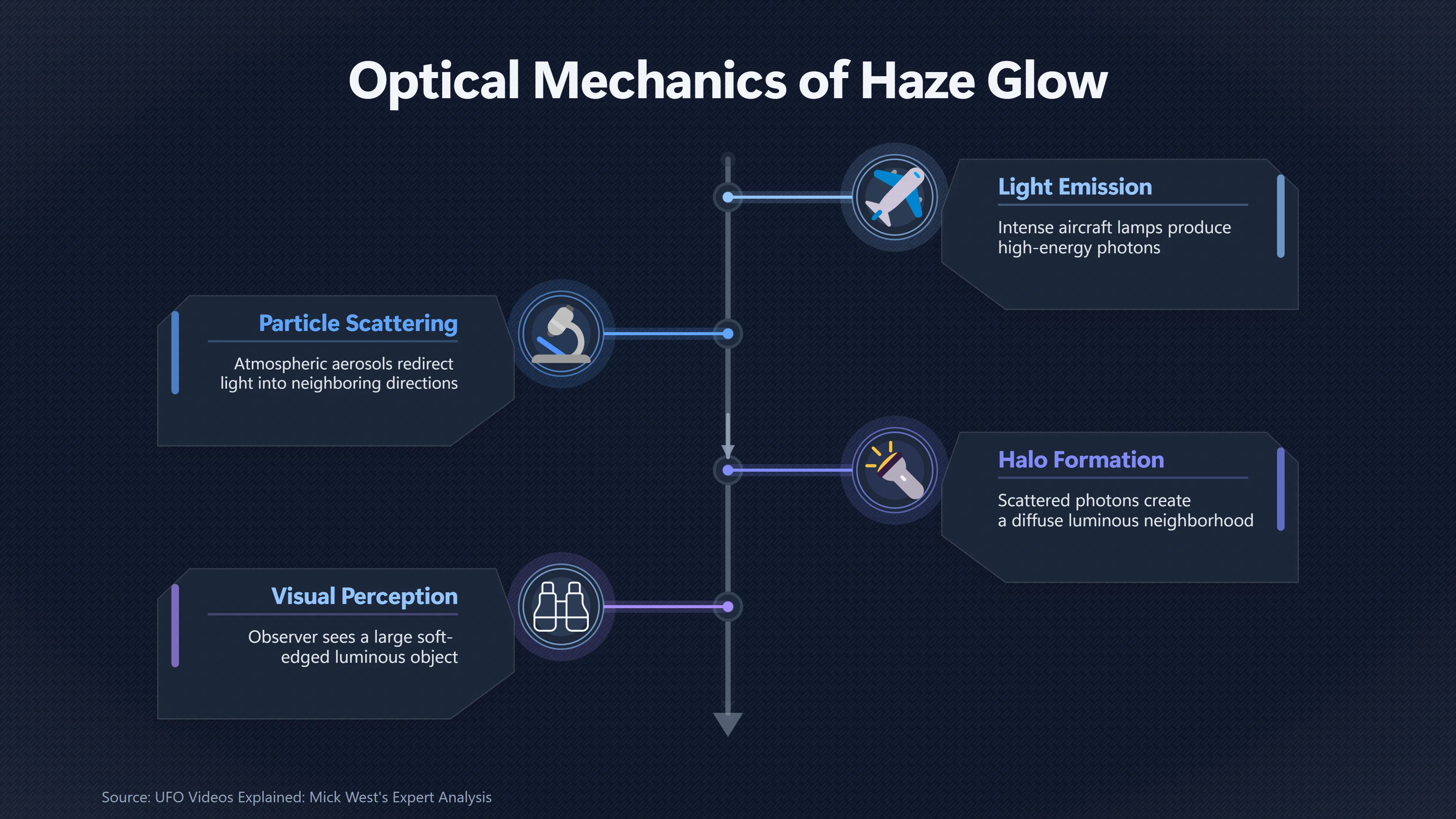
At night, haze can make an aircraft light look much larger than the lamp that produced it. Light from a bright landing or taxi lamp does not travel only along a perfectly direct path to the observer: suspended particles scatter some of it into neighbouring directions. Around an intense source, that scattered component can form a diffuse halo or “glow”. Night-time imaging research treats this glow as a distinct atmospheric effect around artificial lights, not merely as ordinary loss of visibility.[cv-foundation.org]cv-foundation.orgOpen source on cv-foundation.org.
For an aircraft observer, the perceptual result can be striking. The compact lamp remains extremely conspicuous while the weaker visual information defining the fuselage, wings and tail is suppressed by haze. The halo then occupies more of the visible scene than the lamp itself, so what is physically a small light mounted on a conventional aircraft may be perceived as a larger, soft-edged luminous object. That mechanism is directly relevant to UFO and UAP reports describing a bright “blob”, “orb” or featureless light where no aircraft structure was apparent.
How haze spreads a compact light into a halo
The key process is scattering. Atmospheric aerosols redirect light rather than simply blocking it. The US Environmental Protection Agency describes haze as the product of tiny particles that scatter and absorb light, reducing clarity; it also notes that humidity can make some particles grow and scatter light more effectively.[US EPA]epa.govOpen source on epa.gov. NOAA likewise describes atmospheric light as being scattered and attenuated by molecules, aerosols and cloud particles.[NOAA Chemical Sciences Laboratory]noaa.govOpen source on noaa.gov.
With an ordinary dim object, scattering mainly registers to an observer as poorer contrast. A powerful artificial light introduces an additional complication because there is enough light available for the scattered component itself to become conspicuous. Some photons arrive directly from the lamp, while others have been redirected by particles around the source’s line of sight. Instead of perceiving only a sharply bounded point, the observer can therefore receive light over a surrounding angular area.
This distinction is important enough that researchers working on night-time visibility do not generally model a hazy night scene simply as a darker version of a clear one. Yu Li, Robby Tan and Michael Brown’s 2015 International Conference on Computer Vision paper, Nighttime Haze Removal With Glow and Multiple Light Colors, explicitly added a glow term to the night-time haze model. Their definition is particularly relevant here: the glow represents light from visible sources that has been scattered around before reaching the camera.[CV Foundation]cv-foundation.orgOpen source on cv-foundation.org.
Later research has continued to treat this as a specific physical degradation mechanism. A 2022 Journal of the Optical Society of America A paper describes artificial lights in night-time haze as producing glow and incorporates a “near-light source” component into its optical model. A 2023 study similarly models night-time scenes as containing atmospheric light, direct light and glow, describing glow specifically as the halo around a source.[PubMed]nih.govOpen source on nih.gov.
The phenomenon is therefore more than the loose observation that “fog makes lights fuzzy”. There is a well-established optical reason for an intense source to acquire a luminous neighbourhood that was not part of the physical lamp.
Why the halo hides the aircraft around it
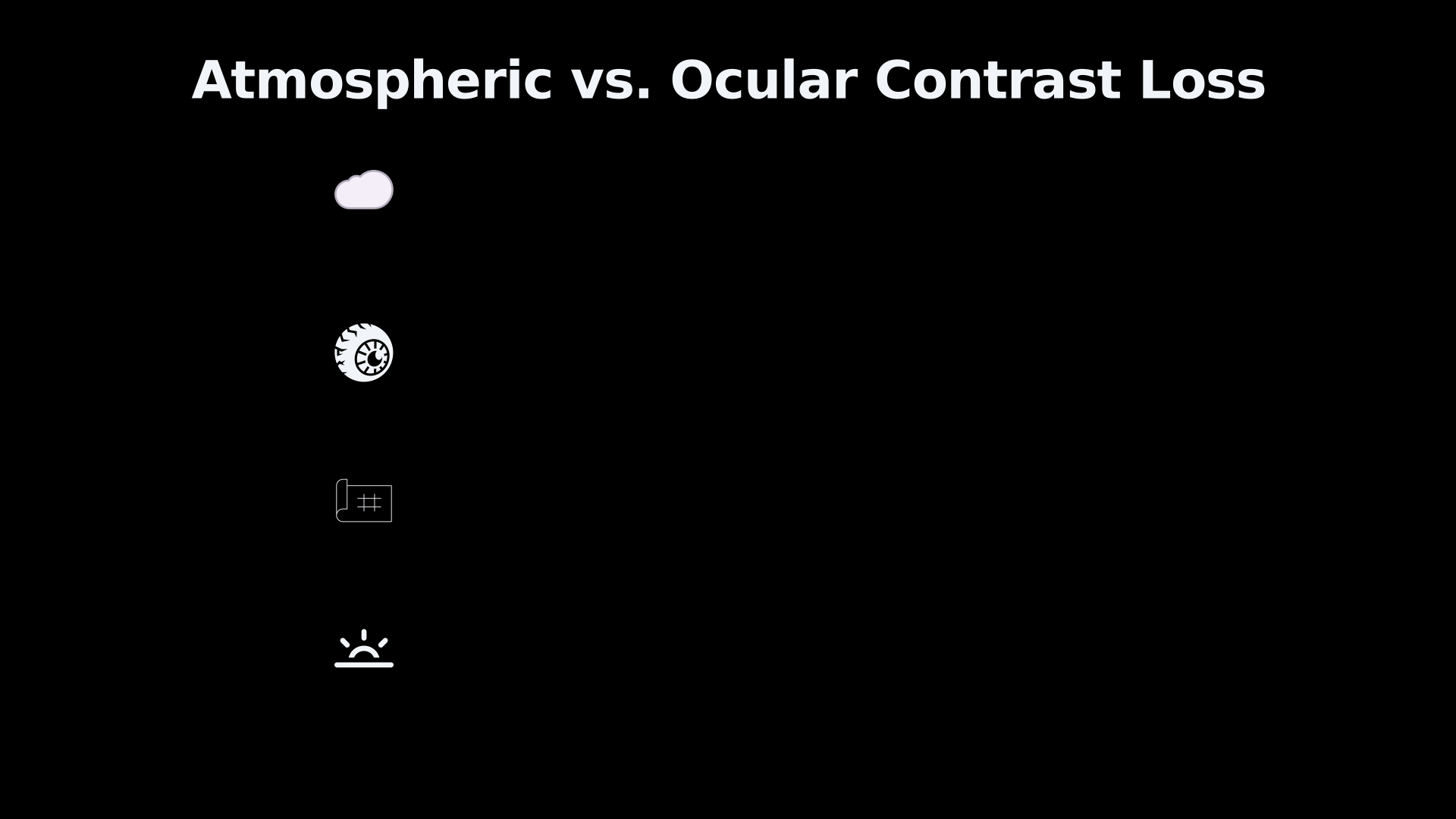
A landing light and the airframe surrounding it present very different visual signals. The lamp is an intense source; an unilluminated wing or fuselage is recognised mainly from comparatively subtle differences between its brightness and that of the background. Haze attacks those differences.
Atmospheric visibility research distinguishes between image-forming light, which carries information about the object, and additional light scattered into the viewing path. Both attenuation of the former and addition of the latter reduce contrast. EPA technical material notes that this contrast reduction grows with viewing distance and with the concentration of scattering and absorbing material.[NEPIS]epa.govOpen source on epa.gov.
A bright halo makes the local problem worse. The glow is concentrated precisely around the part of the aircraft that the observer is most likely to be looking at. In imaging terms, it spreads energy from the bright source across nearby parts of the scene. Modern night-time dehazing research consequently treats glow suppression and recovery of edges or textures as linked problems. One atmospheric point-spread-function approach specifically models the spread of light and then tries to recover edges and textures obscured in hazy night scenes.[arXiv]arxiv.orgOpen source on arxiv.org.
There is also a second source of contrast loss: the observer’s own visual system. Bright lights can produce disability glare, in which stray light within the eye creates what lighting science calls veiling luminance. The International Commission on Illumination defines this as luminance superimposed on the retinal image that reduces contrast. Experimental work on night-time target detection confirms that such veiling luminance from glare impairs visual performance.[CIE]cie.co.atOpen source on cie.co.at.
Atmospheric glow and ocular glare should not be treated as the same phenomenon. One occurs in the atmosphere before the light reaches the observer; the other results from scattering within the eye. But in a real observation they can act in the same direction: the bright source becomes visually dominant while nearby low-contrast structure becomes harder to distinguish.
That combination helps explain a particularly puzzling observation: a witness can clearly see “something” bright in the sky while genuinely being unable to see the wings, tail or fuselage responsible for carrying it.
Why the light can look larger than it really is
A distant aircraft lamp may already be too small for the unaided eye to resolve as a physical lamp housing. What the witness perceives is therefore primarily its luminous image. Once haze spreads some of that light outward, the visible boundary becomes the point at which the diminishing halo finally falls below the observer’s detection threshold, rather than the physical edge of the lamp.
That means apparent luminous size is not a reliable measure of the lamp’s physical size.
The effect is closely related to what researchers describe using an atmospheric point spread function: a nominally compact source is represented after atmospheric scattering by light distributed over a wider area. Recent night-time visibility studies explicitly use such models to reproduce and remove glow around artificial sources.[arXiv]arxiv.orgOpen source on arxiv.org. Research published in 2026 continues to describe prominent night-time glow as a consequence of multiple scattering from artificial light sources, showing that separating glow from underlying scene structure remains an active technical problem.[ScienceDirect]sciencedirect.comOpen source on sciencedirect.com.
This matters for witness estimates because the halo has no hard physical surface. Its apparent diameter can change when the source becomes brighter or dimmer, when the atmospheric path changes, or when scattering conditions change. A brighter portion of a diffuse halo can cross the observer’s visibility threshold and make the “object” seem to expand even though the aircraft has not changed size.
Humidity can contribute indirectly. Some haze-forming aerosols take up water and grow under humid conditions; EPA material notes that this growth can increase their ability to scatter visible light.[US EPA]epa.govOpen source on epa.gov. Consequently, two nights with superficially similar amounts of airborne pollution need not produce identical optical appearances.
The useful distinction is between three different quantities that a casual observation may collapse into one:
- the physical lamp, which is comparatively small;
- the direct luminous image of that unresolved lamp;
- the surrounding scattered glow, whose visible extent depends on atmospheric and observational conditions.
When the last two merge perceptually, a witness has little reason to interpret the visible diameter as an optical halo. It can simply look like the boundary of a luminous object.
A “glowing blob” is not evidence that nothing solid is there
For UFO or UAP assessment, the strongest implication is modest but important: failure to see an aircraft outline beside a bright light is not, by itself, strong evidence that no aircraft is present.
Haze is particularly effective at removing precisely the information needed to make that distinction. EPA visibility research notes that atmospheric particles degrade clarity, colour, texture and form, while scattered “air light” reduces contrast between objects and their backgrounds.[NEPIS]epa.govOpen source on epa.gov. Meanwhile, night-time haze research demonstrates that artificial light sources can generate a separate glow component capable of obscuring scene information around them.[CV Foundation]cv-foundation.orgOpen source on cv-foundation.org.
Consider a distant aircraft approaching roughly towards an observer. Its strongest forward-facing light may be prominent, while much of its airframe presents a small angular size and weak contrast against the night sky. If haze creates a halo around the light at the same time that atmospheric extinction suppresses the aircraft’s edges, the visual hierarchy can effectively reverse: the optical artefact surrounding the lamp becomes easier to see than the large solid aircraft carrying it.
This also explains why descriptions such as “perfectly round” or “larger than a normal aircraft light” need care. A soft halo supplies few structural cues from which to infer shape, scale or distance. Its circular or blob-like appearance can principally describe the distribution of brightness around an unresolved source rather than the geometry of the underlying object.
The mechanism does not establish that every unexplained luminous object is an aircraft, nor can the presence of haze identify a particular aircraft retrospectively. It establishes something narrower and more useful: under hazy night-time conditions, the apparent morphology of a bright light can differ substantially from the morphology of its physical source.

What makes the haze explanation testable
The most useful evidence is therefore not a witness’s estimate of the glowing object’s diameter in isolation. A haze-halo interpretation becomes stronger when several observations converge: reduced atmospheric visibility was actually present; the light occupied a plausible aircraft approach or departure direction; its movement was compatible with an aircraft; and independent flight or airport records place traffic along that line of sight.
Changes in the glow itself can also be informative. Because the visible halo depends on the light reaching the observer through a scattering medium, changes in viewing geometry or haze along the path can alter its intensity and apparent extent without requiring any change in the aircraft. Night-time imaging studies find glow sufficiently variable in intensity, source shape and local illumination that specialised models are needed to separate it from genuine scene structure.[PubMed]nih.govOpen source on nih.gov.
Conversely, haze should not become a catch-all explanation. A convincing identification still has to account for trajectory, timing, angular motion and any reported colour or flashing pattern. If those observations are incompatible with available aircraft movements, demonstrating that haze could produce halos does not resolve the case.
Where the geometry and records do fit, however, the “glowing blob” appearance is not an anomaly that must somehow be explained away after identifying an aircraft. It is an expected consequence of viewing an intense artificial light through scattering material: the atmosphere spreads the strongest light outward while progressively erasing the weaker edges that would have revealed the machine behind it.[CV Foundation]cv-foundation.orgOpen source on cv-foundation.org.
Amazon book picks
Further Reading
Books and field guides related to When Haze Turns Landing Lights Into Glowing Blobs. Use these as the next step if you want deeper reading beyond the article.
Light and Color in the Outdoors
All of science springs from the observation of nature. In this classic book, the late Professor Minnaert accompanies the reader on a tour...
Sensation and Perception
. Bruce Goldstein's SENSATION AND PERCEPTION, the best-seller which has helped over 150,000 students understand the ties between how we s...
The Nature of Light & Colour in the Open Air
Explains such natural phenomena as rainbows, mirages, iridescent clouds, and halos for the scientist and the artist
Human Factors in Aviation
Since the 1950s, a number of specialized books dealing with human factors has been published, but very little in aviation. Human Factors...
eBay marketplace picks
Marketplace Samples
Live-tested eBay searches with available results related to this page.
Selected fromaircraft wall art oneBay.co.uk.


Endnotes
1.
Source: epa.gov
Link:https://www.epa.gov/sites/default/files/2016-07/documents/introvis.pdf
2.
Source: arxiv.org
Link:https://arxiv.org/abs/1607.06235
3.
Source: arxiv.org
Link:https://arxiv.org/abs/2308.01738
Additional References
4.
Source: icao.int
Link:https://www.icao.int/sites/default/files/sp-files/SAM/Documents/2023-RLA06901-SAMAIM16/SAMAIM16_WP12_Proposl%20of%20amendment%20to%20ICAO%20Annex%203%20-%20Creation%20of%20PANS-MET%20-%20Impact%20on%20AIS%20AIM%20wApnd%20A.pdf
5.
Source: youtube.com
Title: UFO Videos Explained: Mick West’s Expert Analysis
Link:https://www.youtube.com/watch?v=-_4QF__92q0
Source snippet
Gimbal UFO - A New Analysis...
6.
Source: youtube.com
Title: My UFO Mistake
Link:https://www.youtube.com/watch?v=_YIS16GfzfQ
Source snippet
UFO Videos Explained: Mick West's Expert Analysis...
7.
Source: youtube.com
Title: Gimbal UFO
Link:https://www.youtube.com/watch?v=qsEjV8DdSbs
Source snippet
UFO [Parallax]({{ 'parallax/' | relative_url }}) Illusion...
8.
Source: youtube.com
Title: UFO Parallax Illusion
Link:https://www.youtube.com/watch?v=IRd1RY2PuvA
Source snippet
Why does the moon follow us?...
9.
Source: youtube.com
Title: Why does the moon follow us?
Link:https://www.youtube.com/watch?v=ia2tFVZHyPo