Within Weather Records
Did the UFO vanish into cloud?
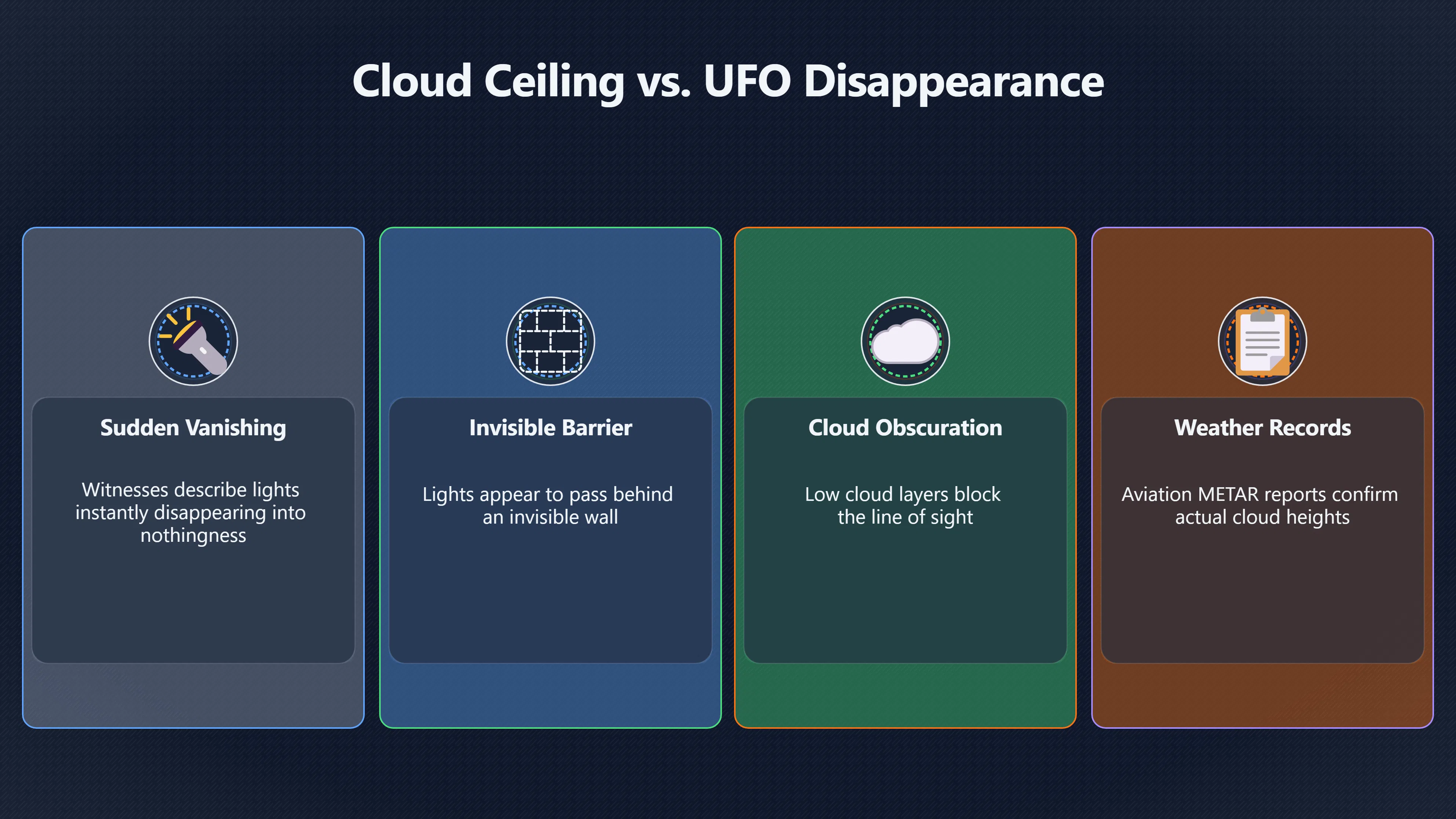
Low or broken cloud can make a steady light seem to blink out, vanish upward or pass behind an invisible barrier.
On this page
- Cloud bases, oktas and what they reveal
- Why broken layers create dramatic disappearances
- How aviation ceiling records test the claim
Page outline Jump by section
Introduction
A common feature in UFO reports is not the appearance of a mysterious light but its disappearance. Witnesses often describe a bright object that suddenly vanishes, seems to fly upward into nothing, or passes behind an invisible boundary in the sky. In many cases, low cloud and cloud ceilings provide a straightforward testable explanation. A steady light does not need to accelerate, switch off, or depart at extraordinary speed if a cloud layer simply blocks the line of sight.
 For investigators trying to distinguish unidentified reports from identifiable phenomena, cloud ceilings are particularly valuable because they leave records. Aviation weather observations, cloud-base measurements and sky-cover reports can often show whether a reported disappearance occurred at exactly the altitude where a cloud layer was present. In many cases, the question is not whether the light vanished, but whether it vanished into cloud.
Did the UFO vanish into cloud?
A cloud ceiling is the height of the lowest broken or overcast cloud layer above the ground. In aviation weather reporting, ceilings are derived from the lowest cloud layer reported as broken (BKN) or overcast (OVC), not from isolated cloud patches. This makes ceiling measurements a useful way to test reports of lights disappearing at a particular apparent height. [Federal Aviation Administration]faa.govFederal Aviation Administration Chapter 7Chapter 7. Safety of Flight- Ceiling is not specified; defined as the lowest broken or overcast layer, or the vertical visibility. - NWS… [National Weather Service]forecast.weather.govNational Weather Service NOAA's National Weather Serviceweather.govNOAA's National Weather Service - GlossaryCeiling: (Abbrev. CIG) - The height of the cloud base for the lowest broken or overc…
The key point is that a witness may see a light clearly below a cloud base and then lose it abruptly when it reaches the cloud layer. At night, the cloud itself may be nearly invisible. The observer therefore experiences the event as a sudden disappearance rather than an obscuration.
This effect is especially common with:
- Aircraft landing lights seen at a distance.
- Helicopters operating beneath broken cloud.
- Bright planets glimpsed through cloud gaps.
- Satellites passing into cloud cover. [tarmacview.com]tarmacview.comCloud Cover | Airport Lights InspectionCloud cover is measured visually by dividing the sky into eight parts (oktas), with each part repr…
- Distant navigation lights over water.
The human eye often interprets a disappearing point of light as motion. When the light is lost against a dark cloud edge, witnesses may conclude that it accelerated upward or instantly departed, even though it simply entered an obscured region.
Cloud bases, oktas and what they reveal
Weather observers do not merely record whether the sky is cloudy. They measure how much of the sky is covered using a scale called oktas, which divides the sky into eighths. Aviation reports commonly classify cloud cover as scattered (3–4 oktas), broken (5–7 oktas), or overcast (8 oktas). Broken and overcast layers are particularly important because they define a ceiling. [Earth, Ocean, and Atmospheric Sciences]eoas.ubc.caEarth, Ocean, and Atmospheric Sciences UBC ATSC 113ATSC 113 - Cloud CoverageFor aviation, the altitude of cloud base for the lowest cloud with coverage ≥ 5 oktas (i.e. lowest broken or ove… [Skybrary]skybrary.aeroSkybraryMeteorological Aerodrome Report (METAR)Cloud amount is reported as FEW = few (1-2 oktas), SCT = scattered (3-4 oktas), BKN = brok… [Met Office]weather.metoffice.gov.ukwe measure cloud1 okta represents a cloud amount of 1 eighth or less, but not zero; 7 oktas represents a cloud amount of 7 eighths or mor…
This distinction matters for UFO investigations.
A witness may report:
“The light climbed and disappeared.”
The weather record may show:
- Broken cloud at 1,500 feet.
- Overcast cloud at 2,000 feet.
- Visibility otherwise good.
In that situation, the disappearance occurred in an environment where a hidden cloud barrier already existed.
The cloud base itself may not be visible at night. A witness looking toward a dark section of sky can easily miss the boundary between clear air and low stratus or stratocumulus cloud. Yet a bright light entering that layer may disappear almost instantly.
Because cloud amount is measured systematically in METAR aviation observations, investigators can compare reported disappearance heights with actual cloud layers rather than relying on subjective descriptions such as “partly cloudy” or “mostly clear.” [Met Office]weather.metoffice.gov.ukwe measure cloud1 okta represents a cloud amount of 1 eighth or less, but not zero; 7 oktas represents a cloud amount of 7 eighths or mor… [Drone Pilot Ground School]dronepilotgroundschool.comreading aviation routine weather metar reportbroken, 2,500 ft. overcast; 07/05 means the temperature is 7°C and the dew point is 5°C; A2992 means the…Read more…
Why broken layers create dramatic disappearances
Broken cloud is often more deceptive than overcast cloud. [skybrary.aero]skybrary.aeroSkybraryMeteorological Aerodrome Report (METAR)Cloud amount is reported as FEW = few (1-2 oktas), SCT = scattered (3-4 oktas), BKN = brok…
With an overcast layer, observers can usually see a continuous cloud deck. When a light enters it, the explanation is obvious. Broken cloud behaves differently. Large gaps allow lights to appear and disappear repeatedly.
A bright aircraft may:

- Emerge through a gap.
- Remain visible for several seconds.
- Vanish behind cloud.
- Reappear through another opening.
- Disappear again.
To an observer unaware of the cloud structure, this can resemble intelligent manoeuvring or intermittent illumination.
The effect becomes stronger at night because observers often see the light but not the cloud producing the obstruction. The result can be reports of lights that “blinked out”, “jumped between positions”, or “faded into another dimension”. In reality, the cloud layer is acting like a moving screen.
Aviation weather guidance defines broken cloud as roughly five-eighths to seven-eighths sky coverage. That means substantial gaps remain even though a ceiling exists. Those gaps are exactly what create the illusion of objects repeatedly appearing and disappearing. [Met Office]weather.metoffice.gov.ukwe measure cloud1 okta represents a cloud amount of 1 eighth or less, but not zero; 7 oktas represents a cloud amount of 7 eighths or mor… [Boldmethod]boldmethod.comBoldmethodHow Cloud Ceilings Are ReportedIf the sky is covered between 5/8 and 7/8 with clouds, it's reported as broken…. And if it's… [Skybrary]skybrary.aeroSkybraryMeteorological Aerodrome Report (METAR)Cloud amount is reported as FEW = few (1-2 oktas), SCT = scattered (3-4 oktas), BKN = brok…
How aviation ceiling records test the claim
One of the most useful aspects of cloud-ceiling explanations is that they can be checked after the fact.
Most airports issue METAR reports at regular intervals. These observations record:
- Cloud layers. [* Cloud-base heights.]forecast.weather.govNational Weather Service NOAA's National Weather Serviceweather.govNOAA's National Weather Service - GlossaryCeiling: (Abbrev. CIG) - The height of the cloud base for the lowest broken or overc… [* Visibility.]faa.govFederal Aviation Administration Chapter 7Chapter 7. Safety of Flight- Ceiling is not specified; defined as the lowest broken or overcast layer, or the vertical visibility. - NWS…
- Weather conditions.
- Vertical visibility when cloud completely obscures the sky. [Met Office]weather.metoffice.gov.ukwe measure cloud1 okta represents a cloud amount of 1 eighth or less, but not zero; 7 oktas represents a cloud amount of 7 eighths or mor… [2moratech.com]moratech.comSky Condition Observing and Reporting StandardsThe height of the bases of each reported layer of clouds and/or obscurations; or the verti…
An investigator can compare a UFO report with the nearest weather observation.
For example:
Witness statementWeather record to checkLight vanished at low altitudeLowest ceiling heightLight disappeared repeatedlyBroken-cloud layersObject vanished overheadOvercast layer above observerObject faded into a bright hazeVertical visibility or obscured sky reports
If the disappearance point matches a recorded cloud base, the weather explanation gains considerable strength. If no cloud layers existed anywhere near the reported altitude or direction, investigators may need to examine other possibilities.
This approach is more reliable than relying on memory because cloud ceilings are measured operationally for aviation safety rather than collected for UFO studies. Their value lies in being independent records.
When cloud ceilings are most likely to mislead observers
Several conditions make cloud-related disappearances particularly convincing.
Low ceilings after sunset
Low stratus layers can become nearly invisible after dark. Aircraft lights remain bright, but the cloud deck fades into the background. The observer sees the disappearance but not the cause. [World Meteorological Organization]WikipediaWorld Meteorological OrganizationThe World Meteorological Organization (WMO) is a specialized agency of the United Nations responsible…
Thin or uneven cloud layers
A cloud layer does not need to be thick. Even a relatively thin section can reduce the contrast of a distant light enough to make it vanish from view.
Viewing near the horizon
The longer atmospheric path near the horizon means lights are already dimmed by distance and haze. Entering cloud at that point can cause an apparently instantaneous disappearance.
Patchy stratocumulus
Low stratocumulus often forms extensive fields with irregular gaps. These conditions are especially effective at creating intermittent visibility and repeated “reappearances.” [International Cloud Atlas]cloudatlas.wmo.intInternational Cloud AtlasCloud identification guideCloud identification guide; Nimbostratus. Ns. Dark rain cloud or bright snow cloud. U…
A practical interpretation rule
When a UFO report centres on a light that suddenly vanished, one of the first questions should be whether a cloud ceiling existed along the viewing path.
A recorded ceiling does not automatically explain every case. Witnesses can misjudge direction, distance and timing, and some reports occur under genuinely clear skies. However, cloud ceilings provide one of the few objective tests available. If a light disappears precisely where a broken or overcast layer was present, the event no longer requires an extraordinary explanation.
For this reason, intermittent disappearance is among the most weather-sensitive features in UFO reporting. A low cloud layer can create the impression of a light passing behind an invisible wall in the sky, when the wall was there all along and simply could not be seen.
Amazon book picks
Further Reading
Books and field guides related to Did the UFO vanish into cloud?. Use these as the next step if you want deeper reading beyond the article.
The UFO Experience
Places cloud-related disappearances within the broader problem of UFO report evaluation.
The Cloudspotter's Guide
Directly supports understanding cloud layers, cloud bases and how lights disappear behind cloud.
NightWatch
Helps readers distinguish sky objects from atmospheric interruptions and viewing conditions.
eBay marketplace picks
Marketplace Samples
Example marketplace items related to this page. Use the search link to explore similar finds on eBay.



Endnotes
-
Source: forecast.weather.gov
Title: National Weather Service NOAA’s National Weather Service
Link: https://forecast.weather.gov/glossary.php?word=ceilingSource snippet
weather.govNOAA's National Weather Service - GlossaryCeiling: (Abbrev. CIG) - The height of the cloud base for the lowest broken or overc...
-
Source: skybrary.aero
Link: https://skybrary.aero/articles/meteorological-aerodrome-report-metarSource snippet
SkybraryMeteorological Aerodrome Report (METAR)Cloud amount is reported as FEW = few (1-2 oktas), SCT = scattered (3-4 oktas), BKN = brok...
-
Source: moratech.com
Link: https://www.moratech.com/aviation/metar-class/metar-pg10-sky.htmlSource snippet
Sky Condition Observing and Reporting StandardsThe height of the bases of each reported layer of clouds and/or obscurations; or the verti...
-
Source: boldmethod.com
Link: https://www.boldmethod.com/learn-to-fly/weather/cloud-ceilings-celestial-dome/Source snippet
BoldmethodHow Cloud Ceilings Are ReportedIf the sky is covered between 5/8 and 7/8 with clouds, it's reported as broken.... And if it's...
-
Source: weather.gov
Link: https://www.weather.gov/media/directives/010_pdfs_archived/pd01008013b.pdfSource snippet
Broken cloud layer (5 to 7 oktas cloud amount). Clouds may be... Visibility 1 1/2 SM and light freezing rain, broken CB clouds (ceiling)...
-
Source: faa.gov
Title: Federal Aviation Administration Chapter 7
Link: https://www.faa.gov/air_traffic/publications/atpubs/aim_html/chap7_section_1.htmlSource snippet
Chapter 7. Safety of Flight- Ceiling is not specified; defined as the lowest broken or overcast layer, or the vertical visibility. - NWS...
-
Source: weather.metoffice.gov.uk
Link: https://weather.metoffice.gov.uk/guides/observations/how-we-measure-cloudSource snippet
we measure cloud1 okta represents a cloud amount of 1 eighth or less, but not zero; 7 oktas represents a cloud amount of 7 eighths or mor...
-
Source: eoas.ubc.ca
Title: Earth, Ocean, and Atmospheric Sciences UBC ATSC 113
Link: https://www.eoas.ubc.ca/courses/atsc113/flying/met_concepts/01-met_concepts/01c-cloud_coverage/index.htmlSource snippet
ATSC 113 - Cloud CoverageFor aviation, the altitude of cloud base for the lowest cloud with coverage ≥ 5 oktas (i.e. lowest broken or ove...
-
Source: metoffice.gov.uk
Link: https://www.metoffice.gov.uk/services/transport/aviation/regulated/training-resources-for-aviation/metars-and-tafsSource snippet
Met OfficeMETARs & TAFsMETARs are coded weather reports summarising current conditions at aerodromes, including wind, visibility, weather...
-
Source: dronepilotgroundschool.com
Title: reading aviation routine weather metar report
Link: https://www.dronepilotgroundschool.com/reading-aviation-routine-weather-metar-report/Source snippet
broken, 2,500 ft. overcast; 07/05 means the temperature is 7°C and the dew point is 5°C; A2992 means the...Read more...
-
Source: wmo.int
Link: https://wmo.int/world-meteorological-day-2017/classifying-cloudsSource snippet
World Meteorological OrganizationClassifying cloudsHigh-level clouds typically have a base above about 5 000 metres (16 500 feet); middle...
-
Source: cloudatlas.wmo.int
Link: https://cloudatlas.wmo.int/cloud-identification-guide.htmlSource snippet
International Cloud AtlasCloud identification guideCloud identification guide; Nimbostratus. Ns. Dark rain cloud or bright snow cloud. U...
-
Source: cloudatlas.wmo.int
Link: https://cloudatlas.wmo.int/some-useful-concepts-levels.htmlSource snippet
| International Cloud AtlasThe troposphere can be vertically divided into three levels, formerly known as “étages”: high, middle and low...
-
Source: wmo.int
Link: https://wmo.int/Source snippet
World Meteorological Organization WMO: HomepageWMO divides the world into six regions for the purpose of coordinating meteorological acti...
-
Source: faa.gov
Link: https://www.faa.gov/ -
Source: tarmacview.com
Title: cloud base
Link: https://www.tarmacview.com/glossary/cloud-base/Source snippet
Airport Lights InspectionNov 18, 2025 — Cloud ceiling is the lowest altitude above ground level of a broken or overcast cloud layer, a ke...
-
Source: tarmacview.com
Link: https://www.tarmacview.com/glossary/cloud-ceiling/Source snippet
Cloud Ceiling | Airport Lights InspectionThe cloud ceiling is the height above ground level (AGL) of the lowest cloud layer that covers m...
-
Source: tarmacview.com
Link: https://www.tarmacview.com/glossary/cloud-cover/Source snippet
Cloud Cover | Airport Lights InspectionCloud cover is measured visually by dividing the sky into eight parts (oktas), with each part repr...
-
Source: Wikipedia
Link: https://en.wikipedia.org/wiki/OktaSource snippet
OktaIn meteorology, an okta is a scale of measurement used to describe the amount of cloud cover at any given location such as a weath...
-
Source: Wikipedia
Title: World Meteorological Organization
Link: https://en.wikipedia.org/wiki/World_Meteorological_OrganizationSource snippet
World Meteorological OrganizationThe World Meteorological Organization (WMO) is a specialized agency of the United Nations responsible...
-
Source: Wikipedia
Title: Cloud cover
Link: https://en.wikipedia.org/wiki/Cloud_coverSource snippet
Cloud coverCloud cover refers to the fraction of the sky obscured by clouds on average when observed from a particular location. Okta...
-
Source: Wikipedia
Link: https://en.wikipedia.org/wiki/METARSource snippet
METARCAVOK is an abbreviation for Ceiling And Visibility OK, indicating no cloud below 5,000 ft (1,500 m) or the highest minimum secto...
-
Source: eoas.ubc.ca
Title: ca UB C ATSC 113
Link: https://www.eoas.ubc.ca/courses/atsc113/flying/met_concepts/01-met_concepts/01d-ceilings/index.htmlSource snippet
ATSC 113 - CeilingAccording to the International Civil Aviation Organization (ICAO), ceiling is the height above ground level (AGL) of th...
-
Source: rmets.org
Title: international cloud atlas and new cloud classifications
Link: https://www.rmets.org/metmatters/international-cloud-atlas-and-new-cloud-classificationsSource snippet
1 Apr 2017 — International Cloud Atlas and new cloud classifications · Alto: mid-level · Cirrus/cirro: feathers, wispy · Cumulus/cumulo...
-
Source: wiki.ivao.aero
Link: https://wiki.ivao.aero/en/home/training/documentation/metar_explanationSource snippet
explanation | IVAO Documentation LibraryThe ceiling (coverage > 50% or 4/8th) is the height above the earth's surface of the lowest layer...
Additional References
-
Source: aviationweather.gov
Link: https://aviationweather.gov/help/data/Source snippet
AWC Product InfoMETAR contains a report of wind, visibility, runway visual [range]({{ 'range/' | relative_url }}), present weather, sky condition, temperature, dew point...
-
Source: weatherbriefing.com
Link: https://www.weatherbriefing.com/cloud-catalogSource snippet
Cloud AtlasLow clouds are based below 6,500 feet (2,000 meters), middle clouds are between 6,500 and 20,000 feet, and high clouds are abo...
-
Source: pilotworkshop.com
Link: https://pilotworkshop.com/tips/vv_in_a_metar/Source snippet
VV in a METAR“That VV in the METAR is 'vertical visibility,' but you've probably also heard it on the ATIS or AWOS as 'indefinite ceiling...
-
Source: reddit.com
Link: https://www.reddit.com/r/flying/comments/12or8o3/vfr_metar_ceilings/Source snippet
VFR METAR Ceilings: r/flyingUnderstanding VFR METAR ceilings in aviation. Is scattered a ceiling in aviation? Is broken clouds a ceiling...
-
Source: space.oscar.wmo.int
Link: https://space.oscar.wmo.int/variables/view/cloud_coverSource snippet
for Variable: Cloud coverFull name, Cloud cover; Definition, 3D field of fraction of sky filled by clouds.; Measuring Units, %, Uncerta...
-
Source: bom.gov.au
Link: https://www.bom.gov.au/aviation/data/education/awp-metarspeci.pdf -
Source: weather.gov.dm
Link: https://weather.gov.dm/resources/common-forecast-terms-and-weather-systems -
Source: facebook.com
Link: https://www.facebook.com/Boldmethod/posts/the-faa-defines-a-ceiling-as-the-height-of-the-lowest-layer-of-clouds-above-the-/887355276752888/Source snippet
"The height of the lowest layer of clouds above the surface...25 Jul 2024 — The FAA defines a ceiling as: "The height of the lowest laye...
-
Source: youtube.com
Link: https://www.youtube.com/watch?v=g5wBWOTrloASource snippet
How to Decode METARs and TAFsIn this video I go over examples of decoding aviation METARs and TAFs. Meteorological Aerodrome Reports (MET...
-
Source: cloudatlas.wmo.int
Link: https://cloudatlas.wmo.int/Source snippet
Cloud Atlas: HomeThe WMO International Cloud Atlas is the reference for the classification of clouds and meteorological [meteors]({{ 'meteors/' | relative_url }}). It provi...
Topic Tree