Within Infrared
Why range makes or breaks UFO speed claims
Without reliable range, an infrared UFO clip cannot turn screen motion into trustworthy size, altitude or speed.
On this page
- Why angular motion is not physical speed
- How nearby small objects mimic distant fast ones
- What data an evidence package needs
Page outline Jump by section
Introduction
Many dramatic speed estimates in infrared UFO videos fail at the same point: the distance to the object is unknown. A camera can measure how quickly something moves across its field of view, but that is only angular motion — a change in direction from the observer’s perspective. Converting that angular motion into a real speed requires range. Without range, it is impossible to determine reliably whether an object is small and nearby, large and distant, slow or fast. This is one of the most important mechanisms behind false impressions of extraordinary performance in infrared UFO footage. Analyses by the US Department of Defense’s All-domain Anomaly Resolution Office (AARO) repeatedly emphasise that apparent motion can be heavily influenced by geometry, parallax and observer movement rather than by extreme object speed. [AARO]aaro.milGo Fast Case ResolutionAAROAARO GoFast Case ResolutionFebruary 24, 2025 — 6 Feb 2025 — Motion parallax is an optical effect that induces an observer to perceive…
 In the context of UFO reports, this means that a striking infrared clip may record a real object while still providing insufficient information to calculate its true velocity. The missing number is often not time, but distance.
Why angular motion is not physical speed
An infrared video directly records where an object appears in the image. It does not automatically reveal how far away that object is.
Imagine an object crossing ten degrees of the camera’s view in ten seconds. That measurement is real. However, the corresponding physical distance travelled depends entirely on range. If the object is 500 metres away, the distance covered is modest. If it is 50 kilometres away, the same angular movement represents a vastly larger physical displacement.
This distinction is fundamental in tracking and guidance systems. Engineers frequently work with line-of-sight rate — the rate at which an object’s apparent direction changes — because angular measurements are available even when range is uncertain. Converting line-of-sight motion into physical motion requires additional distance information. [ASTESJ]astesj.comGuidance Law Based on Line-of-Sight Rate InformationASTESJGuidance Law Based on Line-of-Sight Rate Information…June 20, 2019 — 15 Nov 2018 — The goal of the missile intercept problem is… [JHU Applied Physics Lab]secjhuapl.edu29 01 Palumbo Principles Rev2018Principles of Homing Guidanceby NF Palumbo · 2010 · Cited by 188 — INTRODUCTION. The key objective of this article is to provide a broad…
Infrared UFO debates often skip this step. Viewers see an object moving rapidly across the screen and intuitively assume high speed. Yet the screen only shows angular movement. The actual velocity remains unknown until range is established.
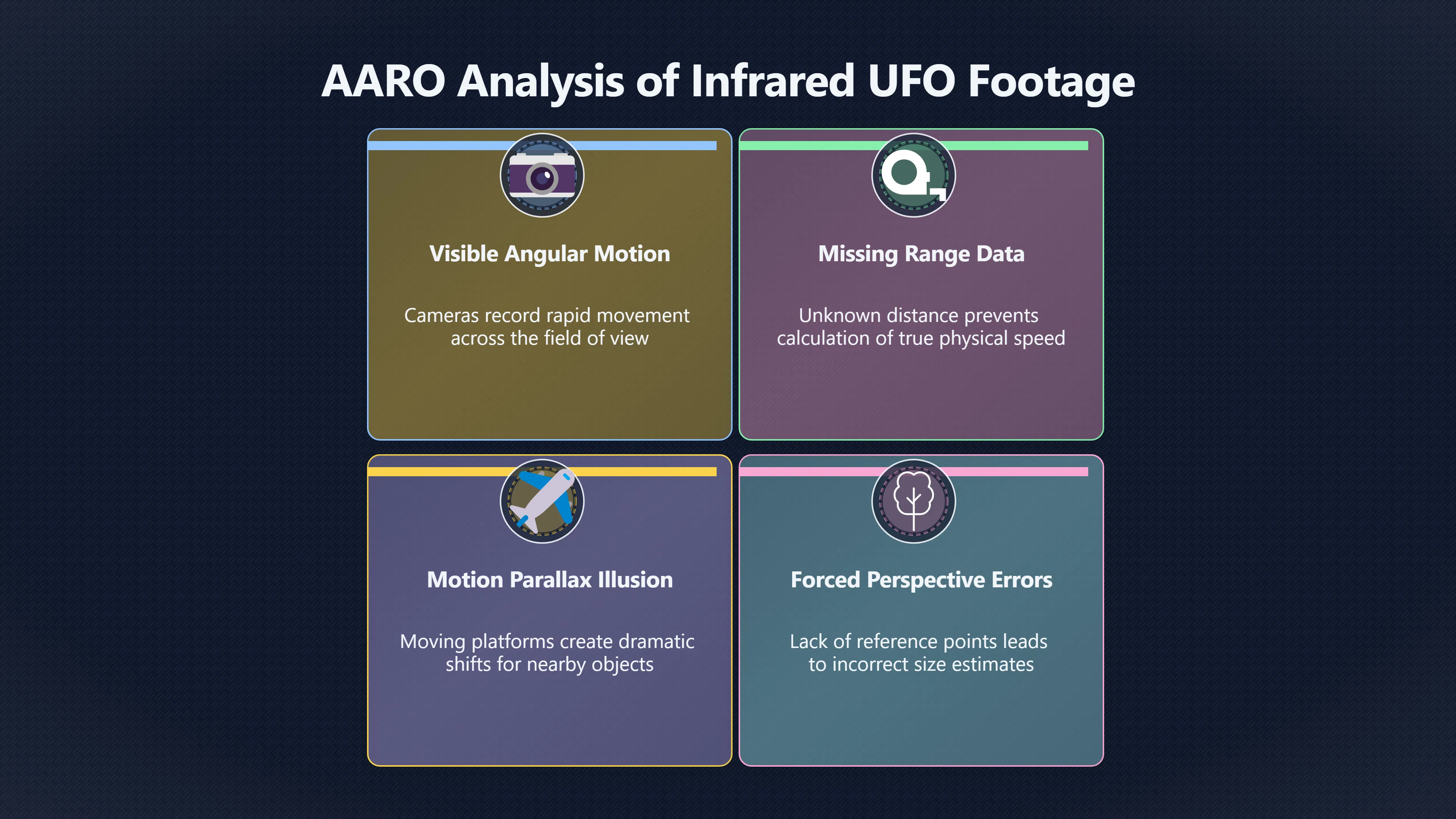
AARO’s discussion of forced perspective highlights the same problem. Humans naturally estimate size and distance using visual references. When those references are absent or ambiguous, errors in distance estimation lead directly to errors in size and speed estimation. [AARO]aaro.milObservers will often compare unknown objects to clouds, trees, buildings, or other non-…Read more…
How nearby small objects mimic distant fast ones
The reason range matters so much is that different physical situations can produce nearly identical images.
A small object close to the sensor can subtend the same angle as a much larger object far away. To the camera, both may appear as similarly sized blobs. Once detail is lost through distance, infrared contrast processing and limited resolution, distinguishing between those possibilities becomes extremely difficult.
This creates a classic ambiguity:
- A nearby bird may appear similar in size to a distant aircraft.
- A small balloon can resemble a much larger object at greater distance.
- A slow-moving object near the observer can create the same angular motion as a much faster object farther away.
Because infrared footage often removes familiar visual cues such as colour, markings, windows or wing shapes, the ambiguity becomes even harder to resolve. AARO notes that observers frequently struggle to judge the size and distance of unknown aerial objects when reliable reference points are absent. [AARO]aaro.milGo Fast Case ResolutionAAROAARO GoFast Case ResolutionFebruary 24, 2025 — 6 Feb 2025 — Motion parallax is an optical effect that induces an observer to perceive…
The result is that a mundane object can appear to possess extraordinary speed simply because the observer has unconsciously chosen the wrong distance estimate.
Parallax: the illusion that creates extreme speed
The most important range-related illusion in infrared UFO videos is motion parallax.
Parallax occurs when the observer is moving. Objects at different distances appear to shift against the background at different rates. Nearby objects seem to move much faster across the scene than distant ones.
This effect is familiar from everyday travel. Looking from a train window, nearby trees appear to race past while distant hills barely seem to move. The difference is caused primarily by geometry rather than by the actual speeds of the trees and hills.
Infrared footage recorded from aircraft introduces the same problem. The camera platform is moving rapidly, often at hundreds of knots. If a tracked object is relatively close to the aircraft, its apparent movement against the background can become dramatic even when its own speed is modest.
AARO’s formal resolution of the well-known “GoFast” video concluded that the object’s apparently extraordinary speed was attributable to motion parallax. According to the office’s analysis, the visual impression of extreme velocity resulted from viewing geometry and aircraft motion rather than evidence of a remarkably fast object. [AARO]aaro.milObservers will often compare unknown objects to clouds, trees, buildings, or other non-…Read more…
This is why screen motion alone is a poor indicator of performance. A fast-moving image is not necessarily an image of a fast-moving object.

Why infrared footage often lacks depth clues
Visible-light observations sometimes provide enough contextual information to estimate range. Buildings, terrain features, cloud layers, aircraft navigation lights and known object shapes can all help constrain distance.
Infrared footage often removes many of these clues.
Several factors contribute:
- Background features may be invisible or indistinct.
- Thermal contrast can reduce an object’s apparent shape to a bright or dark blob.
- Narrow fields of view at high zoom magnifications limit scene context.
- Atmospheric effects can obscure depth information.
- The recording may not include stereoscopic or multiple-view observations.
The result is a measurement problem. The sensor may provide accurate bearing and angular movement while providing little reliable information about depth.
This explains why analysts frequently seek additional sensor data rather than relying on the video alone. A clip may show that an object exists and moves, yet still fail to reveal how far away it is.
What data an evidence package needs
A convincing speed calculation requires more than the video itself.
To estimate true velocity reliably, investigators ideally need:
- Range measurements from radar, laser rangefinders or other sensors.
- Precise aircraft position and velocity data.
- Camera pointing information and field-of-view settings.
- Time-synchronised sensor records.
- Atmospheric and environmental context.
- Information about background terrain or cloud layers.
When these elements are available, analysts can reconstruct the geometry of the encounter and determine whether an object’s motion was genuinely unusual.
When they are absent, multiple interpretations often remain possible. A speed estimate may vary enormously depending on the assumed distance. An object thought to be travelling at hundreds or thousands of kilometres per hour can sometimes become consistent with a balloon, bird or other ordinary aerial target once a different range estimate is applied. [AARO]aaro.milObservers will often compare unknown objects to clouds, trees, buildings, or other non-…Read more…

Why range makes or breaks UFO speed claims
The key lesson from infrared UFO analysis is simple: cameras measure angles, not distances.
Without reliable range information, an infrared clip cannot by itself establish an object’s true size, altitude or speed. The same angular motion can represent a nearby slow target or a distant fast one. Parallax, observer motion and forced perspective can amplify the illusion of extraordinary performance, especially when visual depth cues are missing. [AARO]aaro.milObservers will often compare unknown objects to clouds, trees, buildings, or other non-…Read more…
For that reason, the strongest UFO investigations treat infrared video as only one piece of evidence. The decisive question is often not how fast the object appears to move on the screen, but whether anyone can demonstrate how far away it was. Until that number is known, speed claims remain highly uncertain.
Amazon book picks
Further Reading
Books and field guides related to Why range makes or breaks UFO speed claims. Use these as the next step if you want deeper reading beyond the article.
The UFO Handbook
Focuses on evaluating sightings, evidence quality, and common interpretation errors.
How to Measure Anything
Directly relates to the problem of estimating speed without reliable range data.
The Demon-Haunted World
Encourages careful reasoning about extraordinary claims from incomplete evidence.
eBay marketplace picks
Marketplace Samples
Example marketplace items related to this page. Use the search link to explore similar finds on eBay.


Endnotes
-
Source: aaro.mil
Title: Go Fast Case Resolution
Link: https://www.aaro.mil/Portals/136/PDFs/case_resolution_reports/AARO_GoFast_Case_Resolution_Card_Methodology_Final.pdfSource snippet
AAROAARO GoFast Case ResolutionFebruary 24, 2025 — 6 Feb 2025 — Motion parallax is an optical effect that induces an observer to perceive...
Published: February 24, 2025
-
Source: aaro.mil
Link: https://www.aaro.mil/Portals/136/PDFs/Information%20Papers/AARO_Effect_of_Forced_Perspective_and_Parallax_View_on_UAP_Observations_2024.pdfSource snippet
Observers will often compare unknown objects to clouds, trees, buildings, or other non-...Read more...
-
Source: astesj.com
Title: Guidance Law Based on Line-of-Sight Rate Information
Link: https://www.astesj.com/publications/ASTESJ_030626.pdfSource snippet
ASTESJGuidance Law Based on Line-of-Sight Rate Information...June 20, 2019 — 15 Nov 2018 — The goal of the missile intercept problem is...
Published: June 20, 2019
-
Source: media.defense.gov
Title: DOPSR 2024 0263 AARO HISTORICAL RECORD REPORT VOLUME 1 2024
Link: https://media.defense.gov/2024/Mar/08/2003409233/-1/-1/0/DOPSR-2024-0263-AARO-HISTORICAL-RECORD-REPORT-VOLUME-1-2024.PDFSource snippet
Historical Record Report Volume 18 Mar 2024 — SECTION I: Introduction. This report represents Volume I of the All-domain Anomaly Resoluti...
-
Source: secjhuapl.edu
Title: 29 01 Palumbo Principles Rev2018
Link: https://secwww.jhuapl.edu/techdigest/content/techdigest/pdf/V29-N01/29-01-Palumbo_Principles_Rev2018.pdfSource snippet
Principles of Homing Guidanceby NF Palumbo · 2010 · Cited by 188 — INTRODUCTION. The key objective of this article is to provide a broad...
-
Source: Wikipedia
Title: Forced perspective
Link: https://en.wikipedia.org/wiki/Forced_perspectiveSource snippet
Forced perspectiveForced perspective is a technique that employs optical illusion to make an object appear farther away, closer, large...
-
Source: Wikipedia
Link: https://en.wikipedia.org/wiki/ParallaxSource snippet
ParallaxParallax is a displacement or difference in the apparent position of an object viewed along two different lines of sightRead more...
Additional References
-
Source: researchgate.net
Link: https://www.researchgate.net/publication/398474116_Real-time_Motion_Parallax_Generation_System_using_Spherical_Rendering_and_View_Morphing_in_Unknown_EnvironmentsSource snippet
(PDF) Real-Time Motion Parallax Generation System...16 Mar 2026 — This paper presents a novel intermediate viewpoint generation system t...
-
Source: reddit.com
Link: https://www.reddit.com/r/UFOs/comments/166dk0u/according_to_aaros_new_website_the_flir_gimbal/Source snippet
According to AARO's new website, the FLIR, Gimbal and...According to AARO, the FLIR (Tic Tac UAP), Gimbal, and GoFast videos are “unreso...
-
Source: researchgate.net
Link: https://www.researchgate.net/publication/254011144_Measurement_angular_velocity_based_on_video_technologySource snippet
Measurement angular velocity based on video technologyTo measure the angular velocity of the object with video measurement technique is a...
-
Source: Wikipedia
Link: https://en.wikipedia.org/wiki/Proportional_navigationSource snippet
Proportional navigationProportional navigation is a guidance law (analogous to proportional control) used in some form or another by m...
-
Source: resources.mpi-inf.mpg.de
Link: https://resources.mpi-inf.mpg.de/StereoParallax/supplemental.pdfSource snippet
Parallax in Stereo 3D: Model and Applicationsby P Kellnhofer · Cited by 43 — This is a supplemental text for the SIGGRAPH Asia 2016 paper...
-
Source: researchgate.net
Link: https://www.researchgate.net/publication/245615969_Increasing_the_range_of_self-generated_motion_parallax_increases_its_effectivenessSource snippet
Increasing the range of self-generated motion parallax...28 Feb 2026 — Motion parallax is an effective source of depth information, Its...
-
Source: researchgate.net
Link: https://www.researchgate.net/publication/370446562_Manipulation_of_Motion_Parallax_Gain_Distorts_Perceived_Distance_and_Object_Depth_in_Virtual_RealitySource snippet
Manipulation of Motion Parallax Gain Distorts Perceived...9 May 2023 — PDF | On Mar 1, 2023, Xue Teng and others published Manipulation...
Published: May 2023
-
Source: colinzheng.com
Link: https://www.colinzheng.com/wp-content/data/research/papers/thesis_uw08.pdfSource snippet
Parallax Photography: Creating 3D Motions from Stillsby KC Zheng · 2008 · Cited by 1 — A full-view panorama extends the sampling of a pho...
-
Source: jenrs.com
Link: https://www.jenrs.com/publications/JENRS_0303003.pdfSource snippet
tion proportional to line of sight (LOS) angular rate, so that missile velocity vector...Read more...
-
Source: etd.lib.metu.edu.tr
Link: https://etd.lib.metu.edu.tr/upload/12621850/index.pdfSource snippet
method for estimating target velocity and range withby BCAN BABAOĞLU · 2018 — A new algorithm for both target speed and range estimation...
Topic Tree