Within Weather Records
Why a low planet can look alive
A bright planet near the horizon can redden, blur, shimmer or seem to move when thin haze sits along the line of sight.
On this page
- Why the horizon is the worst viewing angle
- How haze changes color, brightness and apparent motion
- Checks that separate planets from nearby objects
Page outline Jump by section
Introduction
A bright planet low on the horizon is one of the most common ordinary explanations behind reports of strange lights in the sky. Witnesses often describe a light that changes colour, pulses, drifts, hovers, darts slightly from side to side, or appears almost alive. Yet in many cases the object is a bright planet—especially Venus or Jupiter—seen through a long, turbulent path of atmosphere near the horizon. NASA’s Night Sky Network notes that Venus shining low above the horizon has been reported as a UFO many times, precisely because its appearance can become unusual under these conditions. [Night Sky Network]nightsky.jpl.nasa.govNight Sky Network Identifying UFOs and UAPsSirius and Jupiter are also often reported as UFOs, as well as Mercury.Read more…
 The key clue is that the atmosphere affects celestial objects most strongly when they are low in the sky. Haze, humidity, temperature layers and atmospheric turbulence can alter a planet’s apparent colour, brightness and position enough to create a convincing impression of motion or intelligent control. Understanding these effects provides a useful visibility clue when evaluating UFO reports.
Why the horizon is the worst viewing angle
When a planet is high overhead, its light travels through a relatively short column of air before reaching an observer. Near the horizon, the same light must pass through a much greater thickness of atmosphere. Every layer of air, dust, haze, smoke, humidity and turbulence has an opportunity to distort the image. NOAA Global Monitoring Laboratory [EarthSky]earthsky.orgrefraction distortion moon sun near horizonWhat makes oddly shaped suns and moons on the horizon?8 Apr 2025 — For objects with a small angular size – like stars – atmospheric refra…
This longer atmospheric path produces several effects at once: [astropix.com]astropix.comAtmospheric Effects ScintillationAtmospheric EffectsScintillation - Scintillation causes rapid changes in brightness in the celestial object being viewed. This is why sta…
- Increased scattering and dimming.
- Stronger atmospheric refraction. [gml.noaa.gov]gml.noaa.govNOAA Global Monitoring LaboratorySolar Calculator Glossary - Global Monitoring Laboratory- Due to atmospheric refraction, sunrise occurs…
- Greater sensitivity to turbulence.
- More noticeable colour changes.
- More apparent positional instability.
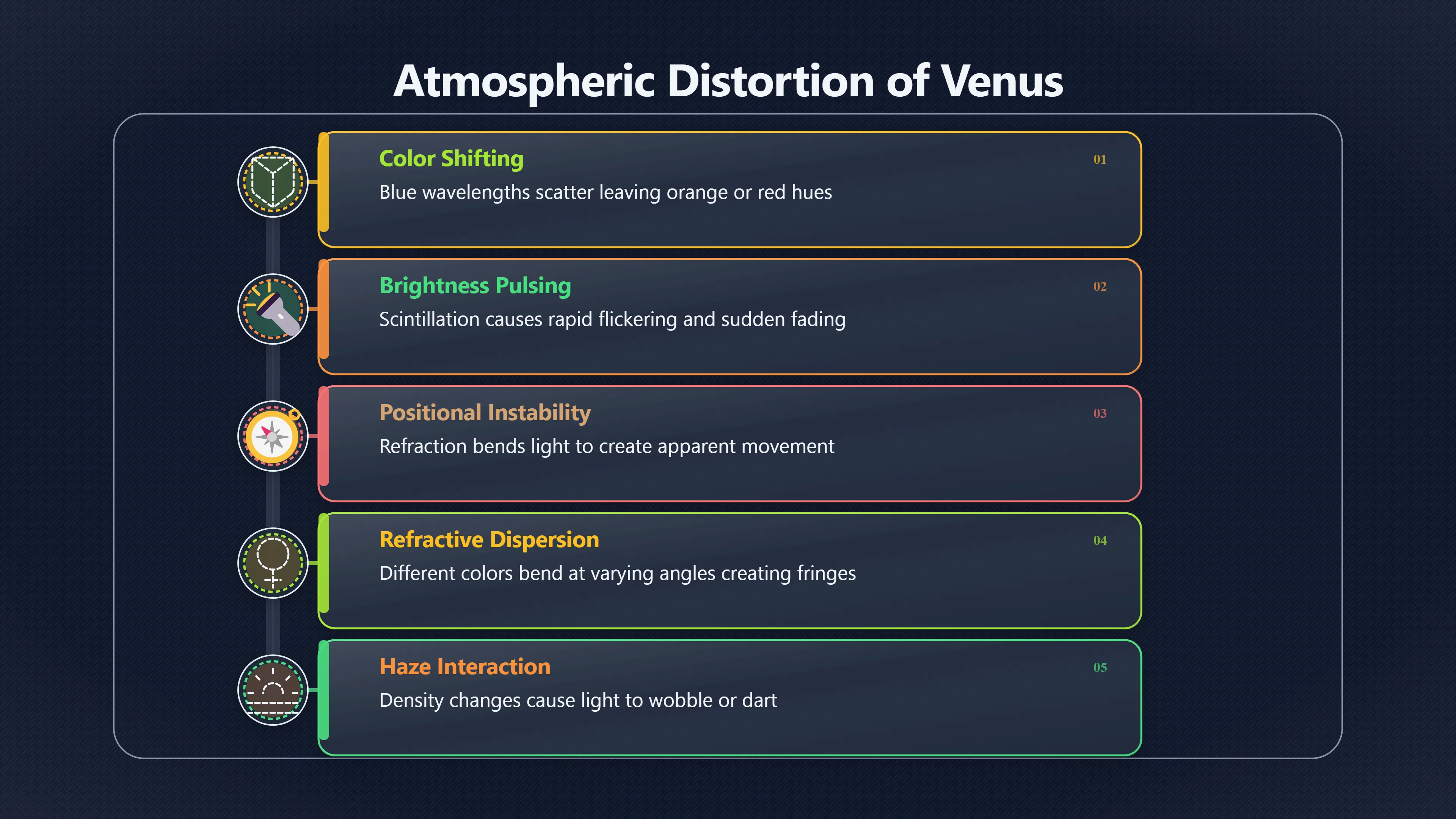
Atmospheric refraction bends incoming light and changes the apparent position of celestial objects. Near the horizon, refraction becomes much stronger and more variable than it is overhead. Objects can appear higher than their true position, and changing atmospheric conditions can make their apparent location fluctuate slightly over time. [NOAA Global Monitoring Laboratory]gml.noaa.govNOAA Global Monitoring LaboratorySolar Calculator Glossary - Global Monitoring Laboratory- Due to atmospheric refraction, sunrise occurs… [British Astronomical Association]britastro.orgatmospheric refractionBritish Astronomical AssociationAtmospheric RefractionMar 2, 2019 — This short tutorial looks at the some of the effects that the refract…
For a witness without astronomical reference points, these subtle shifts can easily be interpreted as deliberate movement. A stationary planet may seem to hover, climb, descend or wander.
How haze changes colour, brightness and apparent motion
Why planets become red, orange or multicoloured
One of the most frequently reported UFO characteristics is a light that changes colour. Witnesses may report transitions from white to orange, red, blue or green.
Near the horizon, blue wavelengths are scattered more efficiently than red wavelengths. As a result, planets often appear orange or reddish when viewed through a thick atmospheric path. Humidity, pollution, smoke and haze can strengthen the effect. [Cloudy Nights]cloudynights.comCloudy Nights About the twinkling of starsCloudy NightsAbout the twinkling of starsApril 3, 2021 — 3 Apr 2021 — Refractive dispersion is due to the fact that air bends blue light…
Atmospheric dispersion adds another layer of distortion. Because different colours of light are bent by slightly different amounts, a bright planet close to the horizon can briefly display coloured fringes or flashes. Under turbulent conditions these colours may seem to flicker rapidly, creating the impression of a light changing colour on its own. [Cloudy Nights]cloudynights.comCloudy Nights About the twinkling of starsCloudy NightsAbout the twinkling of starsApril 3, 2021 — 3 Apr 2021 — Refractive dispersion is due to the fact that air bends blue light…
Why a planet can appear to pulse or flash
Atmospheric scintillation—the same process that causes stars to twinkle—produces rapid changes in apparent brightness, colour and position as light passes through turbulent air. Although planets usually twinkle less than stars because they appear as tiny discs rather than perfect points, strong turbulence near the horizon can still make bright planets shimmer dramatically. [NOAA Institutional Repository]repository.library.noaa.govnoaa 32474 DS1NOAA Institutional Repository^ 0Fc0 ^rEs o* W6by JH Churnside · 1989 · Cited by 27 — If the signal is averaged over a finite disk, such a…
To an observer, this can resemble:
- Pulsing brightness.
- Intermittent flashing.
- Sudden brightening and fading.
- Rapid colour changes. [astropix.com]astropix.comAtmospheric Effects ScintillationAtmospheric EffectsScintillation - Scintillation causes rapid changes in brightness in the celestial object being viewed. This is why sta…
- Apparent vibration.
Such descriptions occur repeatedly in UFO reports involving bright evening or morning planets.

Why a stationary planet can seem to move
Human perception contributes to the illusion. When observers stare at a bright light against a dark sky without nearby reference points, tiny involuntary eye movements can make the object appear to drift. Atmospheric turbulence can add small apparent position shifts, reinforcing the sensation. [2astropix.com]astropix.comAtmospheric Effects ScintillationAtmospheric EffectsScintillation - Scintillation causes rapid changes in brightness in the celestial object being viewed. This is why sta…
Thin haze layers can make the effect even stronger. As the haze density changes, different portions of the planet’s light are scattered or refracted. The result can be a light that seems to wobble, dart slightly, or perform short erratic movements despite remaining fixed in the sky.
Why Venus is involved so often
Venus deserves special attention because it is exceptionally bright and often appears low in the sky after sunset or before sunrise.
NASA’s Night Sky Network specifically identifies Venus as one of the most commonly misidentified celestial objects in UFO reports, particularly when it is near the horizon. Under suitable conditions Venus can outshine every star in the sky and remain visible through twilight, haze and thin cloud. [Night Sky Network]nightsky.jpl.nasa.govNight Sky Network Identifying UFOs and UAPsSirius and Jupiter are also often reported as UFOs, as well as Mercury.Read more…
Several characteristics make Venus especially prone to misidentification:
- Extreme brightness attracts attention.
- It often appears isolated from other stars.
- It can remain visible before other celestial objects emerge.
- Haze and turbulence readily distort its appearance.
- Witnesses may not expect a planet to be that bright.
A witness who notices a brilliant reddish-white light hovering over a distant ridge or coastline may reasonably assume it is an aircraft, drone or unknown object rather than a planet.
Checks that separate planets from nearby objects
Weather and visibility records can help distinguish a horizon planet from an aircraft, drone or genuinely nearby object.
Several practical checks are particularly useful.
Check the azimuth and elevation. If the reported object matches the position of Venus, Jupiter or another bright planet at the time of the sighting, the identification gains strength. Planetarium software and astronomical databases can verify this. [Night Sky Network]nightsky.jpl.nasa.govNight Sky Network Identifying UFOs and UAPsSirius and Jupiter are also often reported as UFOs, as well as Mercury.Read more…
Look for horizon conditions. Reports occurring through haze, mist, smoke, humidity or temperature inversions are more likely to involve atmospheric distortion. Thin haze may be present even when witnesses describe the sky as generally clear. [windowthroughtime]windowthroughtime.wordpress.comwindowthroughtime Atmospheric scintillationwindowthroughtimeAtmospheric scintillation - windowthroughtime28 Aug 2023 — Stars near the horizon will appear to twinkle more than those…
Assess duration. Planets often remain visible in roughly the same part of the sky for long periods. Witnesses may interpret gradual changes caused by Earth’s rotation as movement of the object itself.
Compare observations from multiple locations. A planet will appear in essentially the same direction for observers across a wide area. A nearby object will not.
Watch for disappearance into haze. Planets near the horizon frequently fade, brighten or vanish as atmospheric conditions change. This behaviour is consistent with visibility effects rather than controlled flight. [Cloudy Nights]cloudynights.comCloudy Nights About the twinkling of starsCloudy NightsAbout the twinkling of starsApril 3, 2021 — 3 Apr 2021 — Refractive dispersion is due to the fact that air bends blue light…

What investigators learn from these reports
Horizon-planet cases illustrate why weather and visibility records are valuable in UFO investigations. Witnesses are often reporting genuine observations: the light really does seem to change colour, shimmer, pulse or move. The mistake lies not in the observation but in the interpretation.
The combination of low viewing angle, haze, atmospheric refraction and turbulence can transform a bright planet into something that appears dynamic and mysterious. Because these effects are strongest near the horizon, reports describing a brilliant stationary or slowly drifting light low in the sky deserve careful comparison with astronomical positions and local visibility conditions before more exotic explanations are considered. [Night Sky Network]nightsky.jpl.nasa.govNight Sky Network Identifying UFOs and UAPsSirius and Jupiter are also often reported as UFOs, as well as Mercury.Read more… [NOAA Global Monitoring Laboratory]gml.noaa.govNOAA Global Monitoring LaboratorySolar Calculator Glossary - Global Monitoring Laboratory- Due to atmospheric refraction, sunrise occurs…
Amazon book picks
Further Reading
Books and field guides related to Why a low planet can look alive. Use these as the next step if you want deeper reading beyond the article.
NightWatch
Helps readers identify Venus, Jupiter and other bright sky objects affected by haze.
Turn Left at Orion
Supports practical recognition of planets and stars before interpreting them as UFOs.
The Backyard Astronomer's Guide
Explains observing conditions and the appearance of bright planets near the horizon.
The Cloudspotter's Guide
Adds atmospheric context for haze, clouds and visibility effects on low planets.
eBay marketplace picks
Marketplace Samples
Example marketplace items related to this page. Use the search link to explore similar finds on eBay.



Endnotes
-
Source: nightsky.jpl.nasa.gov
Title: Night Sky Network Identifying UFOs and UAPs
Link: https://nightsky.jpl.nasa.gov/news/39/Source snippet
[Sirius]({{ 'sirius/' | relative_url }}) and Jupiter are also often reported as UFOs, as well as Mercury.Read more...
-
Source: gml.noaa.gov
Link: https://gml.noaa.gov/grad/solcalc/glossary.htmlSource snippet
NOAA Global Monitoring LaboratorySolar Calculator Glossary - Global Monitoring Laboratory- Due to atmospheric refraction, sunrise occurs...
-
Source: earthsky.org
Title: refraction distortion moon sun near horizon
Link: https://earthsky.org/astronomy-essentials/refraction-distortion-moon-sun-near-horizon/Source snippet
What makes oddly shaped suns and moons on the horizon?8 Apr 2025 — For objects with a small angular size – like stars – atmospheric refra...
-
Source: Wikipedia
Link: https://en.wikipedia.org/wiki/Atmospheric_refractionSource snippet
Atmospheric refractionAtmospheric refraction is the deviation of light or other electromagnetic wave from a straight line as it passes...
-
Source: Wikipedia
Link: https://en.wikipedia.org/wiki/TwinklingSource snippet
March 4, 2026 — Twinkling, also called scintillation, is a generic term for variations in apparent brightness, colour, or position of a d...
Published: March 4, 2026
-
Source: repository.library.noaa.gov
Title: noaa 32474 DS1
Link: https://repository.library.noaa.gov/view/noaa/32474/noaa_32474_DS1.pdfSource snippet
NOAA Institutional Repository^ 0Fc0 ^rEs o* W6by JH Churnside · 1989 · Cited by 27 — If the signal is averaged over a finite disk, such a...
-
Source: astropix.com
Title: Atmospheric Effects Scintillation
Link: https://www.astropix.com/books/GDPI/CHAPTER1/105.HTMSource snippet
Atmospheric EffectsScintillation - Scintillation causes rapid changes in brightness in the celestial object being viewed. This is why sta...
-
Source: Wikipedia
Link: https://en.wikipedia.org/wiki/HorizonSource snippet
HorizonRefraction can make distant objects seem higher or, less often, lower than they actually are. An unusually large refraction may...
-
Source: windowthroughtime.wordpress.com
Title: windowthroughtime Atmospheric scintillation
Link: https://windowthroughtime.wordpress.com/tag/atmospheric-scintillation/Source snippet
windowthroughtimeAtmospheric scintillation - windowthroughtime28 Aug 2023 — Stars near the horizon will appear to twinkle more than those...
-
Source: britastro.org
Title: atmospheric refraction
Link: https://britastro.org/2019/atmospheric-refractionSource snippet
British Astronomical AssociationAtmospheric RefractionMar 2, 2019 — This short tutorial looks at the some of the effects that the refract...
-
Source: cloudynights.com
Title: Cloudy Nights About the twinkling of stars
Link: https://www.cloudynights.com/forums/topic/764513-about-the-twinkling-of-stars/Source snippet
Cloudy NightsAbout the twinkling of starsApril 3, 2021 — 3 Apr 2021 — Refractive dispersion is due to the fact that air bends blue light...
Published: April 3, 2021
-
Source: bencraven.org.uk
Title: Atmospheric refraction
Link: https://bencraven.org.uk/tag/atmospheric-refraction/Source snippet
Ben CravenThe reason that we can see them at all is that light travelling through the atmosphere is refracted by the air: its path is (us...
Additional References
-
Source: reddit.com
Link: https://www.reddit.com/r/askastronomy/comments/1fhig5z/a_flickering_object_in_the_northern_hemisphere/Source snippet
A “flickering” object in the northern hemisphere: r/askastronomyBright stars twinkle more, and stars near the horizon twinkle more. They...
-
Source: astroshop.eu
Link: https://www.astroshop.eu/magazine/practical-tips/peter-s-problem-solvers/colour-fringing-on-low-lying-planets/i%2C1484Source snippet
Colour fringing on low-lying planetsColour fringing on planets is very common, even with expensive telescopes. The reason for this and th...
-
Source: esa.int
Link: https://www.esa.int/Science_Exploration/Space_Science/Envision/Top_five_Venus_mysteries_Envision_will_solve -
Source: researchgate.net
Link: https://www.researchgate.net/publication/233775239_Using_stellar_scintillation_for_studies_of_turbulence_in_the_Earth%27s_atmosphereSource snippet
(PDF) Using stellar scintillation for studies of turbulence in...9 Mar 2016 — Stellar scintillation observed through the Earth's atmosph...
-
Source: warwick.ac.uk
Link: https://warwick.ac.uk/fac/sci/physics/research/astro/theses/seanobrien.msc.pdfSource snippet
rs) twinkle, while planets (wandering stars) do not: 'The planets are...Read more...
-
Source: facebook.com
Link: https://www.facebook.com/groups/326916019733179/posts/625950963163015/Source snippet
ens because starlight must pass through Earth's turbulent atmosphere.Read more...
-
Source: primitiveproton.com
Title: Few stars, such as Betelgeuse, Sirius, and Rigel
Link: https://primitiveproton.com/atmospheric-scintillation-why-stars-twinkle-and-planets-dont/Source snippet
Primitive ProtonAtmospheric Scintillation: Why Stars Twinkle And Planets...It is an astronomical term for changes in stars' brightness o...
-
Source: facebook.com
Link: https://www.facebook.com/AstroKirsten/posts/why-do-stars-twinkle-but-planets-dont-heres-whats-going-oneven-though-stars-are-/1343560821104506/Source snippet
e. Planets typically don't twinkle as much as stars because they...
-
Source: facebook.com
Link: https://www.facebook.com/groups/849994733672039/posts/1020575039947340/Source snippet
In fact, climate modeling by NASA’s Goddard Institute for...
-
Source: archive.org
Link: https://archive.org/download/aliensinskies00unit/aliensinskies00unit.pdfSource snippet
ing UFOs and that the subject is not worthy.Read more...
Topic Tree