Within Radar
Is One Radar Blip Really a UFO?
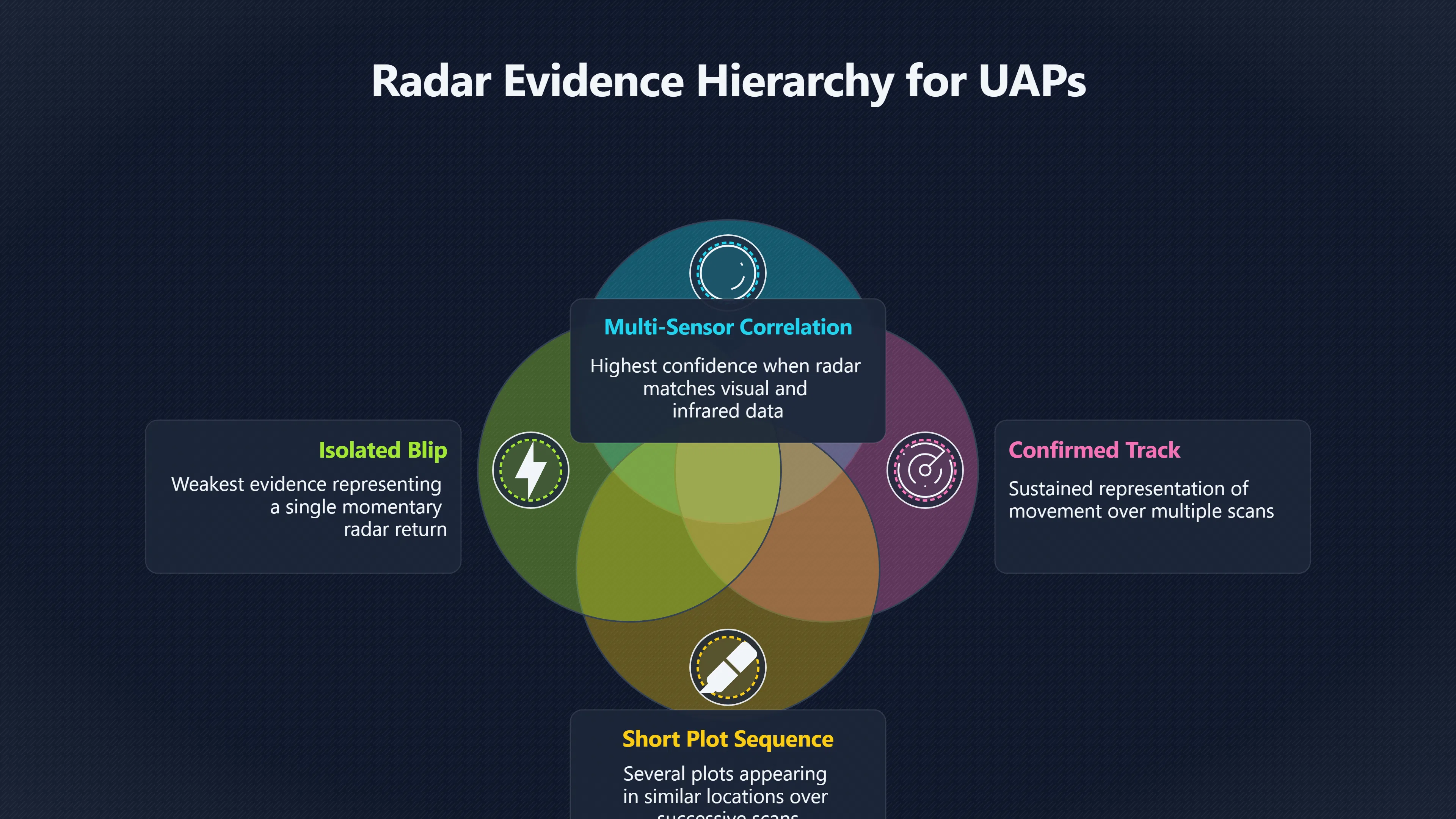
A single blip, a short plot sequence, and a multi-sensor track are not equally strong evidence for an unusual object.
On this page
- What counts as a plot, track, or correlation
- How processing can link unrelated returns
- Why time synced independent confirmation matters
Page outline Jump by section
Introduction
When a UFO report claims that an object was “tracked on radar”, the phrase can sound far more impressive than the underlying evidence actually warrants. A single radar blip, a brief sequence of returns, and a confirmed multi-sensor track are fundamentally different kinds of evidence. Treating them as equivalent is one of the most common mistakes in discussions of radar-associated UFO cases.
 This distinction matters because radar systems routinely generate ambiguous or false returns. Aviation authorities note that atmospheric effects such as anomalous propagation can create numerous extraneous blips on radar displays, while modern radar processing is specifically designed to suppress clutter and reduce false targets. A radar contact becomes more persuasive only as it survives repeated scans, forms a coherent track, and receives independent confirmation from other sensors or observers. [Federal Aviation Administration]faa.govFederal Aviation Administration Section 5Surveillance SystemsThe bending of radar pulses, often called anomalous propagation or ducting, may cause many extraneous blips to appear… [Federal Aviation Administration]faa.govFederal Aviation Administration Section 5Surveillance SystemsThe bending of radar pulses, often called anomalous propagation or ducting, may cause many extraneous blips to appear…
Is One Radar Blip Really a UFO?
Usually, no. A single radar blip is the weakest form of radar evidence.
Radar does not directly display physical objects. It displays detected energy that has passed through a chain of filtering, thresholding and processing steps. A lone return may represent a genuine aircraft, but it can also result from clutter, interference, atmospheric refraction, weather effects, reflections from terrain, or random signal fluctuations. Primary radar systems are particularly vulnerable because they detect reflections without automatically identifying their source. [Skybrary]skybrary.aeroSkybraryPrimary Surveillance Radar (PSR)The radar relies on reflected signals but is not aware if they are received from aircraft or from…
In practical terms, a single unexplained mark on one radar sweep tells investigators very little. It provides only a momentary indication that something reflected radar energy at a particular place and time. It does not reliably establish:
- A stable object.
- A consistent flight path.
- Speed or acceleration.
- Altitude.
- Identity.
- Whether the return was even produced by a discrete airborne target.
For this reason, aviation and defence operators generally place far more weight on tracks than on isolated plots.
What Counts as a Plot, Track, or Correlation?
The terminology often becomes blurred in UFO discussions.
A plot
A plot is a single radar detection from one antenna sweep or scan cycle. It is essentially a point on a display representing where the radar believes a return occurred at that moment.
One plot alone provides almost no information about behaviour.
A short plot sequence
If several plots appear in roughly similar locations over successive scans, operators may see the beginning of a possible track.
However, a short sequence is still not necessarily evidence of a real object. Depending on radar settings and environmental conditions, unrelated returns can sometimes appear close enough in space and time to look meaningful.
The evidential value is higher than a lone blip, but uncertainty remains substantial.
A confirmed track
A confirmed track is a processed and sustained representation of a target’s movement over time. The radar system or operators have determined that multiple detections are sufficiently consistent to represent the same object.
A confirmed track can provide:
- Direction of travel.
- Estimated speed.
- Changes in heading.
- Persistence over time.
- Consistency with known aircraft behaviour or inconsistency with it.
The key difference is persistence. Random noise rarely produces a coherent path that survives repeated scans over an extended period.
How Processing Can Link Unrelated Returns
A common misunderstanding is that a radar track is simply a direct recording of reality.
In reality, modern radar systems often construct tracks by linking detections believed to belong to the same target. The software predicts where a target should appear on the next scan and attempts to associate new returns with that prediction.
This process is extremely useful, but it introduces a subtle risk. If ambiguous detections occur in a cluttered environment, the system may occasionally connect returns that do not originate from a single object.
The result can be:
- A short-lived false track.
- Apparent motion created by linked clutter.
- Track jumps or sudden manoeuvres.
- Temporary ghost targets.
Radar designers devote significant effort to reducing false-target rates because clutter, weather, terrain reflections and atmospheric effects can otherwise generate misleading detections. Modern systems use filtering, Doppler processing, moving-target indicators and other techniques specifically because false returns are a known operational problem. [RTX]rtx.comRTXPrimary (Non-Cooperative) Surveillance Radar (NCSR)ASR-XM delivers exceptional aircraft detection with low false target rates – even i… [Indra Group]indragroup.com12 psr brochure v1 02 2009 engPRIMARY SURVEILLANCE RADAR2 Jan 2009 — The integrated weather channel has an independent set of Doppler filters that eliminate clutter fr…
This does not mean every unusual track is false. It means that the existence of a track alone is not sufficient proof that an extraordinary object was present.
Why Time-Synced Independent Confirmation Matters
The strongest radar evidence does not come from radar alone.
Investigators place much greater confidence in an event when independent systems detect the same target at the same time and location.
Examples include:
- Primary radar plus secondary radar. [skybrary.aero]skybrary.aeroSkybraryPrimary Surveillance Radar (PSR)The radar relies on reflected signals but is not aware if they are received from aircraft or from…
- Radar plus infrared imagery.
- Radar plus optical observation. [* Multiple independent radar sites.]science.nasa.govNASA ScienceIndependent Study Team ReportAt present, analysis of UAP data is hampered by poor sensor calibration, the lack of multiple me… [* Radar plus aircraft instrumentation.]skybrary.aeroSkybraryPrimary Surveillance Radar (PSR)The radar relies on reflected signals but is not aware if they are received from aircraft or from…
This approach helps separate genuine targets from sensor-specific artefacts.
A useful comparison comes from weather radar practice. Meteorologists routinely verify suspicious returns by checking adjacent radar systems, satellite imagery and other data sources because some apparent targets result from anomalous propagation rather than actual weather. Cross-checking helps reveal whether a feature is real or an artefact of one sensor. [Weather.gov]weather.govNWS Weather RadarAnomalous Propagation (AP): (Ground Clutter). Anomalous Propagation (AP) refers to meteorological situations where a sig…
The same logic applies to UFO investigations. If only one sensor records an event, uncertainty remains high. If multiple independent systems record the same object with matching timing and geometry, confidence rises significantly.
Why Atmospheric Effects Often Create Blips but Rarely Strong Tracks
Many radar anomalies are transient.
The FAA notes that anomalous propagation, often called ducting, can produce numerous extraneous blips on radar displays when atmospheric conditions bend radar beams toward the ground. Similar effects are recognised across aviation and weather-radar operations. [Federal Aviation Administration]faa.govFederal Aviation Administration Section 5Surveillance SystemsThe bending of radar pulses, often called anomalous propagation or ducting, may cause many extraneous blips to appear… [Federal Aviation Administration]faa.govFederal Aviation Administration Section 5Surveillance SystemsThe bending of radar pulses, often called anomalous propagation or ducting, may cause many extraneous blips to appear…
These conditions commonly generate:
- Isolated returns.
- Clusters of scattered detections.
- Stationary false targets. [skyradar.com]skyradar.comatsep use cases impact of false targets on air traffic controlATSEP Use Cases: Impact of False Targets on Air Traffic Control21 Sept 2023 — Anomalous propagation, also known as ducting, is a phenomen…
- Brief apparent movements.
What they usually do not generate is a long, coherent, independently verified track showing consistent motion across multiple sensors.
That difference is important. A radar contact that appears once during unusual propagation conditions may be entirely consistent with known radar behaviour. A sustained, correlated track across several systems requires a more demanding explanation.
The Problem With the Phrase “Tracked on Radar”
In UFO reporting, the phrase often compresses crucial details into a few words.
Two reports may both claim an object was “tracked on radar”, yet the underlying evidence could differ dramatically:
SituationEvidential strengthOne isolated blipVery weakTwo or three related plotsWeak to moderateSustained single-radar trackModerateTrack confirmed by independent radarStrongerRadar, visual and infrared correlationStrongest within radar-based cases
Without knowing which category applies, the phrase itself reveals little.
This is one reason recent scientific reviews of unidentified aerial phenomena have emphasised the importance of multiple measurements, calibrated sensors and complete metadata. NASA’s independent UAP study concluded that analysis is frequently limited by poor calibration, missing metadata and the lack of multiple measurements of the same event. [NASA Science]science.nasa.govNASA ScienceIndependent Study Team ReportAt present, analysis of UAP data is hampered by poor sensor calibration, the lack of multiple me… [NASA]science.nasa.govNASA ScienceIndependent Study Team ReportAt present, analysis of UAP data is hampered by poor sensor calibration, the lack of multiple me…
What Changes the Assessment?
For radar-associated UFO reports, the most important question is not whether radar detected something, but how much evidence exists that the detection represented a real, persistent object.
Confidence increases when:
- The target appears over many scans.
- The track remains coherent.
- Independent sensors agree.
- Timing is precisely synchronised.
- Environmental conditions have been checked.
- Known clutter and propagation effects have been ruled out.
Confidence decreases when:
- Only a single blip is reported.
- The detection is brief.
- No raw data are available.
- The event depends on one sensor.
- Atmospheric or clutter-related explanations remain plausible.
In short, a radar blip is merely a detection. A confirmed track is an interpretation supported by repeated observations. A correlated multi-sensor track is stronger still. Understanding those distinctions is essential when evaluating whether a radar-based UFO report points to an unusual object or to one of the many ordinary ways radar systems can produce misleading returns.
Amazon book picks
Further Reading
Books and field guides related to Is One Radar Blip Really a UFO?. Use these as the next step if you want deeper reading beyond the article.
Introduction to Radar Systems
Explains the difference between isolated returns and sustained tracks.
The Report on Unidentified Flying Objects
Discusses radar cases and evidential standards.

eBay marketplace picks
Marketplace Samples
Example marketplace items related to this page. Use the search link to explore similar finds on eBay.
Endnotes
-
Source: faa.gov
Title: Federal Aviation Administration Section 5
Link: https://www.faa.gov/air_traffic/publications/atpubs/aim_html/chap4_section_5.htmlSource snippet
Surveillance SystemsThe bending of radar pulses, often called anomalous propagation or ducting, may cause many extraneous blips to appear...
-
Source: faa.gov
Title: Federal Aviation Administration4-5-2
Link: https://www.faa.gov/air_traffic/publications/atpubs/aim/aim0405.htmlSource snippet
4-5-2. Air Traffic Control Radar Beacon System (ATCRBS)8 Jan 2015 — (b) The bending of radar pulses, often called anomalous propagation o...
-
Source: skybrary.aero
Link: https://skybrary.aero/articles/primary-surveillance-radar-psrSource snippet
SkybraryPrimary Surveillance Radar (PSR)The radar relies on reflected signals but is not aware if they are received from aircraft or from...
-
Source: skybrary.aero
Link: https://skybrary.aero/articles/radar-clutter -
Source: rtx.com
Link: https://www.rtx.com/collinsaerospace/what-we-do/industries/air-traffic-management/surveillance/non-cooperative-surveillance-radarSource snippet
RTXPrimary (Non-Cooperative) Surveillance Radar (NCSR)ASR-XM delivers exceptional aircraft detection with low false target rates – even i...
-
Source: weather.gov
Link: https://www.weather.gov/mlb/Doppler_Dual_Pol_Weather_RadarSource snippet
NWS Weather RadarAnomalous Propagation (AP): (Ground Clutter). Anomalous Propagation (AP) refers to meteorological situations where a sig...
-
Source: science.nasa.gov
Link: https://science.nasa.gov/wp-content/uploads/2023/09/uap-independent-study-team-final-report.pdfSource snippet
NASA ScienceIndependent Study Team ReportAt present, analysis of UAP data is hampered by poor sensor calibration, the lack of multiple me...
-
Source: nasa.gov
Title: update nasa shares uap independent study report names director
Link: https://www.nasa.gov/news-release/update-nasa-shares-uap-independent-study-report-names-director/Source snippet
UPDATE: NASA Shares UAP Independent Study Report14 Sept 2023 — We found that NASA can help the whole-of-government UAP effort through sys...
-
Source: faa.gov
Link: https://www.faa.gov/air_traffic/publications/atpubs/aip_html/part2_enr_section_1.1.htmlSource snippet
ENR 1.1: General Rulesb) The bending of radar pulses, often called anomalous propagation or ducting, may cause many extraneous blips to a...
-
Source: aim-sg.caas.gov.sg
Link: https://aim-sg.caas.gov.sg/aim-content/uploads/aip/2025-07-24/final/2022-09-08-Non-AIRAC/html/eAIP/ENR-1.6-en-GB.html?s=6D13FAE627645A2EBC593B3E445085AA9D666E48Source snippet
If, however...Read more...
-
Source: science.nasa.gov
Link: https://science.nasa.gov/uap/faqs/Source snippet
8 May 2026 — In 2023, NASA commissioned the UAP Independent Study Team to examine unidentified anomalous phenomena from a scientific pers...
Published: May 2026
-
Source: science.nasa.gov
Link: https://science.nasa.gov/uap/Source snippet
nasa.govUAP9 Jun 2022 — A study team to examine unidentified anomalous phenomena (UAPs) – that is, observations of events in the sky that...
-
Source: space.com
Title: nasa ufo uap study team first results revealed
Link: https://www.space.com/nasa-ufo-uap-study-team-first-results-revealedSource snippet
NASA UFO report finds no evidence of 'extraterrestrial...14 Sept 2023 — "At present, analysis of UAP data is hampered by poor sensor cal...
-
Source: indragroup.com
Title: 12 psr brochure v1 02 2009 eng
Link: https://www.indragroup.com/sites/default/files/12_psr_brochure_v1_02-2009_eng.pdfSource snippet
PRIMARY SURVEILLANCE RADAR2 Jan 2009 — The integrated weather channel has an independent set of Doppler filters that eliminate clutter fr...
-
Source: skyradar.com
Title: atsep use cases impact of false targets on air traffic control
Link: https://www.skyradar.com/blog/atsep-use-cases-impact-of-false-targets-on-air-traffic-controlSource snippet
ATSEP Use Cases: Impact of False Targets on Air Traffic Control21 Sept 2023 — Anomalous propagation, also known as ducting, is a phenomen...
-
Source: Wikipedia
Title: Anomalous propagation
Link: https://en.wikipedia.org/wiki/Anomalous_propagationSource snippet
Anomalous propagationAnomalous propagation refers to false radar echoes usually observed when calm, stable atmospheric conditions, oft...
-
Source: noaa.gov
Title: anomalous propagation
Link: https://www.noaa.gov/jetstream/anomalous-propagationSource snippet
JetStream Max: Anomalous Propagation9 Aug 2023 — False echoes are known as anomalous propagation (AP) - an echo that is not precipitation...
Additional References
-
Source: researchgate.net
Link: https://www.researchgate.net/publication/332254869_Surveillance_Radar_System_Limitations_and_the_Advent_of_the_Automatic_Dependent_Surveillance_Broadcast_system_for_Aircraft_MonitoringSource snippet
Surveillance Radar System Limitations and the Advent of...7 Apr 2019 — In this paper, the limitations of the surveillance radar system t...
-
Source: studocu.com
Link: https://www.studocu.com/en-us/document/harvard-medical-school/estadistica/nasa-uap-independent-study-team-final-report-key-findings-and-recommendations/157385671Source snippet
NASA UAP Independent Study Team Final ReportAt present, analysis of UAP data is hampered by poor sensor calibration, the. lack of multipl...
-
Source: nextgov.com
Link: https://www.nextgov.com/ideas/2023/09/nasa-report-finds-no-evidence-ufos-are-extraterrestrial/390350/Source snippet
NASA report finds no evidence that UFOs are extraterrestrialAnalysis of this data is “hampered by poor sensor calibration, the lack of mu...
-
Source: managingexpectations.net
Link: https://managingexpectations.net/blog/articles/nasa-uap-study-managing-expectations.htmlSource snippet
NASA's UAP Study: What It Did — and Did Not — ConcludeNASA's study team treated UAP as a scientific and data problem: how should reliable...
-
Source: cfinotebook.net
Link: https://www.cfinotebook.net/notebook/air-traffic-control/radarSource snippet
RadarThe bending of radar pulses, often called anomalous propagation or ducting, may cause many extraneous blips to appear on the radar o...
-
Source: studyaircrafts.com
Link: https://www.studyaircrafts.com/atc-transponder -
Source: medium.com
Link: https://medium.com/%40timventura/ufos-and-radar-targets-clutter-safety-and-false-certainty-c3eab7a878ad -
Source: thedebrief.org
Link: https://thedebrief.org/nasa-has-little-to-say-about-ufos-as-anniversary-of-study-team-reports-release-nears/Source snippet
NASA Has Little to Say About UFOs as Anniversary...12 Jul 2024 — “Currently, UAP data analysis is hindered by poor sensor calibration, l...
-
Source: intersoft-electronics.com
Link: https://intersoft-electronics.com/wp-content/uploads/2023/09/IE-IEA-01364-001-ATC-Challenges-and-Solutions-1.pdfSource snippet
PSR is the 'classic' radar that does not require the. 'cooperation' of the target aircraft for detection and tracking.Read more...
-
Source: fastcompany.com
Title: nasa just threw cold water on the idea that ufo sightings are extraterrestrial
Link: https://www.fastcompany.com/90954823/nasa-just-threw-cold-water-on-the-idea-that-ufo-sightings-are-extraterrestrialSource snippet
NASA just threw cold water on the idea that UFO sightings...19 Sept 2023 — NASA's independent study team found no evidence that reported...
Topic Tree