Within Parallax
Why Zoom Makes UFOs Look Faster
Zoom, tracking, cropping, and stabilization can hide camera movement while magnifying tiny angle changes into dramatic screen motion.
On this page
- How long lenses magnify angular motion
- Why stabilization can conceal the moving platform
- Metadata that helps test the illusion
Page outline Jump by section
Introduction
Zoom can make UFO footage look faster because it narrows the camera’s field of view, enlarges distant objects, and turns tiny angular changes into large movements across the screen. Stabilisation and tracking can make the problem worse by hiding the camera motion that produced much of the apparent movement in the first place. This matters for identified flying objects because a distant aircraft, balloon, bird, drone, reflection, or sensor artefact may appear to perform dramatic manoeuvres when the real ingredients are zoom, cropping, a moving camera platform, and missing range information. NASA’s UAP study highlighted poor sensor calibration, lack of multiple measurements, and lack of sensor metadata as barriers to reliable analysis, while AARO’s public imagery cases repeatedly show how short clips can be unresolved or reclassified when better context is available. [NASA Science]science.nasa.govScience Independent Study Team ReportNASA ScienceIndependent Study Team ReportSeptember 13, 2023 — At present, analysis of UAP data is hampered by poor sensor calibration, th…
How Long Lenses Magnify Angular Motion
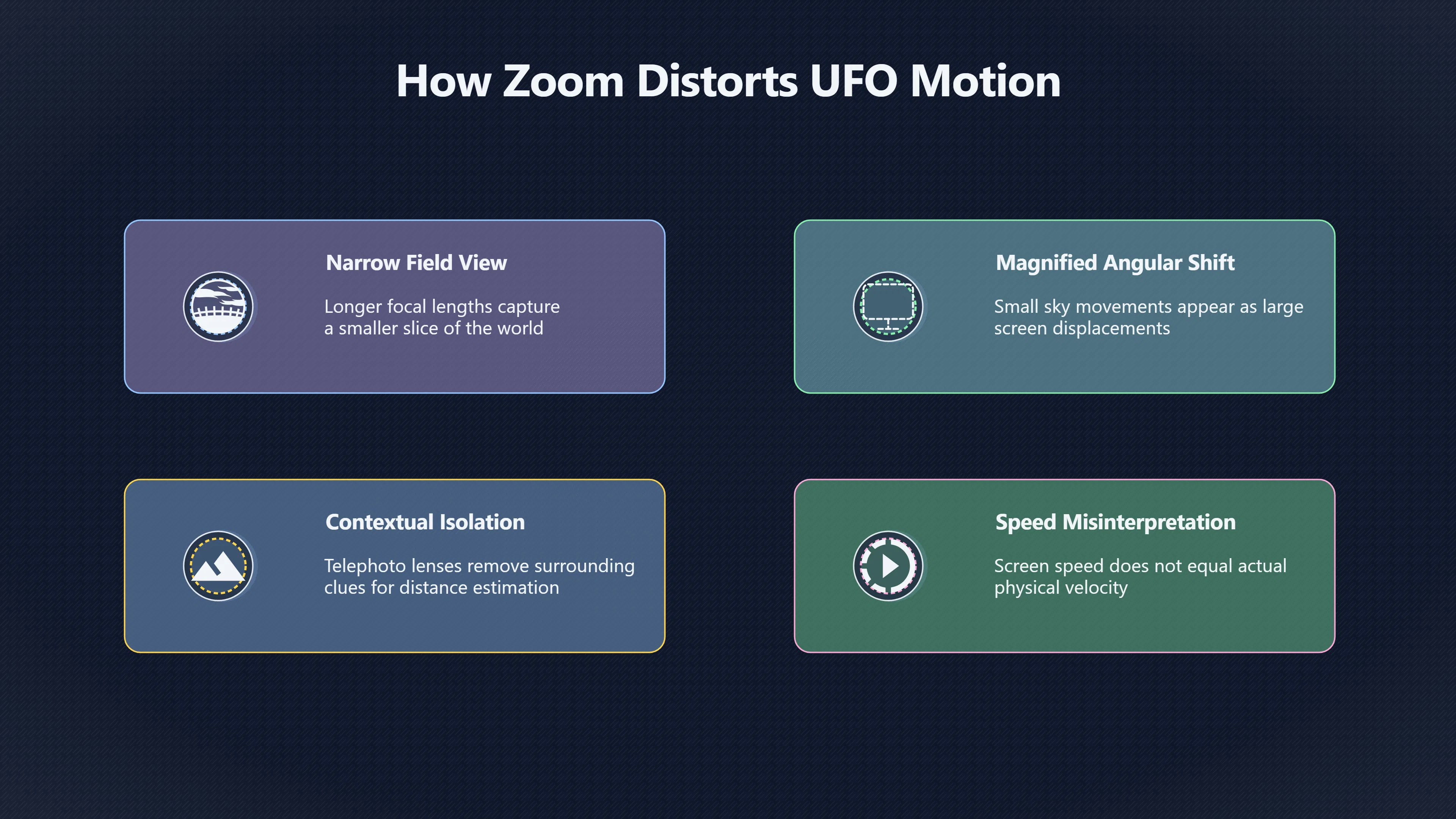
A zoomed image is not just a closer-looking version of the same scene. It is a narrower slice of the world. In optical terms, field of view is the area or angular span captured by a lens system, and for a given sensor size, longer focal length means a narrower angular field of view. Edmund Optics explains that focal length defines angular field of view: shorter focal lengths produce wider views, while longer focal lengths produce narrower ones. [Edmund Optics]edmundoptics.co.ukEdmund Optics Understanding Focal Length and Field of ViewEdmund OpticsUnderstanding Focal Length and Field of View - Edmund OpticsLearn how to understand focal length and field of view for imagi…
That narrow view changes how motion feels. If an object shifts by a small angle in the sky, it may barely move in a wide shot. In a narrow telephoto shot, the same angular shift can carry it across a large part of the frame. The object has not necessarily accelerated; the screen representation has been magnified. This is why zoomed UFO clips can feel urgent and fast even when the underlying motion may be ordinary.
Telephoto lenses also isolate subjects from context. Tamron’s general lens guidance describes telephoto lenses as having a narrow angle of view, enlarging distant subjects, and capturing less background information than standard lenses. That is useful for wildlife or sports photography, but risky in UFO interpretation because the viewer loses the surrounding clues needed to estimate distance, altitude, and scale. [Tamron]tamron.euTamronWhat is a Telephoto Lens?February 24, 2025 — 24 Feb 2025 — Characteristically, a telephoto lens has a narrow angle of view and enla…
The practical mistake is treating screen speed as physical speed. A dot crossing pixels quickly is not the same as an object travelling fast through the air. To turn image movement into real-world speed, an analyst needs range, field of view, camera orientation, platform motion, frame rate, and ideally independent measurements. Without those, a zoomed clip can only show apparent angular motion.
Why Digital Zoom and Cropping Are Especially Misleading
Optical zoom changes the lens’s field of view before the image is recorded. Digital zoom and cropping are different: they enlarge part of an already captured image. FLIR’s thermography guidance makes the same basic point in a measurement context: digital zoom does not improve accuracy; it simply enlarges the displayed image. [Flir]flir.comUnderstanding Distance:Size RatioFlirUnderstanding Distance:Size RatioMay 8, 2020 — 8 May 2020 — Digital zoom doesn't improve accuracy, so higher resolution or narrow fie…
That distinction matters in UFO footage. A cropped clip may look as though it was filmed through a powerful sensor close to the object, when in reality the viewer may be seeing a small patch of a much wider image. Social media reposts often compound the problem by trimming the frame, compressing the file, removing metadata, and replaying only the most dramatic few seconds. The result is a clip optimised for surprise rather than measurement.
Cropping also removes stabilising references. A horizon, wing edge, cockpit overlay, cloud layer, sea texture, or distant terrain line may reveal that the camera is panning, tilting, banking, or mounted on a moving aircraft. Once those references disappear, the remaining object can look like the only moving thing in the scene. That makes an ordinary camera manoeuvre easier to misread as object manoeuvre.
This is one reason original files matter. A clean analysis normally starts with the least edited version available, not the most zoomed extract. Wide-field footage can show whether the apparent motion persists when the surrounding scene is restored.
Why Stabilisation Can Conceal the Moving Platform
Image stabilisation is designed to make footage easier to watch, not necessarily easier to interpret as evidence. Electronic video stabilisation commonly works by estimating camera motion and then shifting or warping a cropped region of the image to smooth that motion. A technical overview of digital video stabilisation describes the process as camera motion estimation followed by camera motion correction, including feature tracking, motion modelling, smoothing, and frame warping. [ceva-ip.com]ceva-ip.comvideo stabilization using computer vision tips and insights from cevas expertsvideo stabilization using computer vision tips and insights from cevas experts
For everyday video, that is a benefit. For UFO analysis, it can be a trap. Stabilisation can remove the visible wobble or drift that would otherwise warn the viewer that the camera is moving. The target may appear to glide, jump, or accelerate against a calm frame, while the hidden stabilisation algorithm is quietly compensating for hand movement, aircraft vibration, vehicle motion, or gimbal movement.
Electronic stabilisation can also reduce the field of view because it needs spare pixels around the edge of the frame to shift the visible crop. That means stabilised footage may be both smoother and more tightly framed than the original. The viewer sees a neater clip, but also a less complete one. [Wikipedia]WikipediaImage stabilizationImage stabilization
There is a second risk: stabilisation can create false confidence. A smooth video feels more deliberate and instrument-like than a shaky one. But smoothness does not prove that the object moved smoothly, nor that the camera was stationary. It may simply show that software or a gimbal successfully hid the observer’s motion.
Tracking Systems Can Make the Object Look More Active Than It Is
Military, drone, telescope, and smartphone tracking systems can keep a target near the centre of the frame while the camera platform moves. This is helpful for recording, but it complicates interpretation. When a camera tracks a target, the target may stay visually steady while the background scrolls, rotates, or shifts. Viewers may then assign the background motion to the object instead of to the camera.
The U.S. Navy ATFLIR-style display is a useful example because its field-of-view states can be very narrow. A commonly cited ATFLIR reference describes wide, medium, and narrow fields of view of roughly 6°×6°, 3°×3°, and 1.5°×1.5°, with further narrowing possible in some modes. In such a narrow view, small changes in line of sight can look large. [forums.vrsimulations.com]forums.vrsimulations.comA/A Forward Looking Infrared (FLIRA/A Forward Looking Infrared (FLIR
This is one reason the GOFAST video became such an important case study. The object seemed to race across the ocean, but AARO later assessed that it did not demonstrate anomalous performance characteristics, and that full-motion video analysis and speed-distance calculations were central to its assessment. AARO’s public imagery page also states more broadly that it uses techniques such as full-motion video analysis, pixel examination, geolocation, speed, and distance calculation when evaluating cases. [AARO]aaro.milAAROUAP ImageryThe video footage associated with this report is insufficient for AARO to render a determination on its subject report con…
The lesson is not that every tracked UFO video is mistaken. It is that a tracked target in a narrow field of view is not self-explanatory. The viewer needs to know what the camera was doing, not only what the object seemed to do.
The Most Common Zoom-and-Stabilisation Mistakes
The most useful way to read a zoomed UFO clip is to separate what is visible from what is inferred. The video may show a bright point, a dark shape, a hot spot, or an object crossing the frame. It may not show distance, size, altitude, or true speed.
Common errors include:
- Assuming closeness from size. A zoomed or cropped object may look close because it occupies more pixels, not because it is physically near.
- Mistaking pixel motion for velocity. Fast movement across a screen is angular motion; physical speed needs range.
- Ignoring platform motion. A camera on a jet, helicopter, drone, boat, or moving car can create much of the apparent motion.
- Trusting stabilised footage too much. Stabilisation can hide the camera movement that would explain the effect.
- Forgetting compression and reposting. Online copies may lack the original resolution, frame rate, metadata, and surrounding context.
- Reading a short clip as a complete event. A few seconds may exclude the approach, zoom change, lock-on, loss of track, or later identification.
These mistakes often reinforce each other. A short, cropped, stabilised, highly zoomed clip is exactly the kind of footage that feels persuasive to a casual viewer and weak to a technical analyst.
Metadata That Helps Test the Illusion
The strongest antidote to zoom errors is not sceptical instinct; it is usable data. NASA’s 2023 independent UAP study said analysis is hampered by poor sensor calibration, lack of multiple measurements, lack of sensor metadata, and lack of baseline data. NASA’s release summarised the same need as systematic calibration, multiple measurements, and thorough sensor metadata. [NASA Science]science.nasa.govScience Independent Study Team ReportNASA ScienceIndependent Study Team ReportSeptember 13, 2023 — At present, analysis of UAP data is hampered by poor sensor calibration, th…
For zoom and stabilisation questions, the most useful metadata includes:
- camera model, lens, sensor size, and focal length;
- optical zoom level and any digital zoom or crop applied; [Field of View]meetoptics.comSource details in endnotes. ew at the time of recording;
- frame rate, shutter speed, resolution, and compression history;
- stabilisation mode, gimbal mode, tracking mode, and whether post-processing was applied;
- camera platform speed, heading, altitude, position, and attitude;
- timestamps accurate enough to compare with aircraft, satellite, weather, or radar data;
- original uncropped file, not only a social media extract.
This does not mean a video is worthless without every detail. It means confidence should scale with the available context. A sharp-looking clip with missing field of view, range, and stabilisation history can still be visually interesting while remaining weak evidence for extraordinary motion.

What a Better UFO Video Would Preserve
A stronger recording is often less dramatic at first glance. It keeps the wide shot. It preserves the original file. It avoids unnecessary digital zoom. It includes the horizon or fixed landmarks where possible. It records long enough to show the object’s path before and after the surprising moment. It keeps audio, timestamps, and device metadata intact.
For aircraft or sensor footage, the same principle applies at a more technical level. Analysts need the display symbology, platform motion, sensor mode, range assumptions, and field of view. If the public sees only a cropped export, the most important information may be outside the visible frame.
AARO’s public case summaries show why this matters. Some footage can be assessed with high confidence when the object’s behaviour, morphology, and context are ordinary; other footage remains unresolved because the available video is insufficient for a determination. The unresolved label should not automatically be read as exotic. It may simply mean the clip lacks the metadata needed to separate object motion from camera, zoom, tracking, and stabilisation effects. [AARO]aaro.milOpen source on aaro.mil.
The Takeaway for UFO Footage
Zoom and stabilisation do not fake UFO videos by themselves. They change the conditions under which viewers judge motion. A camera can make a distant object look close, make a slow angular drift look fast, make the observer’s movement disappear, and remove the background clues that would help correct the mistake.
That is why zoomed UFO clips need a different standard of caution from ordinary visual impressions. The more a video relies on heavy magnification, tight cropping, target tracking, or stabilised output, the less safe it is to infer speed from appearance alone. In the IFO context, the question is not simply “What does the object look like it is doing?” but “How much of that motion belongs to the camera system?”
Amazon book picks
Further Reading
Books and field guides related to Why Zoom Makes UFOs Look Faster. Use these as the next step if you want deeper reading beyond the article.
Understanding Exposure
Rating: 4.5/5 from 19 Google Books ratings
Explains focal length, exposure and camera behaviour behind misleading footage.
eBay marketplace picks
Marketplace Samples
Example marketplace items related to this page. Use the search link to explore similar finds on eBay.



Endnotes
-
Source: science.nasa.gov
Title: Science Independent Study Team Report
Link: https://science.nasa.gov/wp-content/uploads/2023/09/uap-independent-study-team-final-report.pdfSource snippet
NASA ScienceIndependent Study Team ReportSeptember 13, 2023 — At present, analysis of UAP data is hampered by poor sensor calibration, th...
Published: September 13, 2023
-
Source: aaro.mil
Link: https://www.aaro.mil/UAP-Cases/Official-UAP-Imagery/Source snippet
AAROUAP ImageryThe video footage associated with this report is insufficient for AARO to render a determination on its subject report con...
-
Source: tamron.eu
Link: https://www.tamron.eu/nl-BE/newsroom/blog/what-is-a-telephoto-lensSource snippet
TamronWhat is a Telephoto Lens?February 24, 2025 — 24 Feb 2025 — Characteristically, a telephoto lens has a narrow angle of view and enla...
Published: February 24, 2025
-
Source: flir.com
Title: Understanding Distance:Size Ratio
Link: https://www.flir.com/discover/professional-tools/understanding-distancesize-ratio/Source snippet
FlirUnderstanding Distance:Size RatioMay 8, 2020 — 8 May 2020 — Digital zoom doesn't improve accuracy, so higher resolution or narrow fie...
Published: May 8, 2020
-
Source: ceva-ip.com
Title: video stabilization using computer vision tips and insights from cevas experts
Link: https://www.ceva-ip.com/blog/video-stabilization-using-computer-vision-tips-and-insights-from-cevas-experts/ -
Source: Wikipedia
Title: Image stabilization
Link: https://en.wikipedia.org/wiki/Image_stabilization -
Source: forums.vrsimulations.com
Title: A/A Forward Looking [Infrared]({{ ‘infrared/’ | relative_url }}) (FLIR)
Link: https://forums.vrsimulations.com/support/index.php/A/A_Forward_Looking_Infrared_%28FLIR%29 -
Source: aaro.mil
Link: https://www.aaro.mil/Portals/136/PDFs/AARO_Mission_Brief_2025.pdf -
Source: nasa.gov
Title: update nasa shares uap independent study report names director
Link: https://www.nasa.gov/news-release/update-nasa-shares-uap-independent-study-report-names-director/ -
Source: Wikipedia
Title: Pentagon UFO videos
Link: https://en.wikipedia.org/wiki/Pentagon_UFO_videos -
Source: assets.science.nasa.gov
Title: Astrophotography Guide
Link: https://assets.science.nasa.gov/content/dam/science/psd/solar/2023/09/a/Astrophotography_Guide.pdf?emrc=69b3304cc3fd1 -
Source: forums.vrsimulations.com
Title: G Advanced Targeting FLIR (ATFLIR)
Link: https://forums.vrsimulations.com/support/index.php/A/G_Advanced_Targeting_FLIR_%28ATFLIR%29 -
Source: edmundoptics.co.uk
Title: Edmund Optics Understanding Focal Length and Field of View
Link: https://www.edmundoptics.co.uk/knowledge-center/application-notes/imaging/understanding-focal-length-and-field-of-view/Source snippet
Edmund OpticsUnderstanding Focal Length and Field of View - Edmund OpticsLearn how to understand focal length and field of view for imagi...
-
Source: meetoptics.com
Link: https://www.meetoptics.com/academy/field-of-view?srsltid=AfmBOopwc3Nl813jj4nfCZe7YTHurECZbWJzqWCrLEwlDTEVv2DOhfTe -
Source: tamron-americas.com
Link: https://tamron-americas.com/blog/what-is-optical-image-stabilization-what-does-image-stabilization-do/?srsltid=AfmBOorfHoGK7iinE07YzpKAqNYkM9TBlLPBB7VWQtFcH0PEISv0LkMI -
Source: rp-photonics.com
Link: https://www.rp-photonics.com/field_of_view.html
Additional References
-
Source: youtube.com
Title: Understanding Telephoto Compression and Angular Motion
Link: https://www.youtube.com/watch?v=33a4h_N_H8ASource snippet
Analyzing UAP Imagery: The Impact of Camera Settings...
-
Source: researchgate.net
Link: https://www.researchgate.net/publication/257922762_Automated_UAV-based_Video_Exploitation_for_Mapping_and_Surveillance -
Source: facebook.com
Link: https://www.facebook.com/deepuniversee/posts/videos-and-images-shared-online-in-this-style-usually-fall-into-the-broader-cate/970619415735947/ -
Source: scirp.org
Link: https://www.scirp.org/journal/paperinformation?paperid=146509 -
Source: canon-europe.com
Link: https://www.canon-europe.com/pro/infobank/image-stabilisation-lenses/ -
Source: reddit.com
Link: https://www.reddit.com/r/ufo/comments/1iooz44/pentagon_releases_aaro_report_on_go_fast_video/ -
Source: glintphotography.com
Link: https://glintphotography.com/learn/photography-glossary/ -
Source: skepticalinquirer.org
Link: https://skepticalinquirer.org/2024/12/quick-guide-to-modern-video-analysis-techniques-for-uap-and-ufos/ -
Source: facebook.com
Link: https://www.facebook.com/BrightBytess/posts/scientists-are-analyzing-footage-of-a-ufo-reportedly-observed-flying-at-close-ra/941293048815611/ -
Source: lenovo.com
Link: https://www.lenovo.com/us/en/glossary/telephoto/?srsltid=AfmBOopbbEwjLTCGVyQM1RjHv9tX722sDy-PcJAnsQK5rFt_e2Ip0hwt
Topic Tree