Within IFOs
Is That UFO Really Venus?
Venus, Jupiter and Mars can appear to pulse, change colour or hover when viewed low through haze or moving cloud.
On this page
- Why Venus looks bright
- Atmosphere and false motion
- Planet checking tools
Page outline Jump by section
Introduction
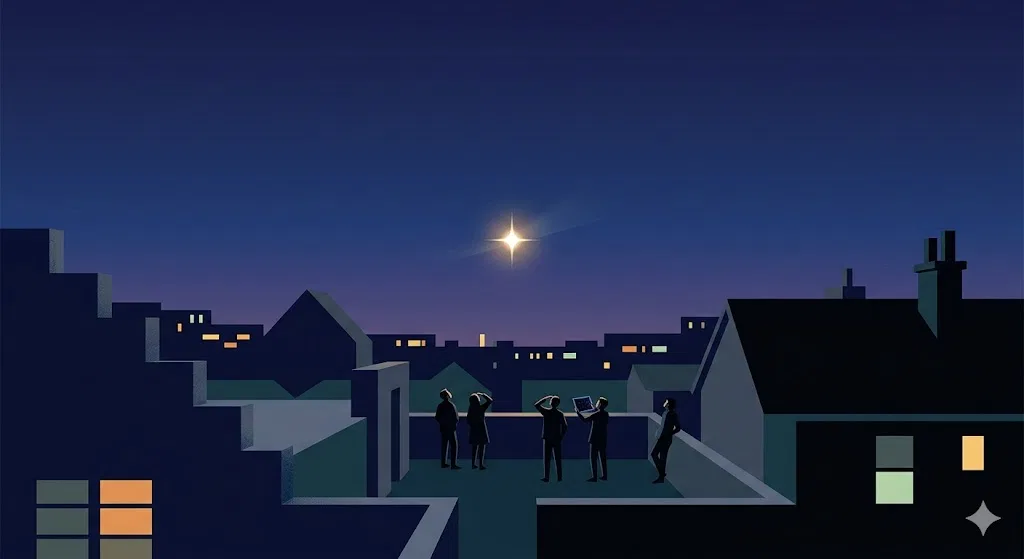
Venus is one of the most reliable sources of sincere UFO reports because it can look startlingly bright, fixed in place and oddly close when it is seen low over a clear horizon. Jupiter, Mars and Mercury can cause similar confusion, especially when several bright planets line up in twilight and appear as a formation of lights. The important point is not that witnesses are “just seeing a planet” in a dismissive sense. It is that a real, bright astronomical object can be transformed by atmosphere, haze, moving cloud, poor distance cues and expectation into a report of a hovering or colour-changing object.
NASA’s Night Sky Network puts the issue plainly: Venus shining bright and low has been reported many times as a UFO, and Venus, Jupiter, Sirius and Mercury are among the sky objects most often confused for unexplained lights. The same source recommends checking the date, time, direction, brightness, duration and path of a sighting against planetarium software before treating the object as unknown. [Night Sky Network]nightsky.jpl.nasa.govNews & Resources | Night Sky Network…
Why Venus looks unnaturally bright
Venus is not just “a bright star”. It is often the brightest natural point-like object in the sky, outshone only by the Sun and Moon. NASA describes Venus as Earth’s closest planetary neighbour and the third brightest object in the sky after the Sun and Moon. Its brilliance comes from several factors working together: it is relatively near Earth, it is close enough to the Sun to receive strong sunlight, and it is wrapped in dense, reflective clouds. [NASA Science]science.nasa.govScience Venus: FactsScience Venus: Facts
That brightness matters for UFO reports because the eye has few scale cues in the sky. A bright object on a dark or twilight background can feel nearer than it is. If the observer is driving, walking, or looking between buildings or trees, the planet may seem to “follow” them or hold position against the landscape. In reality, Venus is effectively fixed at celestial distance while the foreground moves.
Venus is also restricted by geometry. Because its orbit lies inside Earth’s orbit, it never appears far from the Sun in our sky. That is why it is usually seen as the “evening star” after sunset or the “morning star” before sunrise rather than high overhead at midnight. NASA notes that Venus appears in morning and evening guises from Earth because it stays on one side or the other of the Sun from our viewpoint. [NASA Science]science.nasa.govScience Venus: FactsScience Venus: Facts This low twilight setting is exactly where UFO reports are most likely to become confusing: the object is bright, isolated, near the horizon, and visible when aircraft, clouds, streetlights and fading daylight all compete for interpretation.
Jupiter can play the same role, although usually less dramatically. NASA’s Jet Propulsion Laboratory described Jupiter as a bright planet standing low in the western sky after sunset in February 2022, while Venus was visible low in the south-east before sunrise and was the brightest planet because of its reflective cloud cover. [NASA Jet Propulsion Laboratory (JPL]jpl.nasa.govJet Propulsion Laboratory (JPL)What's UpJet Propulsion Laboratory (JPL)What's Up A low Jupiter may be reported as a stationary light, an aircraft that never arrives, or a distant object hovering over a road, hill or coastline.
Why low planets pulse, shimmer and change colour
A planet near the horizon is viewed through a much longer path of atmosphere than the same planet higher in the sky. That extra air is not uniform. It contains layers of different temperature and density, plus haze, moisture, dust and turbulence. As light passes through these layers, it is refracted, scattered and sometimes briefly split or dimmed. The result can be a light that seems to pulse, wobble, flare or change colour.
The general effect is known as scintillation. Britannica explains that twinkling is caused by turbulence in Earth’s atmosphere bending incoming light, and that objects near the horizon pass through more air than objects overhead. It also notes that planets normally twinkle less than stars because they present a tiny disk rather than a perfect point, but even a planet close to the horizon can show a small twinkle. [Encyclopedia Britannica]britannica.comSource details in endnotes. For UFO interpretation, “small” is enough: a brilliant low Venus seen through unsteady air can look far more active than a steady astronomical chart would suggest.
This is why colour-change reports are not automatically exotic. Near the horizon, atmospheric refraction and scattering can reduce blue light, redden the object, and make turbulent colour flashes more noticeable. Thin cloud can add another layer of apparent behaviour: the planet may brighten and fade as cloud filaments pass across it, giving the impression of a pulsing light source. If the cloud itself is moving, the fixed planet can appear to drift in the opposite direction, even though the motion belongs to the foreground.
The mechanism is ordinary, but the experience can be vivid. A witness may truthfully report a bright object that changed from white to orange, seemed to flicker red or green, and hovered for several minutes. Those details are compatible with a low bright planet viewed through an unstable horizon atmosphere. They are not, by themselves, evidence of a craft changing propulsion, altitude or direction.
Why a stationary planet can seem to move
Many “hovering UFO” reports contain a paradox: the object seems fixed for a long time, yet also appears to creep, bob, follow the observer or manoeuvre. Bright planets near the horizon are especially good at producing this impression because they sit in a part of the sky where the eye keeps searching for terrestrial explanations.
Several mechanisms can stack together:
- Foreground motion: a planet seen from a moving car may seem to track the vehicle because it stays in roughly the same direction while trees, roofs and road signs slide past.
- Cloud motion: thin cloud crossing a planet can make the light appear to move, pulse or pass behind a veil.
- Autokinesis: a small bright light in a dark, low-detail field can appear to drift when the eye has no stable reference points.
- Expectation: once a light is interpreted as an aircraft or unknown object, the brain may keep looking for aircraft-like motion, size and distance even when the stimulus is astronomical.
- Earth’s rotation: over many minutes, a planet does move slowly across the sky, but not in the quick, purposeful way associated with aircraft or drones.
The most useful clue is duration. Aircraft lights change position noticeably against stars, buildings or the horizon. Satellites usually cross a large arc of sky within minutes. Meteors are over in seconds. A planet can remain in the same general place for much longer, then gradually set. NASA’s Night Sky Network recommends recording how long the object was seen, whether it drifted, which direction it moved, and how its brightness compared with stars, because those simple details often separate planets from aircraft, satellites or other IFO causes. [Night Sky Network]nightsky.jpl.nasa.govNews & Resources | Night Sky Network…
When planets look like a formation
One bright planet can be confusing; several bright planets near the horizon can be more dramatic. Venus and Jupiter close together in twilight can look like a pair of structured lights. Add Mercury lower down, Mars nearby, or the Moon along the same line, and the scene may be described as a formation, a triangle, or a set of hovering lights over a town.
This happens because planets follow the ecliptic, the apparent path of the Sun, Moon and planets across the sky. To a skywatcher, that line is expected. To someone not thinking astronomically, a row of bright objects low in the west after sunset can look artificial. NASA’s Night Sky Network specifically warns that bright planets aligned near the horizon can appear to be a formation of “strange lights”. [Night Sky Network]nightsky.jpl.nasa.govNews & Resources | Night Sky Network…
A current example shows how ordinary this setup can be. The Center for Astrophysics at Harvard and Smithsonian notes that in June 2026 Venus is the brightest and easiest planet to spot, with Jupiter nearby and Mercury lower toward the western horizon, requiring a clear view in twilight. [Center for Astrophysics]cfa.harvard.eduSource details in endnotes. That is exactly the kind of sky geometry that can produce multiple independent UFO calls: the objects are bright, low, grouped, and visible during the transitional period when the sky is not fully dark.
Mars adds a different kind of confusion. It is usually less bright than Venus or Jupiter, but when prominent it can appear distinctly reddish or orange. Low through haze, that colour can be exaggerated, making Mars sound in witness language like a “red orb”, “fireball” or “glowing craft”. Unlike a meteor or aircraft, however, Mars will not streak, flare out, or cross the sky quickly.

How investigators check the planet explanation
A planet explanation is strongest when the sighting data match the sky. It is weak when the timing, direction, elevation or behaviour do not match. Serious IFO work therefore does not identify every bright light as Venus by habit; it tests the candidate.
The practical check begins with four questions: where was the observer, what was the exact date and time, which direction were they facing, and how high above the horizon was the object? With those details, a sky chart can show whether Venus, Jupiter, Mars or Mercury was actually in that part of the sky. NASA’s Night Sky Network specifically recommends tools such as Stellarium to plot the sky for the date and time of the report. [Night Sky Network]nightsky.jpl.nasa.govNews & Resources | Night Sky Network… Stellarium describes its software as a realistic 3D sky map showing what is visible to the naked eye, binoculars or a telescope, while Timeanddate’s night-sky pages provide planet visibility, rise and set times, directions and azimuth angles for a chosen location. [Stellarium]stellarium.orgSource details in endnotes.
A good planet check also compares behaviour:
- Position: Was a bright planet in the same direction and elevation?
- Timing: Did the object appear shortly after sunset or before sunrise, when Venus and Mercury are most likely to be noticed?
- Duration: Did it remain visible for many minutes without crossing the sky like a satellite or aircraft?
- Brightness: Was it brighter than nearby stars and visible in twilight?
- Setting: Did it gradually sink toward the horizon at the rate expected from Earth’s rotation?
- Repeatability: Could the same object be seen again from the same location the next evening or morning?
This repeatability is powerful. A genuine aircraft, drone, fireball or balloon event may not recur in the same place at the same time on following days. Venus or Jupiter often will, with slight changes from night to night. A witness who sees the “UFO” again, checks a sky app, and finds it labelled Venus has not disproved their experience; they have converted a puzzling observation into an identified one.
What Venus explains, and what it does not
Venus and bright planets explain a specific class of UFO report: bright, usually silent lights seen low in the sky, especially in twilight or through haze, that appear to hover, pulse, change colour or form a line with other bright objects. They are especially plausible when the report lacks strong evidence of nearby structure, rapid angular motion, sound, radar correlation, or interaction with the environment.
They do not explain every strange light. A planet cannot pass in front of nearby trees, illuminate the ground at close range, cast a moving shadow, make engine noise, split into fragments, or cross the entire sky in seconds. It also cannot match a report if it was below the local horizon, in the wrong direction, or not visible at the stated time. Those mismatches matter, and they are why planet explanations should be checked rather than assumed.
Still, the planet category deserves a prominent place in IFO analysis because it exposes a common trap: the sky removes ordinary cues for distance, size and speed. A brilliant Venus low over a horizon can be real, bright, persistent and visually strange without being a vehicle at all. The witness saw something; the error lies in assigning it a distance, altitude and behaviour that the observation itself could not support.
Planet-checking tools
For a quick first pass, a sky map is usually enough. Enter the observing location, date and time, then look toward the reported direction. If Venus, Jupiter, Mars or Mercury appears in the same place, the planet hypothesis is strong enough to test further.
The most useful tools are the ones that let the observer change time and location, not just read a general “tonight’s sky” article. Stellarium is a free planetarium program that shows a realistic sky in 3D, while Stellarium Web provides a browser-based star map. In-The-Sky.org offers an online planetarium and rising-and-setting information, and Timeanddate’s night-sky pages give planet visibility and direction data for a selected place. [Time and Date]timeanddate.comSource details in endnotes. [Stellarium]stellarium.orgSource details in endnotes. [Stellarium Web]stellarium-web.orgSource details in endnotes.
A simple field method can also help before any app is opened. Hold a fist at arm’s length: it spans roughly ten degrees of sky. Note whether the object is one fist, two fists or more above the horizon; whether it is in the west, south-west, east or south-east; and whether it stays fixed against nearby stars over several minutes. Those rough notes are often enough to make a later planetarium check meaningful.
The practical takeaway for UFO reports
Venus and bright planets near the horizon are not a catch-all explanation, but they are one of the first explanations worth testing for a bright hovering light. They combine three ingredients that make UFO reports persuasive: high brightness, poor distance cues and atmospheric distortion. Low haze can make the light throb or redden; moving cloud can create false motion; a dark sky can make a fixed point seem to wander; and a line of planets can look like an organised formation.
That is why the best response to a suspected Venus UFO is neither ridicule nor automatic acceptance. Record the time, place, direction, elevation, duration and visible motion. Check a planetarium tool. Look again the next night. If the same bright “object” is in the predicted place and moves with the sky, it has probably crossed the boundary from UFO to IFO: not imaginary, not foolish, but identified.
eBay marketplace picks
Marketplace Samples
Example marketplace items related to this page. Use the search link to explore similar finds on eBay.
Endnotes
-
Source: nightsky.jpl.nasa.gov
Title: Night Sky Network
Link: https://nightsky.jpl.nasa.gov/news/39/Source snippet
News & Resources | Night Sky Network...
-
Source: science.nasa.gov
Title: Science Venus: Facts
Link: https://science.nasa.gov/venus/venus-facts/ -
Source: jpl.nasa.gov
Title: Jet Propulsion Laboratory (JPL)What’s Up
Link: https://www.jpl.nasa.gov/videos/whats-up-february-2022/ -
Source: britannica.com
Link: https://www.britannica.com/science/Why-Do-Stars-Twinkle -
Source: cfa.harvard.edu
Link: https://www.cfa.harvard.edu/current-night-sky -
Source: stellarium.org
Link: https://stellarium.org/ -
Source: timeanddate.com
Link: https://www.timeanddate.com/astronomy/night/help -
Source: stellarium-web.org
Link: https://stellarium-web.org/ -
Source: in-the-sky.org
Link: https://in-the-sky.org/skymap.php -
Source: timeanddate.com
Link: https://www.timeanddate.com/astronomy/night/ -
Source: timeanddate.com
Title: Night Sky Tonight: Visible Planets in Berlin
Link: https://www.timeanddate.com/astronomy/night/germany/berlin -
Source: timeanddate.com
Link: https://www.timeanddate.com/astronomy/night/germany/itzehoe -
Source: nightsky.jpl.nasa.gov
Link: https://nightsky.jpl.nasa.gov/planner/ -
Source: jpl.nasa.gov
Title: find planets in the sky
Link: https://www.jpl.nasa.gov/edu/resources/project/find-planets-in-the-sky/ -
Source: in-the-sky.org
Link: https://in-the-sky.org/ -
Source: in-the-sky.org
Link: https://in-the-sky.org/skymap2.php -
Source: in-the-sky.org
Link: https://in-the-sky.org/location.php -
Source: in-the-sky.org
Link: https://in-the-sky.org/whatsup_times.php -
Source: britannica.com
Title: [Project Blue Book]({{ ‘blue-book/’ | relative_url }})
Link: https://www.britannica.com/topic/Project-Blue-Book -
Source: britannica.com
Link: https://www.britannica.com/story/unidentified-flying-objects-what-we-know -
Source: adsabs.harvard.edu
Link: https://adsabs.harvard.edu/full/1975JRASC..69..175M -
Source: Wikipedia
Link: https://en.wikipedia.org/wiki/Twinkling -
Source: play.google.com
Link: https://play.google.com/store/apps/details?hl=en&id=com.noctuasoftware.stellarium_free -
Source: home.ifa.hawaii.edu
Link: https://home.ifa.hawaii.edu/users/meech/a281/oldlectures/UFO.pdf -
Source: stellarium-labs.com
Link: https://stellarium-labs.com/stellarium-mobile-plus/
Additional References
-
Source: youtube.com
Title: Identifying Bright Planets and Stars Near the Horizon
Link: https://www.youtube.com/watch?v=uT35Yw-6k9YSource snippet
How to Use Planetarium Apps to Identify Night Sky Objects...
-
Source: youtube.com
Title: How to Use Planetarium Apps to Identify Night Sky Objects
Link: https://www.youtube.com/watch?v=q6e02D4Fv80Source snippet
Venus and Jupiter Conjunctions and UFO Reports...
-
Source: primitiveproton.com
Link: https://primitiveproton.com/atmospheric-scintillation-why-stars-twinkle-and-planets-dont/ -
Source: cufos.org
Link: https://cufos.org/resources/classic-ufo-cases/ -
Source: facebook.com
Link: https://www.facebook.com/HISTORY/posts/during-the-cold-war-as-project-blue-book-investigated-potential-ufo-threats-a-sh/1473622884330683/ -
Source: facebook.com
Link: https://www.facebook.com/wxzachary/posts/go-outside-and-look-to-the-bottom-right-of-the-moon-thats-venus-show-the-kiddos-/1163303332034974/ -
Source: facebook.com
Link: https://www.facebook.com/groups/1764709940280136/posts/9393778887373165/ -
Source: reddit.com
Link: https://www.reddit.com/r/aliens/comments/1hctekx/i_recorded_a_flickering_light_in_the_sky_using_my/ -
Source: prl.res.in
Link: https://www.prl.res.in/~rajiv/planexnews/oldarticles/Volume%20-1%2C%20Issue-4.11-15.pdf -
Source: theskylive.com
Link: https://theskylive.com/planets-visible-tonight
Topic Tree