Within Radar
Why Radar UFO Evidence Often Needs Metadata
Without calibration records, weather context, sensor settings, and timing data, a radar anomaly may remain unresolved for ordinary reasons.
On this page
- What radar metadata investigators need
- How missing settings change a case assessment
- Why NASA flagged calibration and context problems
Page outline Jump by section
Introduction
Radar contacts are often presented as some of the strongest evidence in UFO cases because they appear to provide objective measurements rather than human impressions. Yet radar evidence is only as reliable as the information available about how the sensor was operating when the anomaly occurred. When calibration records, weather conditions, radar modes, processing settings, timing data, and system logs are missing, investigators frequently cannot determine whether a radar return represents an aircraft, an environmental effect, a processing artefact, or something genuinely unexplained. NASA’s 2023 independent UAP study highlighted the lack of sensor metadata as one of the major obstacles to analysing unidentified reports scientifically. Without that supporting information, even a dramatic radar track can remain unresolved for ordinary reasons rather than extraordinary ones. [NASA Science]science.nasa.govNASA ScienceIndependent Study Team ReportAt present, analysis of UAP data is hampered by poor sensor calibration, the lack of multiple me…

What Radar Metadata Investigators Need
A radar screen showing a target is only the end product of a complex sensing and processing chain. To evaluate an unusual return, investigators need far more than a screenshot or witness recollection.
Key metadata typically includes:
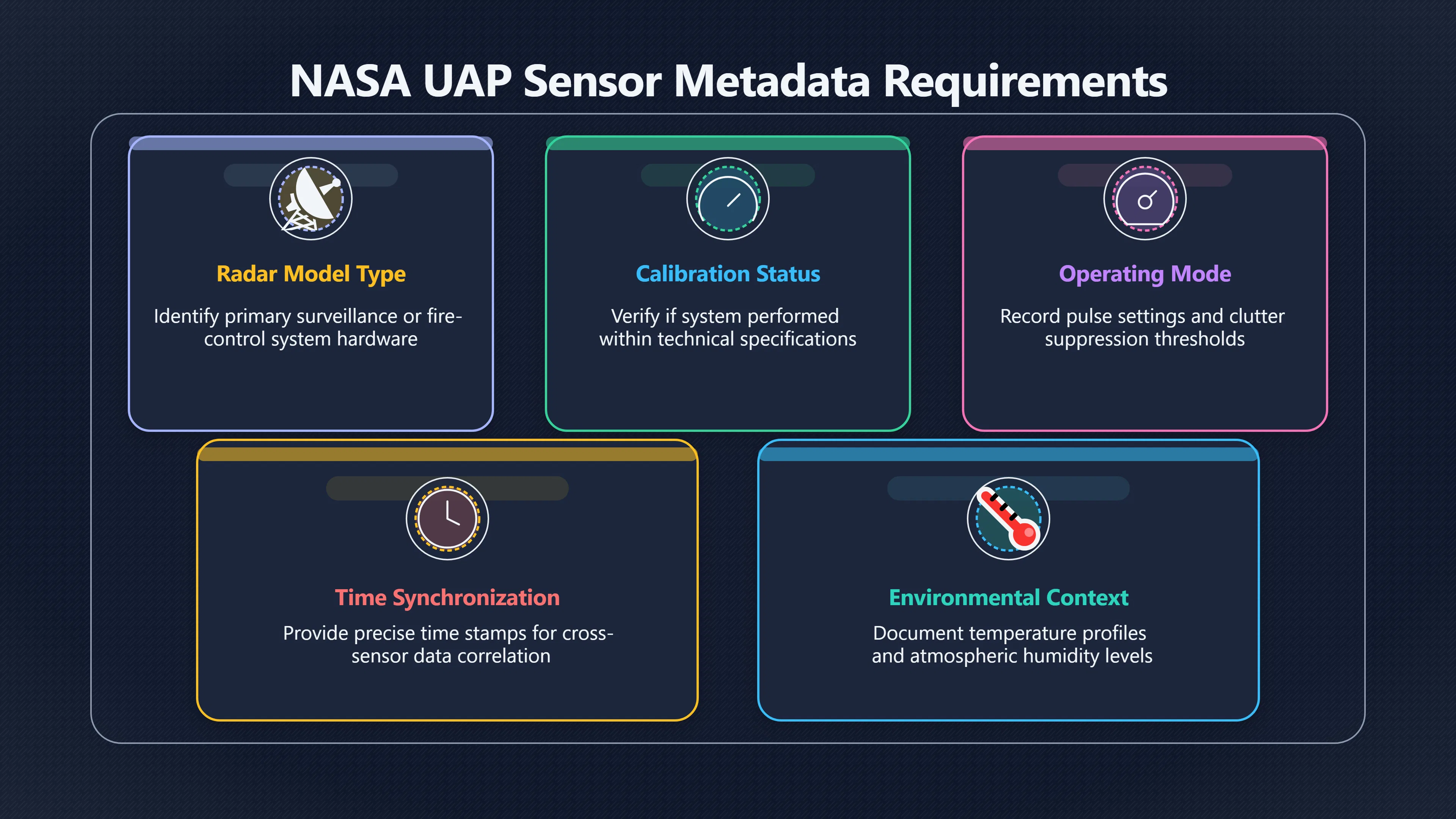
- Radar type and model: primary surveillance radar, secondary surveillance radar, military fire-control radar, weather radar, or another system.
- Calibration status: records showing whether the system was performing within specifications.
- Operating mode: pulse settings, filtering options, tracking algorithms, sensitivity thresholds, and clutter suppression settings.
- Time synchronisation data: precise timestamps that allow correlation with aircraft records, weather observations, optical imagery, and other sensors.
- Environmental conditions: temperature profiles, humidity, pressure, precipitation, and known atmospheric phenomena.
- Maintenance and fault logs: evidence of hardware issues, software updates, or intermittent malfunctions.
- Track history and raw returns: information showing whether a target was a stable object or merely a sequence of intermittent detections.
NASA specifically noted that useful metadata includes information about observing modes, time, location, and environmental context because these details allow analysts to determine whether sensor behaviour was expected under the circumstances. [Wikisource]en.wikisource.orgWikisourceNASA Unidentified Anomalous Phenomena: Independent…14 Oct 2023 — The panel notes that, at present, gathering data on UAP is…
The distinction between raw radar returns and processed tracks is particularly important. Modern radar systems frequently apply filtering and automated track-building software. A final track displayed to an operator may represent a series of algorithmic decisions rather than direct measurements alone. Without metadata documenting those processes, later investigators may not know exactly how the displayed target was generated.
How Missing Settings Change a Case Assessment
Many radar UFO cases remain unresolved not because the observed object was extraordinary, but because the available data are incomplete.
Consider a hypothetical radar contact that appears to move rapidly across a display. If investigators possess only a description of the event, several critical questions remain unanswered:
- Was the radar operating in a normal surveillance mode?
- Had clutter filters been adjusted recently?
- Was the system undergoing testing?
- Were there maintenance issues reported that day?
- Did atmospheric conditions favour unusual propagation? [Wikipedia]WikipediaAnomalous propagationAnomalous propagationAnomalous propagation refers to false radar echoes usually observed when calm, stable atmospheric conditions, oft…
- Was the apparent motion produced by software track association rather than a single physical object?
Each unanswered question weakens the evidential value of the radar observation.
This is why unresolved does not automatically mean unexplained. In many historical cases, the available record consists of operator testimony, summary reports, or partial radar logs rather than complete sensor archives. The absence of metadata prevents investigators from ruling out mundane explanations with confidence.
The problem is similar to receiving a photograph without information about the camera, lens, exposure settings, or image processing. The image may be genuine, but analysts lose much of their ability to determine what actually produced it.

Why Weather Context Matters So Much
Weather information is one of the most frequently missing forms of metadata in older radar UFO reports.
Atmospheric conditions can significantly alter radar performance. Temperature inversions, humidity gradients, and ducting conditions can bend radar beams away from their expected paths. The result can be false targets, displaced echoes, unusual ranges, or apparent tracks that do not correspond to aircraft. The FAA notes that anomalous propagation can create numerous extraneous radar blips and distort normal detection performance. [Federal Aviation Administration]faa.govFederal Aviation Administration4-5-2Air Traffic Control Radar Beacon System (ATCRBS)8 Jan 2015 — (b) The bending of radar pulses, often called anomalous propagation or ducti…
Without contemporaneous meteorological records, investigators cannot reconstruct whether:
- A temperature inversion existed.
- Ducting conditions were present.
- Ground returns were being enhanced.
- Weather clutter was affecting the display.
- Radar beams were propagating abnormally.
A radar anomaly reported decades later may therefore lack the contextual evidence needed to distinguish between an environmental artefact and a genuinely unusual event. The case remains unresolved because the relevant metadata no longer exists or was never preserved. Dipòsit Digital [Radartutorial]radartutorial.euAnomalous Propagation of Electromagnetic WavesNon-standard or anomalous propagation (known as anaprop) occurs when the refractive index i…
Why Calibration Records Are Critical
Calibration establishes whether a radar system’s measurements can be trusted.
A radar may report incorrect range, bearing, altitude, or speed information if components drift outside specifications or if calibration procedures are incomplete. Even small measurement errors can produce large differences when analysts attempt to reconstruct a target’s motion.
NASA’s UAP study repeatedly emphasised sensor calibration as a foundational requirement for credible analysis. The report argued that current UAP investigations are hindered by poor calibration practices and insufficient documentation of sensor performance. [NASA Science]science.nasa.govNASA ScienceIndependent Study Team ReportAt present, analysis of UAP data is hampered by poor sensor calibration, the lack of multiple me… [NASA]science.nasa.govNASA ScienceIndependent Study Team ReportAt present, analysis of UAP data is hampered by poor sensor calibration, the lack of multiple me…
In practical terms, a radar anomaly cannot be fully evaluated if investigators do not know:
- Whether the system passed recent calibration checks.
- What the expected measurement uncertainty was.
- Whether any components were known to be malfunctioning.
- Whether software updates altered system behaviour.
A striking radar track may appear extraordinary until calibration data reveal a known source of measurement error. Conversely, a well-calibrated system provides a stronger foundation for investigating an unresolved event.

Why NASA Flagged Calibration and Context Problems
The strongest recent institutional criticism of UFO data quality has come not from sceptics dismissing reports, but from scientists asking for better measurements.
NASA’s Independent Study Team concluded that analysis of UAP reports is hampered by poor sensor calibration, inadequate metadata, insufficient baseline data, and a lack of multiple independent measurements. The report argued that future investigations require systematic collection of sensor information rather than isolated observations detached from context. NASA Science [space]space.comsensor metadata, and the lack of baseline data," the report states.Read moreSpaceNASA UFO report finds no evidence of 'extraterrestrial…14 Sept 2023 — "At present, analysis of UAP data is hampered by poor senso… The study’s concern was not that radar systems are useless. Rather, it recognised that sensor outputs cannot be interpreted properly without accompanying records explaining how those outputs were generated.
This governance problem has practical consequences. Modern investigative efforts increasingly emphasise:
- Standardised metadata collection.
- Preservation of raw sensor data.
- Cross-sensor correlation.
- Documented calibration procedures.
- Consistent archival practices.
Recommendations for standardised metadata templates have also emerged from organisations examining UAP reporting processes, reflecting a broader recognition that evidence quality depends heavily on preserving contextual information alongside the observation itself. [AUI]aui.eduAUIAARO Releases Report on Unidentified Anomalous…Actionable recommendations include the development of standardized metadata template…
Missing Data Often Explains Why Cases Stay Unresolved
Within the broader category of radar anomalies and spurious sensor returns, metadata gaps represent a distinct problem. A radar contact may not be demonstrably false, yet it may also be impossible to validate because essential contextual information has been lost.
When calibration records, environmental data, operating settings, and timing information are unavailable, investigators cannot reliably reconstruct sensor behaviour. As a result, some radar-associated UFO reports persist as unresolved cases not because they demonstrate extraordinary technology, but because the evidence needed to test ordinary explanations no longer exists.
That limitation is one reason modern scientific and governmental reviews increasingly focus on data quality. The central lesson is straightforward: radar evidence becomes much weaker when investigators cannot determine exactly how the sensor was operating at the moment the anomaly appeared. [NASA Science]science.nasa.govNASA ScienceIndependent Study Team ReportAt present, analysis of UAP data is hampered by poor sensor calibration, the lack of multiple me… [Wikisource]en.wikisource.orgwikisource.orgPage:UAP Independent Study Team - Final Report.pdf/512 Nov 2023 — At present, analysis of UAP data is hampered by poor sens…
Amazon book picks
Further Reading
Books and field guides related to Why Radar UFO Evidence Often Needs Metadata. Use these as the next step if you want deeper reading beyond the article.
Introduction to Radar Systems
Explains the technical context needed to interpret radar metadata.
eBay marketplace picks
Marketplace Samples
Example marketplace items related to this page. Use the search link to explore similar finds on eBay.

Endnotes
-
Source: science.nasa.gov
Link: https://science.nasa.gov/wp-content/uploads/2023/09/uap-independent-study-team-final-report.pdfSource snippet
NASA ScienceIndependent Study Team ReportAt present, analysis of UAP data is hampered by poor sensor calibration, the lack of multiple me...
-
Source: nasa.gov
Title: update nasa shares uap independent study report names director
Link: https://www.nasa.gov/news-release/update-nasa-shares-uap-independent-study-report-names-director/Source snippet
UPDATE: NASA Shares UAP Independent Study Report14 Sept 2023 — We found that NASA can help the whole-of-government UAP effort through sys...
-
Source: en.wikisource.org
Link: https://en.wikisource.org/wiki/NASA_Unidentified_Anomalous_Phenomena%3A_Independent_Study_Team_Report/Responses_to_Statement_of_TaskSource snippet
WikisourceNASA Unidentified Anomalous Phenomena: Independent...14 Oct 2023 — The panel notes that, at present, gathering data on UAP is...
-
Source: faa.gov
Title: Federal Aviation Administration4-5-2
Link: https://www.faa.gov/air_traffic/publications/atpubs/aim/aim0405.htmlSource snippet
Air Traffic Control Radar Beacon System (ATCRBS)8 Jan 2015 — (b) The bending of radar pulses, often called anomalous propagation or ducti...
-
Source: faa.gov
Title: Federal Aviation Administration Section 5
Link: https://www.faa.gov/air_traffic/publications/atpubs/aim_html/chap4_section_5.htmlSource snippet
Section 5. Surveillance SystemsThe bending of radar pulses, often called anomalous propagation or ducting, may cause many extraneous blip...
-
Source: radartutorial.eu
Link: https://www.radartutorial.eu/07.waves/wa17.en.htmlSource snippet
Anomalous Propagation of Electromagnetic WavesNon-standard or anomalous propagation (known as anaprop) occurs when the refractive index i...
-
Source: space.com
Title: sensor metadata, and the lack of baseline data,” the report states.Read more
Link: https://www.space.com/nasa-ufo-uap-study-team-first-results-revealedSource snippet
SpaceNASA UFO report finds no evidence of 'extraterrestrial...14 Sept 2023 — "At present, analysis of UAP data is hampered by poor senso...
-
Source: aui.edu
Link: [https://aui.edu/aaroSource snippet
AUIAARO Releases Report on Unidentified Anomalous...Actionable recommendations include the development of standardized metadata template...
-
Source: science.nasa.gov
Link: https://science.nasa.gov/uap/Source snippet
nasa.govUAP9 Jun 2022 — We commissioned a study team to examine from a scientific perspective unidentified anomalous phenomena (UAPs) – t...
-
Source: en.wikisource.org
Link: [https://en.wikisource.org/wiki/Page%3AUAP_Independent_Study_Team_-Final_Report.pdf/5](https://en.wikisource.org/wiki/Page%3AUAP_Independent_Study_Team-_Final_Report.pdf/5)Source snippet
wikisource.orgPage:UAP Independent Study Team - Final Report.pdf/512 Nov 2023 — At present, analysis of UAP data is hampered by poor sens...
-
Source: Wikipedia
Title: Anomalous propagation
Link: https://en.wikipedia.org/wiki/Anomalous_propagationSource snippet
Anomalous propagationAnomalous propagation refers to false radar echoes usually observed when calm, stable atmospheric conditions, oft...
-
Source: noaa.gov
Title: anomalous propagation
Link: https://www.noaa.gov/jetstream/anomalous-propagationSource snippet
JetStream Max: Anomalous Propagation9 Aug 2023 — False echoes are known as anomalous propagation (AP) - an echo that is not precipitation...
-
Source: zenodo.org
Link: https://zenodo.org/records/20137882Source snippet
Unlocking the Pentagon's Declassified UFO Secrets12 May 2026 — NASA: Provided scientific validation, effectively weaponizing the scientif...
Published: May 2026
Additional References
-
Source: aaro.mil
Link: https://www.aaro.mil/FAQ/Source snippet
AARO FAQAARO will announce when a reporting mechanism is available to the public. What are the leading explanations to account for UAP re...
-
Source: reddit.com
Link: https://www.reddit.com/r/UFOB/comments/1i6y9o8/aaro_internal_report_analysis_major/ -
Source: aaro.mil
Link: https://www.aaro.mil/Portals/136/PDFs/Information_for_UAP_Analysis-20240125.pdfSource snippet
About the PhenomenonUAP performance parameters: including altitude and/or depth, travel path and trajectory, velocity, and maneuverabilit...
-
Source: managingexpectations.net
Link: https://managingexpectations.net/blog/articles/nasa-uap-study-managing-expectations.htmlSource snippet
NASA's UAP Study: What It Did — and Did Not — ConcludeThe panel said UAP analysis is hampered by “poor sensor calibration,” a lack of mul...
-
Source: cfinotebook.net
Link: https://www.cfinotebook.net/notebook/air-traffic-control/radarSource snippet
RadarThe bending of radar pulses, often called anomalous propagation or ducting, may cause many extraneous blips to appear on the radar o...
-
Source: aaro.mil
Link: https://www.aaro.mil/Submit-A-Report/Source snippet
Submit A ReportThis email is for official reports from current or former U.S. Government employees, service members, or contractor person...
-
Source: aaro.mil
Link: https://www.aaro.mil/Portals/136/PDFs/Information%20Papers/AARO_Declassification_Info_Paper_2025.pdfSource snippet
AARO and the Declassification ProcessAARO is responsible for receiving, processing, and adjudicating UAP reports, and routinely accesses...
-
Source: defensescoop.com
Link: https://defensescoop.com/2023/10/18/dods-all-domain-anomaly-resolution-office-is-now-investigating-more-than-800-uap-cases/Source snippet
DOD's All-domain Anomaly Resolution Office confirms...18 Oct 2023 — A new Pentagon report confirms that AARO has received a total of 801...
-
Source: media.defense.gov
Title: DOPSR 2024 0263 AARO HISTORICAL RECORD REPORT VOLUME 1 2024
Link: https://media.defense.gov/2024/Mar/08/2003409233/-1/-1/0/DOPSR-2024-0263-AARO-HISTORICAL-RECORD-REPORT-VOLUME-1-2024.PDFSource snippet
Historical Record Report Volume 18 Mar 2024 — Its work also helped calibrate sensors to improve the quality of data collected. Its method...
-
Source: thenationalnews.com
Title: nasas ufo report advises us government on how to detect mysterious objects
Link: https://www.thenationalnews.com/world/us-news/2023/09/14/nasas-ufo-report-advises-us-government-on-how-to-detect-mysterious-objects/Source snippet
Nasa's UFO report reveals how public can help hunt for...14 Sept 2023 — Released online on Thursday, the 36-page document says that exis...
Topic Tree