Within Strong Cases
Not All Unidentified UFO Cases Are Equal
GEIPAN's split between missing-data cases and investigated unknowns offers a clearer way to avoid treating every unexplained UFO report as equal.
On this page
- Why missing data is not the same as mystery
- How category C differs from category D
- What classification can and cannot prove
Page outline Jump by section
Introduction
One of the most useful features of the French UFO investigation programme GEIPAN is that it does not treat every unexplained report as equally mysterious. Within its classification system, a sighting can remain unidentified for two very different reasons: because there is not enough information to investigate it properly, or because investigators examined the available evidence and still could not reach a conventional explanation. This distinction is captured by GEIPAN’s Category C and Category D classifications. [Geipan]geipan.frigation. · Classification C…
 For readers trying to understand stronger UFO cases after ordinary identified flying objects (IFOs) have been screened out, the difference matters enormously. A report that lacks basic information is not in the same evidential category as a report supported by detailed testimony, corroborating data and a completed investigation. GEIPAN’s approach offers a practical governance model for separating weak unknowns from stronger unknowns without assuming that either category proves anything extraordinary. [Geipan]geipan.frigation. · Classification C…
Why Missing Data Is Not the Same as Mystery
A common problem in UFO archives is that “unidentified” can become a catch-all label. Reports may end up in the same bucket whether they involve multiple witnesses and extensive analysis or merely a brief statement that an unusual light was seen in the sky.
GEIPAN explicitly avoids this problem. Its published classification system defines:
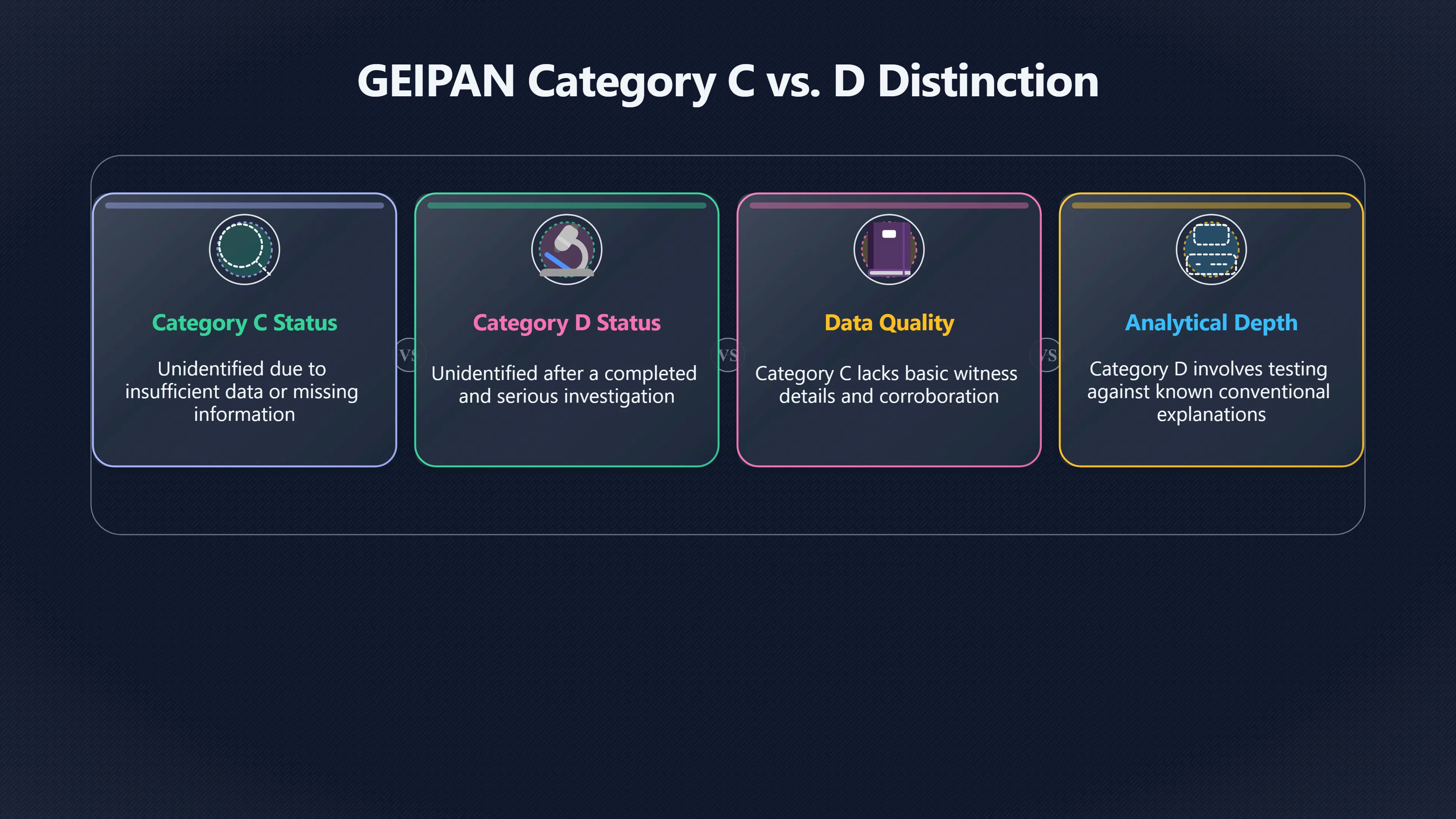
- Category C: a phenomenon not identified because of insufficient data or information.
- Category D: a phenomenon not identified after investigation. Geipan [cnes-geipan.fr]cnes-geipan.frGeipanClassificationClassification C: Phenomenon not identified due to lack of data or information. Classification D: Phenomenon not iden…
This distinction recognises a basic investigative principle: an inability to reach a conclusion is not always evidence of a genuine mystery. Sometimes the obstacle is simply missing information.
For example, a witness might report a strange object but provide no precise time, direction, duration, photographs, weather information or independent witnesses. Investigators may be unable to compare the sighting with aircraft movements, astronomical objects, satellites or atmospheric phenomena. Such a case may remain unresolved, but the unresolved status tells us little about the phenomenon itself. GEIPAN places these reports in Category C because the evidential foundation is too weak to support meaningful conclusions. [Geipan]geipan.frigation. · Classification C…
The distinction helps prevent a statistical illusion. If every unresolved report were counted as equally significant, large numbers of poorly documented sightings could create the impression of a substantial unexplained phenomenon when many cases simply lack enough information for analysis.
How Category C Differs from Category D
The practical difference between Categories C and D is not whether a case has an explanation. It is whether investigators had enough material to conduct a serious examination.
Category C: Unidentified Because the Record Is Incomplete
Category C cases are essentially evidential dead ends. Investigators cannot confidently identify the phenomenon, but neither can they properly test competing explanations.
Typical reasons include:
- Incomplete witness statements.
- Missing dates or times.
- Lack of location information. [cnes-geipan.fr]cnes-geipan.frGeipanClassificationClassification C: Phenomenon not identified due to lack of data or information. Classification D: Phenomenon not iden…
- Absence of corroborating evidence.
- Contradictory or unreliable details.
- Long delays between the event and the report. [Geipan]geipan.frigation. · Classification C…
A Category C classification therefore says more about the quality of the report than about the object or event being reported.
Category D: Unidentified After Investigation
Category D occupies a different position. These are cases for which investigators believe there is enough information to conduct an analysis, yet no satisfactory conventional explanation emerges from that process. GEIPAN defines these as phenomena that remain unidentified after investigation rather than because information is missing. [Geipan]geipan.frigation. · Classification C…
This does not mean investigators have proved that the object displayed impossible characteristics. It means that known explanations considered during the investigation did not adequately fit the available evidence.
GEIPAN’s methodology includes collection of testimony, analysis, investigation and formal classification. Category D sits at the end of that investigative pathway, not at the beginning. [Geipan]geipan.frigation. · Classification C…
Some descriptions of GEIPAN’s process further note internal distinctions such as D1 and D2 categories, intended to reflect differing levels of consistency or evidential strength among investigated unknowns. While the central public distinction remains C versus D, these refinements illustrate the same principle: unexplained cases can vary substantially in quality and reliability. [Geipan]geipan.frigation. · Classification C…
What the Numbers Reveal About Unknowns
GEIPAN’s published statistics show why the C–D distinction is important. In the current archive, Category D cases represent only a small fraction of the total classified record, while Category C cases account for a much larger share. According to GEIPAN’s statistics page, roughly 3% of published cases are classified as unidentified after investigation (Category D), whereas around 30% are unidentified because of insufficient data (Category C). [Geipan]geipan.frigation. · Classification C…
This means that the majority of unresolved reports in the archive are not strong mysteries that resisted extensive investigation. They are cases where investigators lacked the information needed to determine what happened.
For anyone assessing UFO evidence, this is a critical point. Simply citing the percentage of “unidentified” reports can be misleading if Category C and Category D are merged together. GEIPAN’s system keeps them separate and thereby provides a more informative picture of the evidential landscape. [Geipan]geipan.frigation. · Classification C…
What Classification Can and Cannot Prove
The strength of GEIPAN’s framework lies in what it prevents investigators from claiming.
A Category D case is not proof of extraterrestrial craft, advanced technology or unknown physics. GEIPAN itself emphasises that these cases are unidentified after investigation, not unexplainable in principle. New information can lead to re-analysis and reclassification. Both Category C and Category D cases may be revisited if additional evidence becomes available. [Geipan]geipan.frigation. · Classification C…
Likewise, a Category C case should not be interpreted as evidence against the reality of the witness’s experience. A person may have observed something unusual, but the available record is insufficient for a reliable conclusion.
The classification system therefore supports a more disciplined interpretation of UFO data:
- Category C means uncertainty caused by inadequate information.
- Category D means uncertainty that remains after investigation.
- Neither category demonstrates an extraordinary explanation.
- Category D generally deserves more analytical attention because conventional explanations have at least been tested against the available evidence. [Geipan]geipan.frigation. · Classification C… [Geipan]geipan.frigation. · Classification C…

Why GEIPAN’s Approach Matters
Many UFO databases blur the line between weak reports and strong reports. GEIPAN’s classification system provides a cleaner alternative by recognising that not all unknowns are equal.
For the study of stronger UFO reports after IFO screening, the key contribution is methodological rather than sensational. Category C reminds investigators that missing information can create apparent mysteries. Category D identifies the smaller set of cases that remain unresolved despite having enough evidence to examine seriously. By separating these categories, GEIPAN reduces the risk of treating every unexplained sighting as equally significant and creates a clearer framework for judging the evidential weight of UFO reports. [Geipan]geipan.frigation. · Classification C… [Geipan]geipan.frigation. · Classification C…
eBay marketplace picks
Marketplace Samples
Example marketplace items related to this page. Use the search link to explore similar finds on eBay.


Endnotes
-
Source: cnes-geipan.fr
Link: https://www.cnes-geipan.fr/en/node/58787Source snippet
GeipanClassificationClassification C: Phenomenon not identified due to lack of data or information. Classification D: Phenomenon not iden...
-
Source: cnes-geipan.fr
Link: https://www.cnes-geipan.fr/en/missions-methodes-et-resultatsSource snippet
Mission & Geipan | GEIPANClassification C: Phenomenon not identified due to lack of data or information. Classification D: Phenomenon not...
-
Source: cnes-geipan.fr
Link: https://www.cnes-geipan.fr/en/node/58788Source snippet
GeipanMethodology1. Collecting the testimony · 2. Creating the Record · 3. First analysis · 4. Investigation and Processing · 5. Classifi...
-
Source: cnes-geipan.fr
Link: https://www.cnes-geipan.fr/en/node/412Source snippet
· Classification B: Phenomenon probably identified after investigation. · Classification C:...Read more...
-
Source: cnes-geipan.fr
Link: https://www.cnes-geipan.fr/en/faq-pageSource snippet
FAQClassification A: Phenomenon perfectly identified after investigation. · Classification B: Phenomenon probably identified after invest...
-
Source: geipan.fr
Link: https://www.geipan.fr/en/faq-pageSource snippet
igation. · Classification C...
-
Source: cnes-geipan.fr
Title: Geipan Statistics Probably identified phenomenon
Link: https://www.cnes-geipan.fr/en/statsSource snippet
GeipanStatisticsProbably identified phenomenon - (1285 Cas B). 3.2%. Unidentified phenomenon (after investigation) - (106 Cas D). 30.3%...
-
Source: cnes-geipan.fr
Link: https://www.cnes-geipan.fr/en/node/58792Source snippet
Mission & Geipan | GEIPANClassification C: Phenomenon not identified due to lack of data or information. Classification D: Phenomenon not...
-
Source: cnes.fr
Link: https://cnes.fr/en/projects/geipanSource snippet
7 Jul 2025 — GEIPAN, the French UAP research and information group created by CNES in 1977, collects, analyses and archives information o...
-
Source: Wikipedia
Link: https://en.wikipedia.org/wiki/GEIPANSource snippet
GEIPANGEIPAN (an acronym in French for Groupe d'Études et d'Informations sur les Phénomènes Aérospatiaux Non-identifiés, or Unidentif...
-
Source: uapedia.ai
Link: https://uapedia.ai/wiki/geipan-frances-official-uap-unit/Source snippet
GEIPAN: France's Official UAP UnitGEIPAN estimates ~3–3.4% of sightings remain unexplained after investigation, with a drop toward ~2% ov...
-
Source: academia.edu
Link: https://www.academia.edu/99067452/GEIPAN_classification_with_text_mining_and_machine_learningSource snippet
Random Forest consistently outperforms other algorithms...
-
Source: researchgate.net
Link: https://www.researchgate.net/publication/369507030_GEIPAN_classification_with_text_mining_and_machine_learningSource snippet
GEIPAN classification with text mining and machine learningText mining and machine learning, parts of big data analysis, could effectivel...
Additional References
-
Source: strangemag.com
Link: https://www.strangemag.com/recentadditions/onlinefrenchufoarchive.htmlSource snippet
Online French UFO ArchiveThe collation of the sightings and field investigations was the longtime work of the CNES's UFO unit GEIPAN (lat...
-
Source: ised-isde.canada.ca
Link: https://ised-isde.canada.ca/site/science/sites/default/files/documents/Sky-Canada-Preview-January-2025.pdfSource snippet
of Public Reporting of Unidentified Aerial...Accordingly, this report focuses on the services available to the Canadian public for repor...
-
Source: scholarlypublications.universiteitleiden.nl
Link: https://scholarlypublications.universiteitleiden.nl/access/item%3A3674562/downloadSource snippet
Use of Multiple Imputation and Dealing with Missing...by SE Saffari · Cited by 14 — Once the missing values are imputed, multiple impute...
-
Source: academia.edu
Link: https://www.academia.edu/101922617/The_Reliability_of_UFO_Witness_Testimony -
Source: thedebrief.org
Link: https://thedebrief.org/the-new-director-of-geipan-frances-official-uap-investigative-office-discusses-science-and-the-study-of-aerial-mysteries/Source snippet
D: Unidentified Phenomenon after investigation (3.3%). The following is a transcript of The Debrief's interview with Courtade, conducted...
-
Source: research.mental-momentum.ai
Title: Category D: Unidentified after a full, exhaustive investigation 43. Category D
Link: https://research.mental-momentum.ai/r/what-official-ufo-uap-investigations-say-ey55omSource snippet
Official UFO and UAP Investigations Say Today5 days ago — Category C: Unidentified due to a lack of actionable data 43...
-
Source: researchgate.net
Link: [https://www.researchgate.net/publication/359217358The_Impact_of_Physical_Sciences_on_the_Study_of_Unidentified_Aerial_Phenomena_UAP_in_Extraterrestrial_Intelligence-Academic_and_Societal_Implications_Cambridge_Scholars_Publishing_pp_124-141](https://www.researchgate.net/publication/359217358_The_Impact_of_Physical_Sciences_on_the_Study_of_Unidentified_Aerial_Phenomena_UAP_in_Extraterrestrial_Intelligence-_Academic_and_Societal_Implications_Cambridge_Scholars_Publishing_pp_124-141)Source snippet
, in: "Extraterrestrial Intelligence - Academic and Societal Implications"Read more...
-
Source: researchgate.net
Link: https://www.researchgate.net/publication/371163445_The_Scientific_Investigation_of_Unidentified_Aerial_Phenomena_UAP_Using_Multimodal_Ground-Based_ObservatoriesSource snippet
mena (UAP) using an integrated software and instrumentation system for...Read more...
-
Source: dokumen.pub
Link: https://dokumen.pub/the-outsiders-guide-to-ufos-volume-1-mystery-and-science-1480854573-9781480854574.htmlSource snippet
and D2 into “unexplained” (2016 figures from GEIPAN website) There is...Read more...
-
Source: reddit.com
Link: https://www.reddit.com/r/UFOs/comments/nxkne3/france_ufo_situation_classification_and_list_of/Source snippet
France: UFO situation, classification and list of sightings.11 Jun 2021 — Hello, I wanted to give r/UFOs a heads-up on the UFO situation...
Topic Tree