Within Wind Data
When ground wind tells the wrong story
A ground weather reading can help a UFO check, but it can also point the wrong way when the object is higher than the mast.
On this page
- Why 10 metre wind readings are limited
- Obstacles, terrain and local wind variation
- When surface wind still helps a lantern case
Page outline Jump by section
Introduction
Checking the local wind is one of the first things investigators do when assessing whether a reported UFO could have been a balloon, sky lantern, or other drifting light. That check is useful, but it can also be misleading. A common error is to compare a sighting directly with the nearest weather station’s surface wind reading and assume any mismatch rules out a drifting object.
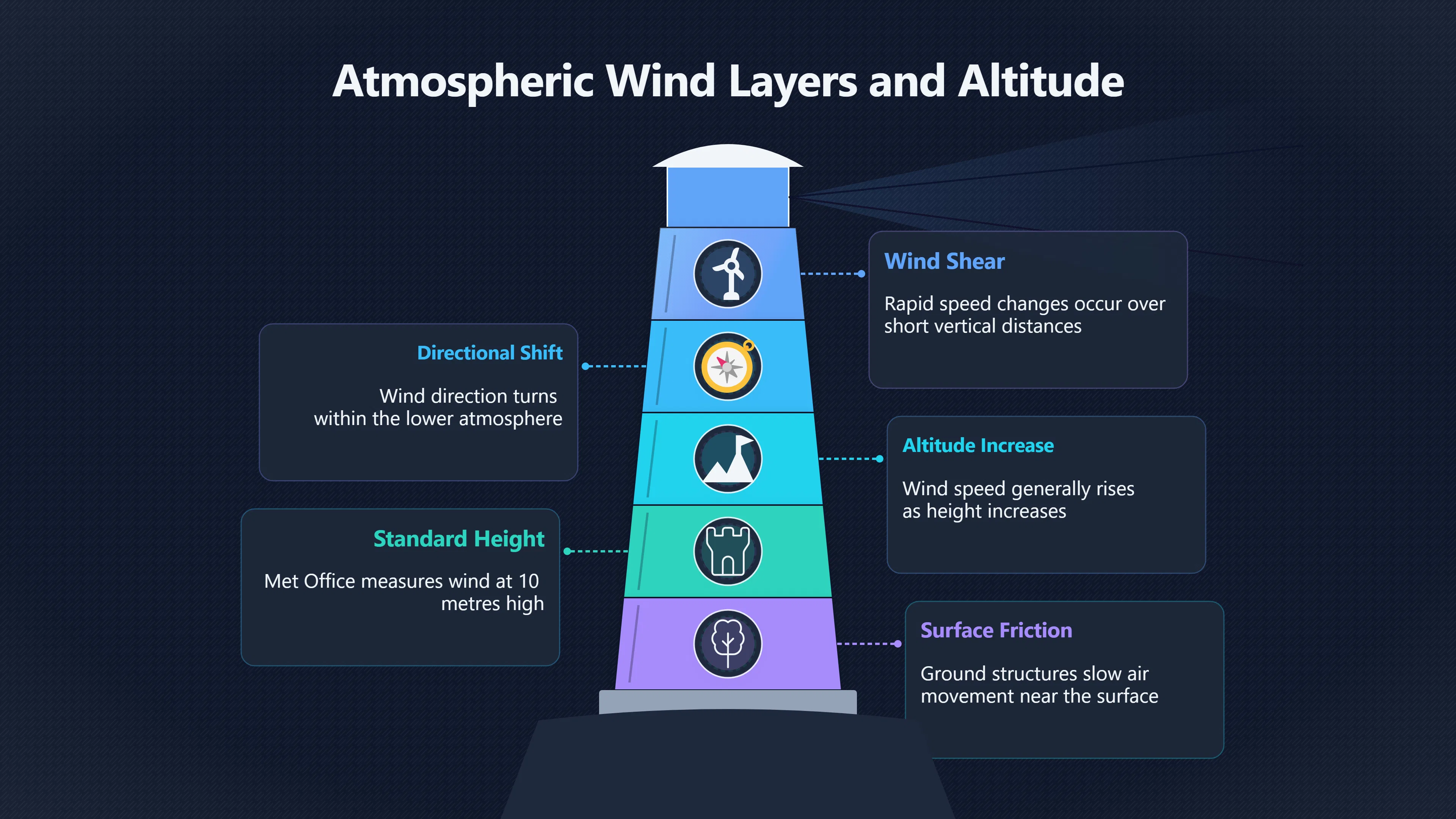
 In reality, the reported wind is usually measured at a standard height of about 10 metres above the ground. Objects seen hundreds of metres higher may be travelling in air moving at a different speed or even a different direction. As a result, some UFO reports appear to contradict the wind when they may simply be following a different layer of the atmosphere. Understanding this limitation is essential when evaluating drift claims. [Met Office]metoffice.gov.ukwhy do we measure wind at less than 500mMet OfficeHow wind speeds are measured by the Met Office8 Aug 2025 — Wind speed typically increases with height above the Earth's surface… [Met Office]metoffice.gov.ukwhy do we measure wind at less than 500mMet OfficeHow wind speeds are measured by the Met Office8 Aug 2025 — Wind speed typically increases with height above the Earth's surface…
When a wind check creates a false contradiction
A typical UFO discussion goes like this: a witness reports a slow-moving light, someone checks a nearby weather station, and the recorded wind appears inconsistent with the object’s path. The inconsistency is then treated as evidence that the object was not a balloon or lantern.
That conclusion may be premature because the weather station is describing conditions close to the ground, not necessarily where the object was observed. Meteorological organisations standardise wind measurements at roughly 10 metres above open ground so that observations from different sites can be compared consistently. The measurement is not intended to represent every altitude above the station. [Met Office]metoffice.gov.ukwhy do we measure wind at less than 500mMet OfficeHow wind speeds are measured by the Met Office8 Aug 2025 — Wind speed typically increases with height above the Earth's surface… [Met Office]metoffice.gov.ukwhy do we measure wind at less than 500mMet OfficeHow wind speeds are measured by the Met Office8 Aug 2025 — Wind speed typically increases with height above the Earth's surface…
A drifting object only needs to be in a different wind layer for the comparison to break down. Even modest altitude changes can place an object into air moving faster than the surface wind, while larger changes can place it into air moving in a noticeably different direction. [National Weather Service]weather.govNational Weather ServicePlanetary Boundary LayerThe top of the PBL is often marked with a temperature inversion, a change in mass air, a… [NOAA National Severe Storms Laboratory]nssl.noaa.govNational Severe Storms Laboratory2interpretation of doppler velocity patterns in clear air and…wind speed increases from 0 to 38 m s-1 (74 kt) and direction veers from…
Why 10 metre wind readings are limited
Surface observations are valuable because they are standardised and widely available. The problem is not that they are wrong; it is that they answer a narrower question than many UFO investigators assume.
Wind speed generally increases with height because friction from the ground, vegetation, buildings and terrain slows the air near the surface. A balloon or lantern that rises away from this frictional layer can encounter stronger winds than those recorded at the measuring mast. [Met Office]metoffice.gov.ukwhy do we measure wind at less than 500mMet OfficeHow wind speeds are measured by the Met Office8 Aug 2025 — Wind speed typically increases with height above the Earth's surface… [Met Office]metoffice.gov.ukwhy do we measure wind at less than 500mMet OfficeHow wind speeds are measured by the Met Office8 Aug 2025 — Wind speed typically increases with height above the Earth's surface… [RMetS]rmets.orgmeasuring wind speed what anemometerMeasuring Wind Speed: What is an anemometer?6 Mar 2014 — In addition, because wind speed increases with height above the ground, a standa…
Direction can change as well. Meteorological studies of the atmospheric boundary layer show that wind often turns with height rather than remaining fixed through the entire lower atmosphere. Under some conditions the change is small; under others it can be substantial enough to alter the apparent drift direction of a free-floating object. Royal Meteorological Society [National Weather Service]weather.govNational Weather ServicePlanetary Boundary LayerThe top of the PBL is often marked with a temperature inversion, a change in mass air, a…
This creates a recurring UFO-investigation pitfall:
- The witness estimates a high altitude.
- The investigator uses a surface observation.
- The object’s path does not match the surface wind.
- The drifting-object explanation is rejected.
Yet the comparison may never have involved the relevant air mass in the first place.
Low-level wind shear provides another complication. Meteorological agencies define wind shear as rapid changes in wind speed or direction over relatively short vertical distances. In such situations, an object can appear to alter course or accelerate even though it remains entirely wind-driven. [National Weather Service]weather.govNational Weather ServicePlanetary Boundary LayerThe top of the PBL is often marked with a temperature inversion, a change in mass air, a…
Obstacles, terrain and local wind variation
Even before altitude becomes an issue, the nearest weather station may not perfectly represent the conditions at the sighting location.
Professional wind observations are ideally taken in open terrain with minimal obstruction. Large buildings, trees, hills and urban structures can distort local airflow, creating sheltered areas, channelling effects or turbulence that differ from the official observation site. The World Meteorological Organization and the Met Office both emphasise careful exposure standards for wind measurements because local surroundings significantly affect readings. [wow.metoffice.gov.uk]wow.metoffice.gov.ukSite RatingsMeasurements of wind. A: Wind sensors calibrated within last 10 years, mounted 10m above the ground on mast or pole, with no… [Met Office]metoffice.gov.ukwhy do we measure wind at less than 500mMet OfficeHow wind speeds are measured by the Met Office8 Aug 2025 — Wind speed typically increases with height above the Earth's surface… [RMetS]rmets.orgThe Beaufort Wind ScaleThe wind speeds shown in the table below and that you hear quoted in weather or news reports are always measured a…
This matters for UFO reports because witnesses often observe from locations that are far from ideal meteorological sites:
- Valleys can channel wind differently from nearby open terrain.
- Coastal locations may experience local sea-breeze effects.
- Urban areas can create highly variable airflow around buildings.
- Hills and ridges can alter wind direction and speed over short distances.
A witness may therefore experience one wind direction on the ground while a drifting light above nearby open country follows another. The discrepancy can be real without implying unusual propulsion. [Met Office]metoffice.gov.ukwhy do we measure wind at less than 500mMet OfficeHow wind speeds are measured by the Met Office8 Aug 2025 — Wind speed typically increases with height above the Earth's surface… [Met Office]metoffice.gov.ukwhy do we measure wind at less than 500mMet OfficeHow wind speeds are measured by the Met Office8 Aug 2025 — Wind speed typically increases with height above the Earth's surface…
Another subtle problem is distance. The closest reporting station may be several kilometres away. Weather agencies attempt to standardise observations, but wind remains one of the most locally variable meteorological elements. A reading from an airport or exposed field may not perfectly describe conditions at the witness location, especially in complex terrain. [Met Office]metoffice.gov.ukwhy do we measure wind at less than 500mMet OfficeHow wind speeds are measured by the Met Office8 Aug 2025 — Wind speed typically increases with height above the Earth's surface…
A common interpretation mistake: wind direction language
Some apparent contradictions arise from misunderstanding the way wind direction is reported.
Meteorological winds are named for the direction they come from, not the direction they are travelling toward. A westerly wind comes from the west and carries a drifting object eastward. An easterly wind comes from the east and carries objects westward. [Met Office]metoffice.gov.ukwhy do we measure wind at less than 500mMet OfficeHow wind speeds are measured by the Met Office8 Aug 2025 — Wind speed typically increases with height above the Earth's surface…
In UFO discussions, this convention is frequently reversed. An investigator may read “westerly wind” and expect an object to move west, producing an artificial mismatch. Before treating a wind comparison as evidence against a balloon or lantern explanation, it is worth confirming that the direction has been interpreted correctly.
When surface wind still helps a lantern case
Despite these limitations, surface wind data remains useful. The mistake is treating it as the final answer rather than the first clue.
Surface observations can strongly support a drifting-light explanation when several factors align:
- The object was reported at low altitude.
- Witnesses saw it shortly after launch.
- Multiple lights followed the same path.
- The movement broadly matched the local downwind direction.
- No evidence suggests rapid climbing into a different wind layer.
In such cases, a surface wind check can provide meaningful corroboration. A cluster of orange lights drifting steadily away from a wedding venue or festival in the same general direction as the local wind is consistent with lantern behaviour, even if exact speeds and headings are uncertain.
The strongest analyses therefore treat surface wind as a screening tool. A mismatch does not automatically disprove a drifting object, and a match does not automatically prove one. The key question is whether the measured wind is likely to represent the air mass in which the reported object was actually travelling. Met Office [National Weather Service]weather.govNational Weather ServicePlanetary Boundary LayerThe top of the PBL is often marked with a temperature inversion, a change in mass air, a…
The practical lesson for UFO investigations
Surface wind checks are valuable because they are quick and accessible, but they are easy to overinterpret. A 10-metre wind observation describes conditions near the ground under standardised measuring rules, not necessarily the atmosphere hundreds of metres above a witness. Wind speed often increases with height, wind direction can change with altitude, and local terrain can produce differences between a weather station and the observation site. [Royal Meteorological Society]rmets.onlinelibrary.wiley.comRoyal Meteorological SocietyWind turning in the atmospheric boundary layer over land4 Jul 2019 — The turning of the wind with height in t… [Met Office]metoffice.gov.ukwhy do we measure wind at less than 500mMet OfficeHow wind speeds are measured by the Met Office8 Aug 2025 — Wind speed typically increases with height above the Earth's surface… [RMetS]rmets.onlinelibrary.wiley.comRoyal Meteorological SocietyWind turning in the atmospheric boundary layer over land4 Jul 2019 — The turning of the wind with height in t…
For reports involving suspected balloons, lanterns or other drifting lights, a surface wind mismatch should be treated as a prompt for further investigation rather than a decisive refutation. The closer the object is to the ground, the more useful the surface reading becomes. The higher and less certain the object’s altitude, the greater the risk that the ground wind is telling the wrong story. [National Weather Service]weather.govNational Weather ServicePlanetary Boundary LayerThe top of the PBL is often marked with a temperature inversion, a change in mass air, a… [National Weather Service]weather.govNational Weather ServicePlanetary Boundary LayerThe top of the PBL is often marked with a temperature inversion, a change in mass air, a…
Amazon book picks
Further Reading
Books and field guides related to When ground wind tells the wrong story. Use these as the next step if you want deeper reading beyond the article.
The UFO Experience
Shows why careful data interpretation matters before accepting or rejecting IFO explanations.
The Cloudspotter's Guide
Supports a broader understanding of sky conditions and atmospheric layers.
Visual Intelligence
Helps readers think about how quick conclusions can distort sighting interpretation.
eBay marketplace picks
Marketplace Samples
Example marketplace items related to this page. Use the search link to explore similar finds on eBay.


Endnotes
-
Source: metoffice.gov.uk
Title: why do we measure wind at less than 500m
Link: https://www.metoffice.gov.uk/blog/2025/why-do-we-measure-wind-at-less-than-500mSource snippet
Met OfficeHow wind speeds are measured by the Met Office8 Aug 2025 — Wind speed typically increases with height above the Earth's surface...
-
Source: weather.metoffice.gov.uk
Link: https://weather.metoffice.gov.uk/learn-about/met-office-for-schools/other-content/other-resources/understanding-weatherSource snippet
Met OfficeUnderstanding weatherMeasurements of wind strength are made at 10 metres (33 feet) above the ground. A specified height has to...
-
Source: metoffice.gov.uk
Link: https://www.metoffice.gov.uk/research/climate/maps-and-data/data/haduk-grid/faqSource snippet
Met OfficeHadUK-Grid Frequently Asked QuestionsThe standard exposure for wind sensors is at 10 m above ground in an open, level area (suc...
-
Source: weather.gov
Link: https://www.weather.gov/source/zhu/ZHU_Training_Page/clouds/planetary_boundary_layer/PBL.htmlSource snippet
National Weather ServicePlanetary Boundary LayerThe top of the PBL is often marked with a temperature inversion, a change in mass air, a...
-
Source: nssl.noaa.gov
Title: National Severe Storms Laboratory2
Link: https://www.nssl.noaa.gov/publications/dopplerguide/chapter2.phpSource snippet
interpretation of doppler velocity patterns in clear air and...wind speed increases from 0 to 38 m s-1 (74 kt) and direction veers from...
-
Source: rmets.org
Title: measuring wind speed what anemometer
Link: https://www.rmets.org/metmatters/measuring-wind-speed-what-anemometerSource snippet
Measuring Wind Speed: What is an anemometer?6 Mar 2014 — In addition, because wind speed increases with height above the ground, a standa...
-
Source: metoffice.gov.uk
Title: what is wind and how do we measure it
Link: https://www.metoffice.gov.uk/blog/2025/what-is-wind-and-how-do-we-measure-itSource snippet
Met OfficeWhat is wind and how do we measure it?16 Aug 2025 — Wind speed is typically measured in knots (nautical miles per hour), and di...
-
Source: weather.gov
Title: safety llws
Link: https://www.weather.gov/zme/safety_llwsSource snippet
National Weather ServiceLow Level Wind ShearSo what does this mean? It means that within the lowest 2000ft, the wind speed and/or directi...
-
Source: wow.metoffice.gov.uk
Link: https://wow.metoffice.gov.uk/support/siteratings -
Source: weather.metoffice.gov.uk
Link: https://weather.metoffice.gov.uk/guides/observations/how-we-measure-windSource snippet
Met OfficeHow we measure windThe instruments used to measure wind are known as anemometers and can record wind speed, direction and the s...
-
Source: metoffice.gov.uk
Link: https://www.metoffice.gov.uk/research/climate/maps-and-data/data/haduk-grid/datasetsSource snippet
HadUK-Grid DatasetsMean wind speed at 10 m, sfcWind, Average of hourly mean wind speed at a height of 10 m above ground level over the mo...
-
Source: datahub.metoffice.gov.uk
Title: metoffice.gov.uk Glossary of parameters
Link: https://datahub.metoffice.gov.uk/docs/glossary?models=mo-spot-1hr&sortOrder=ALPHABETICALLYSource snippet
The gust speed is equivalent to the maximum 3 second mean wind speed observed over the 10 minutes preceding the validity time. 10m...Rea...
-
Source: weather.metoffice.gov.uk
Link: https://weather.metoffice.gov.uk/guides/what-does-this-forecast-meanSource snippet
does this forecast mean?It is based on observed sea conditions, but is also used to describe wind conditions on land. Wind gust. This val...
-
Source: weather.metoffice.gov.uk
Link: https://weather.metoffice.gov.uk/guides/coast-and-sea/beaufort-scaleSource snippet
wind force scaleThe Beaufort scale, which is used in Met Office marine forecasts, is an empirical measure for describing wind intensity b...
-
Source: weather.metoffice.gov.uk
Link: https://weather.metoffice.gov.uk/learn-about/met-office-for-schools/other-content/other-resources/how-to-measure-the-weatherSource snippet
do we measure the weather?These are often cups which spin through a beam of light to measure the wind speed and are placed 10m above the...
-
Source: datahub.metoffice.gov.uk
Title: metoffice.gov.uk Weather Data Hub | Glossary of parameters
Link: https://datahub.metoffice.gov.uk/docs/glossarySource snippet
The wind speed at 10m above ground level. Improver probabilities spot UK; wind; 10m. More About Probability Wind speed at 10m...Read more...
-
Source: rmets.org
Link: https://www.rmets.org/metmatters/beaufort-wind-scaleSource snippet
The Beaufort Wind ScaleThe wind speeds shown in the table below and that you hear quoted in weather or news reports are always measured a...
-
Source: weather.gov
Link: https://www.weather.gov/media/epz/mesonet/CWOP-WMO8.pdfSource snippet
guidance on the most effective practices for carrying out meteorological...
-
Source: repository.library.noaa.gov
Link: https://repository.library.noaa.gov/view/noaa/58655Source snippet
The height of the constant flux layer reaches ~ 300 m for 10-m wind speeds less than 13 m s−1 while this...Read mo...
-
Source: ndbc.noaa.gov
Title: adjust wind.shtml
Link: https://www.ndbc.noaa.gov/faq/adjust_wind.shtmlSource snippet
NOAAYes, but we only list the standardized wind speeds where those who need them look for them. Anemometer heights on NDBC buoys vary acc...
-
Source: repository.library.noaa.gov
Title: noaa 71416 DS1
Link: https://repository.library.noaa.gov/view/noaa/71416/noaa_71416_DS1.pdfSource snippet
Structure of Turbulence in the Lower Atmospheric...by TR Lee · 2025 · Cited by 2 — In this work we addressed the question of how the ver...
-
Source: repository.library.noaa.gov
Title: noaa 27256 DS1
Link: https://repository.library.noaa.gov/view/noaa/27256/noaa_27256_DS1.pdfSource snippet
of the Hurricane Boundary Layer during the...by A Alford · 2020 · Cited by 47 — Due to the increase in aerodynamic surface roughness ove...
-
Source: repository.library.noaa.gov
Link: https://repository.library.noaa.gov/view/noaa/20353Source snippet
The development of offshore wind energy requires...
-
Source: repository.library.noaa.gov
Link: https://repository.library.noaa.gov/view/noaa/73046Source snippet
govImpact of Land Friction on Surface Wind Structure During...by MA Jisan · 2026 — Momentum budget analysis indicates that land‐induced...
-
Source: repository.library.noaa.gov
Title: noaa 31510 DS1
Link: https://repository.library.noaa.gov/view/noaa/31510/noaa_31510_DS1.pdfSource snippet
Wind Speed Estimates from a High-Resolutionby EP James · 2018 · Cited by 60 — Among the most important parameterizations for forecasting...
-
Source: amc.namem.gov.mn
Link: https://amc.namem.gov.mn/wp-content/uploads/WMO/1.%208_I-2023_en.pdf?_t=1638837866Source snippet
to Instruments and Methods of ObservationPage 1. Guide to Instruments and Methods of Observation. Volume I –Measurement of Meteorological...
-
Source: rmets.onlinelibrary.wiley.com
Link: https://rmets.onlinelibrary.wiley.com/doi/10.1002/qj.3605Source snippet
Royal Meteorological SocietyWind turning in the atmospheric boundary layer over land4 Jul 2019 — The turning of the wind with height in t...
-
Source: rmets.onlinelibrary.wiley.com
Link: https://rmets.onlinelibrary.wiley.com/doi/10.1002/met.2094Source snippet
Royal Meteorological SocietyInvestigation of exposure correction models for wind speed...Nov 21, 2022 — The corrected wind speed measure...
-
Source: seedmech.com
Link: https://www.seedmech.com/documents_folder/wmo_no_8.pdfSource snippet
WORLD METEOROLOGICAL ORGANIZATIONThe purpose of the Guide to Meteorological Instruments and Methods of Observation is to support these ac...
Additional References
-
Source: knmi.nl
Link: https://www.knmi.nl/kennis-en-datacentrum/project/potential-windSource snippet
Potential windFor wind measurements the World Meteorological Organization (WMO) requires that the measurement is at 10 m height, the meas...
-
Source: scribd.com
Link: https://www.scribd.com/document/724960971/WMO-NO-08-volume-IV-edisi-2021Source snippet
WMO No. 8: Instruments & Observation Methods | PDFThis document provides guidance on instruments and methods for observing systems at aut...
-
Source: wmo.int
Link: https://wmo.int/Source snippet
World Meteorological Organization WMO: HomepageA specialized agency of the United Nations whose mandate covers weather, climate and water...
-
Source: artefacts.ceda.ac.uk
Link: https://artefacts.ceda.ac.uk/badc_datadocs/ukmo-midas/ukmo_guide.htmlSource snippet
Office Surface Data Users GuideThe standard exposure is over level, open terrain at a height of 10m above the ground.... gusts measureme...
-
Source: research.tudelft.nl
Link: https://research.tudelft.nl/files/155575145/3_s2.0_B9780323993531000311_main.pdfSource snippet
wind speed profiles in atmospheric boundary layer...The vertical profile of wind speed, extending up to a few hundreds of meters above g...
-
Source: researchgate.net
Link: https://www.researchgate.net/publication/267727029_Extending_the_wind_profile_much_higher_than_the_surface_layer -
Source: community.wmo.int
Link: https://community.wmo.int/site/knowledge-hub/programmes-and-initiatives/instruments-and-methods-of-observation-programme-imop/guide-instruments-and-methods-of-observation-wmo-no-8Source snippet
8)LATEST VERSION OF THE WMO-No. 8; Chapter 5, Measurement of surface wind; Chapter 6, Measurement of precipitation; Chapter 7, Measure...
-
Source: scribd.com
Link: https://www.scribd.com/document/83567776/Guide-to-Meteorological-Instruments-and-Methods-of-Observation-WMO-CIMO-Guide-7th-Edition-2008Source snippet
The tion of the horizontal wind speed over 10 min recorded wind trace can also be used to read peak...Read more...
-
Source: youngusa.com
Link: https://www.youngusa.com/blog/siting-how-to-choose-the-best-location-for-your-weather-station/Source snippet
Considerations... This is because their height requirements (0.3–2 meters) are significantly lower...Read more...
-
Source: campbellsci.co.uk
Link: https://www.campbellsci.co.uk/weather-station-sitingSource snippet
To facilitate leveling/cleaning, CSI recommends installing at a height of 3 m or less.Read more...
Topic Tree