Within IFOs
The Tiny Things Cameras Make Huge
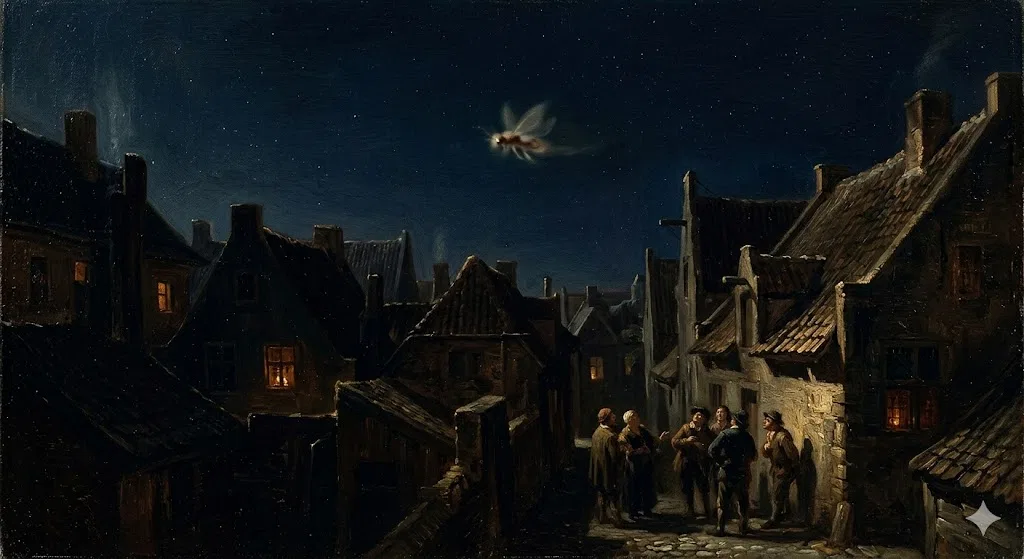
Insects, dust and nearby objects can cross lenses so close and fast that they seem like distant high-speed craft.
On this page
- Near lens scale errors
- Motion blur and focus
- Recognising close object clues
Page outline Jump by section
Introduction
Insects, dust, drifting fibres and other nearby objects are a small but important cause of UFO reports because cameras can make them look much larger, faster and stranger than they are. A fly passing a few centimetres from a phone, security camera or drone lens can cross the frame so quickly that it appears to be a distant craft making an impossible manoeuvre. A speck of dust lit by flash or infrared light can become a glowing “orb”. The key error is not usually that the witness saw nothing; it is that a real close object was interpreted as a far-away aerial object.
This mechanism is especially risky in short videos, zoomed sky footage, doorbell-camera clips and night-vision recordings. Without reliable distance, focus, exposure and sensor metadata, a tiny object near the lens can be assigned the speed, size and altitude of something in the sky. NASA’s UAP study made the same broader point about the need for calibrated sensors, multiple measurements, metadata and baseline data before unusual performance can be inferred from imagery. [NASA Science]science.nasa.govNASA Science…
Near-lens scale errors
The most important clue in many insect-on-camera cases is that the object has no measured range. A camera records an angular position on the image, not a built-in distance. A small object close to the lens and a large object far away can occupy the same apparent size in the frame. If the viewer assumes the object is distant, the calculated speed and size can become wildly inflated.
This is why single-camera UFO clips are fragile evidence when the object is just a dot, blob or streak. Phil Plait’s analysis of the widely circulated “UFOs over Denver” video made the point bluntly: the objects looked mysterious only if they were assumed to be distant; if they were insects close to the camera, their hovering, darting and flashing behaviour became ordinary. He also noted that one camera alone cannot provide the distance information needed to choose between “small and close” and “large and far away”. [Slate]slate.comUFOs over Denver are insectsSlateUFOs over Denver are insects…
The same geometry appears in more technical UAP video debates. Bellingcat’s analysis of a Department of Defense UFO video emphasised parallax: nearby objects or foreground features can seem to move faster than distant ones, and camera motion can create apparent movement even when the object’s own motion is uncertain. Although that case was not about insects, the principle is directly relevant to near-lens objects: apparent speed in a video is not the same as true speed through the air. [bellingcat]bellingcat.comIsn’t That A Balloon? Deflating a Do D UFO VideobellingcatIsn’t That A Balloon? Deflating a DoD UFO Video - bellingcat…
A useful test is to ask what distance has actually been measured, not what distance the scene seems to imply. If the clip has no stereo view, no radar range, no second camera, no shadow or reflection tied to the object, and no clear interaction with known background features, then claims of extreme velocity or large size are usually premature.
Motion blur and focus
Nearby insects become especially misleading when they move during the camera’s exposure. Motion blur is the streaking that occurs when an object changes position while a frame is being captured. A fast insect can therefore be recorded not as a crisp fly, moth or gnat, but as a rod, dash, cigar, translucent smear or segmented streak. The popular “flying rods” or “skyfish” idea grew from exactly this kind of video artefact: optical analyses have generally explained the shapes as insects or birds recorded with motion blur, sometimes capturing wingbeat patterns across a single frame. [Wikipedia]WikipediaRod (optical phenomenonRod (optical phenomenon
Focus adds another layer. Many sky videos are focused on clouds, aircraft, the horizon or infinity. An insect passing close to the lens will then be badly out of focus, so its real body shape disappears. Instead of legs, wings and antennae, the camera may show a soft oval, a translucent blob, a short cylinder or a bright shapeless patch. In the Denver example, the objects looked like blobs partly because they were close to a camera focused for distant scenery. [Slate]slate.comUFOs over Denver are insectsSlateUFOs over Denver are insects…
Night cameras can make the effect stronger. Doorbell cameras, trail cameras and CCTV systems often use infrared illumination, long exposures, compression and aggressive noise reduction. An insect that is invisible to the person watching the scene can be brightly lit right beside the lens, then smeared by exposure and simplified by compression. The result may look self-luminous, even though the object is only reflecting light from the camera’s own illumination.
Dust, pollen, snow, rain droplets and tiny fibres can produce a related but slightly different effect. Canon’s support guidance explains that flash can reflect from dust or particles floating in front of the subject, producing white circular spots in images; it recommends brighter ambient lighting, different zoom choices or separating the flash from the lens to reduce the problem. [Canon]community.usa.canon.comOpen source on canon.com.
Recognising close-object clues
A near-lens explanation is strongest when several clues appear together. None is absolute on its own, but the pattern is often distinctive.
The object crosses the frame in only a few frames. A close insect can appear and vanish quickly because it is moving through the camera’s narrow field of view, not because it has crossed a large distance in the sky.
The object is soft, smeared or oddly shaped while the background is sharp. This suggests a mismatch between the focus distance and the object’s actual distance. A distant craft at the same optical plane as clouds or buildings should not usually be blurred in a completely different way.
The path is erratic in an insect-like way. Small flying insects can hover, turn, dart, loop and change direction rapidly at close range. When their motion is misread as distant, those ordinary local movements can be mistaken for extraordinary acceleration.
The object brightens or flashes without an obvious light source of its own. A nearby insect can catch sunlight, porch light, car headlights, infrared LEDs or camera flash at changing angles. Dust and droplets can do the same when they pass through the camera’s illumination.
There is no reliable range cue. A single camera view rarely proves altitude or distance. Stronger range cues include two synchronised cameras, shadows on known surfaces, a clear pass behind or in front of measured objects, radar, lidar, or a second independent sensor.
The clip comes from a camera type that favours near-field artefacts. Security cameras, trail cameras, dashcams, drones and phone cameras all have practical strengths, but they are not scientific UAP instruments. Their automatic exposure, compression and low-light behaviour are designed to produce usable footage, not to preserve every physical detail of a fast, tiny object near the lens.

Why these cases are easy to overread
Insect and dust cases are persuasive because the footage can be real. There may be no hoax, no editing and no dishonest witness. The misleading part comes later, when the viewer assigns the wrong scale to the object. A tiny gnat becomes a distant sphere; a moth becomes a luminous dart; a blurred wingbeat becomes a structured craft; a dust particle becomes a hovering orb.
This is also why “it moved too fast to be a bug” can be a circular argument. It is only too fast if the object is assumed to be far away. If it is close to the camera, crossing the frame quickly is exactly what would be expected. Metabunk’s analysis of a 2025 daytime “UFO” clip from Hungary made this same point by treating the object as small and close rather than distant and exotic, with parallax in the foreground scene helping explain the apparent motion. [Metabunk]metabunk.orgHungary daytime "UFO" [small/close object + parallax] | MetabunkHungary daytime "UFO" [small/close object + parallax] | Metabunk
The critique does not mean every short, fast object on video is an insect. Birds, balloons, drones, aircraft, debris, reflections and sensor artefacts can also produce confusing imagery. Nor does it mean that all UAP reports are resolved by camera bugs. The narrower point is that close-object explanations must be tested before drawing conclusions about extraordinary speed, altitude or technology.
What better evidence looks like
A strong camera-based UFO case should reduce the near-lens risk rather than merely look strange. The most useful improvements are practical: record longer clips, keep the original file, preserve timestamps and metadata, note the direction of view, and capture reference features such as buildings, trees, stars or the horizon. If possible, a second camera from a different position is far more valuable than a zoomed-in crop from the same angle.
For investigators, the first question should be “what range evidence exists?” rather than “what does it resemble?” A clip that resembles a distant craft may still be a close insect if range is missing. A clip that looks unimpressive may become more interesting if it is independently tracked, seen from multiple positions, or tied to reliable sensor data. NASA’s UAP report stressed that future analysis depends on well-characterised data, multiple calibrated sensors and useful metadata, because weak data can make ordinary objects look anomalous and leave genuinely unusual cases unresolved. [NASA Science]science.nasa.govNASA Science…
The practical lesson for IFO analysis is simple: tiny things near cameras can become huge things in interpretation. Before a video is treated as evidence for unusual aircraft, exotic propulsion or impossible manoeuvres, the insect, dust and near-object pathway has to be ruled out with distance, focus, motion and lighting evidence rather than by appearance alone.
Amazon book picks
Further Reading
Books and field guides related to The Tiny Things Cameras Make Huge. Use these as the next step if you want deeper reading beyond the article.
The Demon-Haunted World
Addresses perception errors and extraordinary interpretations.
How We Know What Isn't So
Rating: 4.0/5 from 6 Google Books ratings
Explains common reasoning mistakes behind mistaken identifications.
eBay marketplace picks
Marketplace Samples
Example marketplace items related to this page. Use the search link to explore similar finds on eBay.


Endnotes
-
Source: science.nasa.gov
Link: https://science.nasa.gov/wp-content/uploads/2023/09/uap-independent-study-team-final-report.pdfSource snippet
NASA Science...
-
Source: slate.com
Title: UFOs over Denver are insects
Link: https://www.slate.com/blogs/bad_astronomy/2012/11/28/ufos_over_denver_are_insects.htmlSource snippet
SlateUFOs over Denver are insects...
-
Source: bellingcat.com
Title: Isn’t That A Balloon? Deflating a Do D UFO Video
Link: https://www.bellingcat.com/news/2023/10/24/isnt-that-a-balloon-deflating-a-dod-ufo-video/Source snippet
bellingcatIsn’t That A Balloon? Deflating a DoD UFO Video - bellingcat...
-
Source: Wikipedia
Title: Rod (optical phenomenon)
Link: https://en.wikipedia.org/wiki/Rod_%28optical_phenomenon%29 -
Source: Wikipedia
Title: Motion blur (media)
Link: https://en.wikipedia.org/wiki/Motion_blur_%28media%29 -
Source: metabunk.org
Title: Hungary daytime “UFO” [small/close object + parallax] | Metabunk
Link: https://www.metabunk.org/threads/hungary-daytime-ufo-small-close-object-parallax.14065/ -
Source: science.nasa.gov
Link: https://science.nasa.gov/uap/ -
Source: nasa.gov
Title: nasa to release discuss unidentified anomalous phenomena report
Link: https://www.nasa.gov/news-release/nasa-to-release-discuss-unidentified-anomalous-phenomena-report/ -
Source: metabunk.org
Title: ufos in micks video sunlit out of focus insects.6045
Link: https://www.metabunk.org/threads/ufos-in-micks-video-sunlit-out-of-focus-insects.6045/ -
Source: metabunk.org
Title: strange object captured over malvern hills western england reddit.14371
Link: https://www.metabunk.org/threads/strange-object-captured-over-malvern-hills-western-england-reddit.14371/ -
Source: metabunk.org
Link: https://www.metabunk.org/home/authors/mick-west.1/ -
Source: metabunk.org
Link: https://www.metabunk.org/forums/ufos-and-aliens.10/page-22 -
Source: Wikipedia
Title: NASA Unidentified Anomalous Phenomena Independent Study Team
Link: https://en.wikipedia.org/wiki/NASA_Unidentified_Anomalous_Phenomena_Independent_Study_Team -
Source: Wikipedia
Title: Backscatter (photography)
Link: https://en.wikipedia.org/wiki/Backscatter_%28photography%29 -
Source: community.usa.canon.com
Link: https://community.usa.canon.com/t5/EOS-DSLR-Mirrorless-Cameras/quot-spots-quot-on-image/td-p/368854 -
Source: community.usa.canon.com
Link: https://community.usa.canon.com/t5/EF-RF-Lenses/How-to-check-dust-in-lens/td-p/516709 -
Source: my.canon
Title: Canon There are white circles in captured images
Link: https://my.canon/en/support/8201031900 -
Source: reddit.com
Title: bellingcat analysis of a ufo video
Link: https://www.reddit.com/r/ufo/comments/17g3svq/bellingcat_analysis_of_a_ufo_video/ -
Source: reddit.com
Link: https://www.reddit.com/r/UFOs/comments/1lmhbxa/metabunk_users_identifying_a_ufo_that_the_people/
Additional References
-
Source: youtube.com
Title: Identifying common artifacts in security camera footage
Link: https://www.youtube.com/watch?v=O129s5D_6aQSource snippet
Bokeh and light effects on camera sensors...
-
Source: facebook.com
Link: https://www.facebook.com/fox9kmsp/posts/a-newly-declassified-video-shown-in-infrared-depicts-an-object-appearing-to-be-a/1465904865578965/ -
Source: facebook.com
Link: https://www.facebook.com/fox5atlanta/posts/a-newly-declassified-video-shown-in-infrared-depicts-an-object-appearing-to-be-a/1545315896966081/ -
Source: facebook.com
Link: https://www.facebook.com/groups/invertid/posts/3151158921686362/ -
Source: reddit.com
Link: https://www.reddit.com/r/Cryptozoology/comments/144ag44/air_rods_or_rods_are_described_as_flying_living/ -
Source: facebook.com
Link: https://www.facebook.com/groups/invertid/posts/3664466357022280/ -
Source: facebook.com
Link: https://www.facebook.com/knoxnews/posts/close-examination-of-the-videos-by-conspiracy-theory-debunker-mick-west-and-othe/10159199817742649/ -
Source: facebook.com
Link: https://www.facebook.com/Meetmattfraser/posts/have-you-ever-noticed-strange-orbs-that-appear-in-pictures-heres-why-they-mean/5824291117614319/ -
Source: instagram.com
Link: https://www.instagram.com/reel/DW6afBCCPlz/ -
Source: justanswer.com
Link: https://www.justanswer.com/video-camera-repair/43d1b-gotten-orbs-strange-phenomena-photos.html
Topic Tree