Within Reflections
Can Pilots Be Fooled by Cockpit Glass?
Cockpit instruments, cabin lighting and layered windscreens can create outside-looking lights even for trained observers.
On this page
- Why aircraft windscreens are optically complicated
- What night flying guidance says about reflections
- Questions that make pilot reports easier to evaluate
Page outline Jump by section
Introduction
Pilot UFO reports often receive special attention because pilots are trained observers operating in highly structured environments. Yet the cockpit itself creates optical conditions that can sometimes generate convincing false targets. Reflections from instrument panels, electronic displays, warning lights, cabin lighting and layered windscreens can appear to float outside the aircraft, particularly during night operations. The result is not carelessness or incompetence. Rather, it is a reminder that expert observers must still interpret visual information through a complex optical system.
 Within the broader category of reflections through windows and windscreens, cockpit reflections are distinctive because they occur in an environment specifically designed around illuminated instruments and multiple transparent layers. Aviation safety guidance treats glare, reflections and night-time visual illusions as genuine operational concerns, precisely because they can affect even experienced crews. [volpe.dot.gov]volpe.dot.govHuman Factors Considerations in the Design and EvaluationFAA Aircraft Certification Test Pilots, Engineers, and Human. Factors… • Inspection of the cockpit for glare and reflections should al…
Can Pilots Be Fooled by Cockpit Glass?
The short answer is yes, although not in the simplistic sense often implied in public debates. Pilots are generally better than average observers when identifying aircraft, stars, weather phenomena and navigation lights. However, they must make those judgements while looking through windscreens that can reflect internal light sources and while operating in conditions where external visual references may be sparse.
A reflected image can be particularly persuasive because it occupies the same field of view as genuine outside objects. If the reflection is bright enough and the outside scene is dark enough, the reflected image may appear to be located beyond the windscreen rather than on it. Under some circumstances, it can seem to maintain a stable position relative to the horizon, clouds or stars.
This possibility does not automatically explain any specific UFO report. It does, however, establish a plausible mechanism that investigators should examine before concluding that an unusual object was physically outside the aircraft.
Why Aircraft Windscreens Are Optically Complicated
Aircraft windscreens are not simple sheets of glass. Modern transport aircraft typically use laminated, multi-layer structures designed for strength, impact resistance, heating and optical performance. Multiple transparent layers create multiple reflective surfaces, increasing opportunities for faint secondary images and “ghost” reflections. Studies of aircraft windscreen transmission and optical properties confirm that cockpit transparencies are complex optical systems rather than perfectly transparent windows. [ResearchGate]researchgate.netResearch Gate(PDF) Optical Radiation Transmittance of AircraftResearchGate(PDF) Optical Radiation Transmittance of Aircraft…July 1, 2007 — Optical radiation can have acute and chronic effects on t…
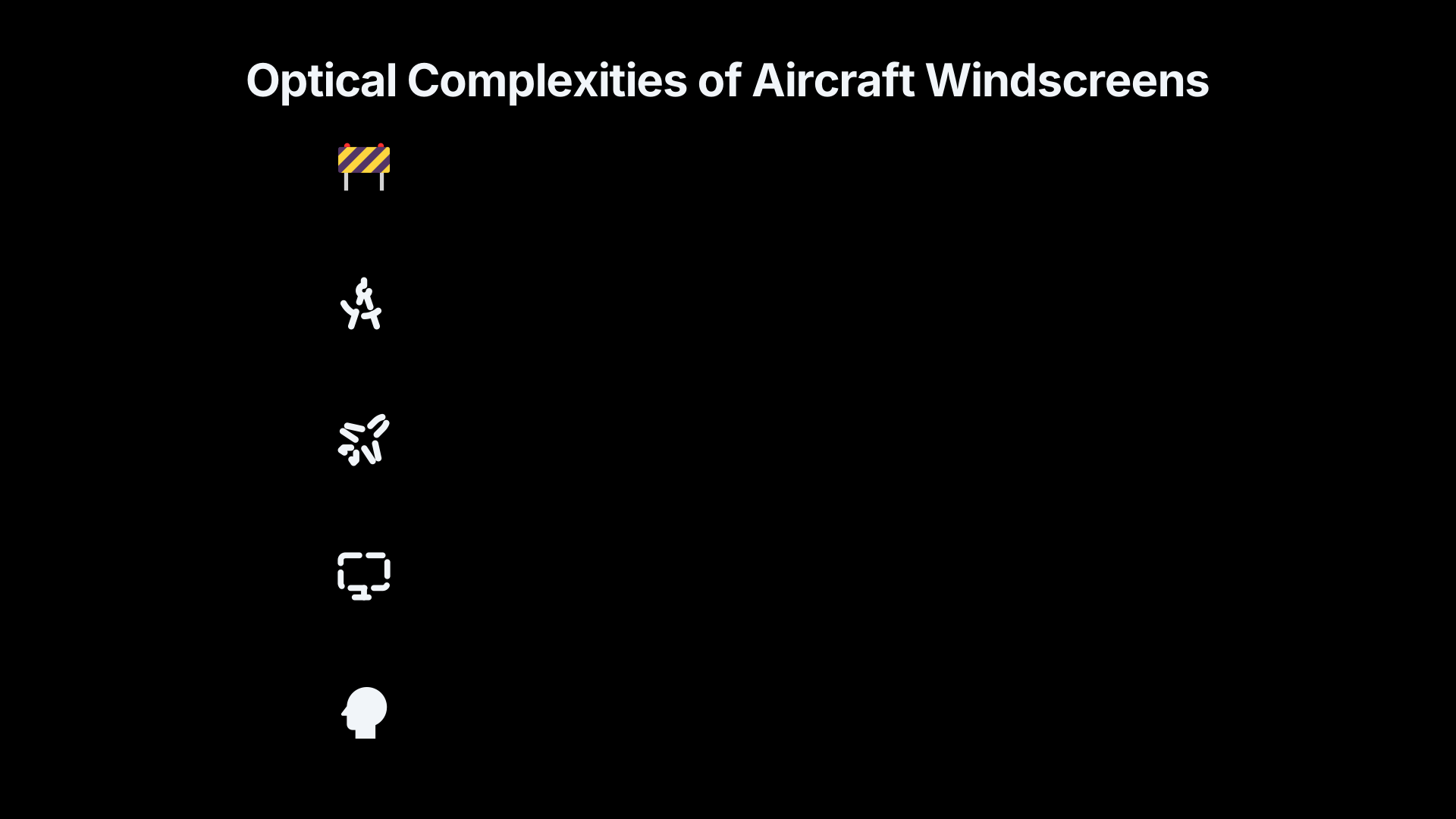
Several features can contribute to misleading visual impressions:
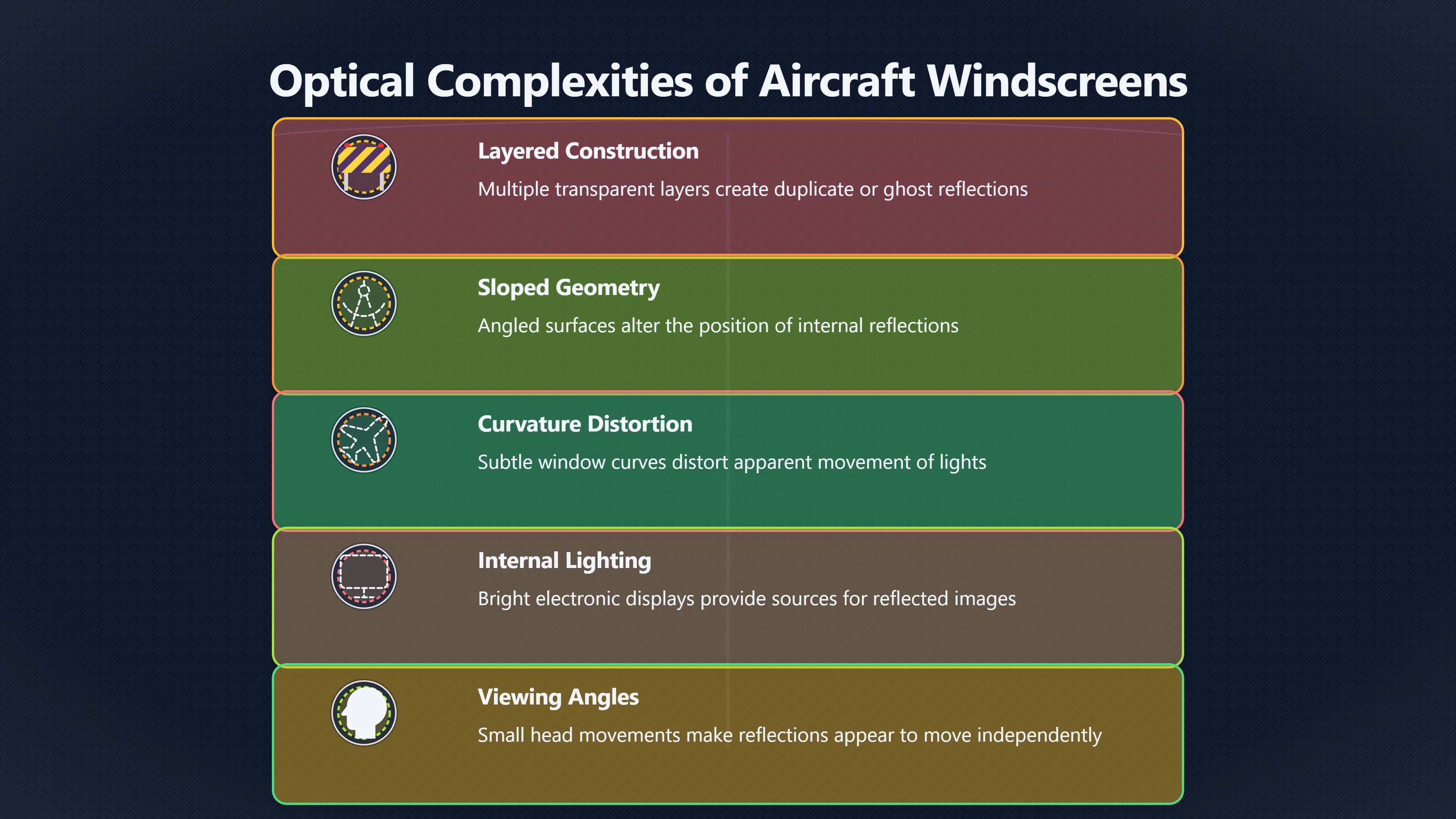
- Layered construction: Light can reflect from more than one surface, producing duplicate or displaced images.
- Sloped geometry: Windscreens are angled rather than vertical, altering where reflections appear.
- Curvature: Some cockpit windows subtly distort apparent position and movement.
- Internal lighting: Modern cockpits contain bright electronic displays, annunciators and standby instruments.
- Changing viewing angles: Small head movements can make reflected images seem to move independently.
Because reflected images are tied to the geometry of the cockpit rather than the outside world, they may behave differently from genuine external objects. However, in darkness those differences are not always immediately obvious.
The Glass-Cockpit Effect
Modern aircraft increasingly rely on electronic displays rather than traditional analogue instruments. These displays improve situational awareness but also introduce large illuminated surfaces into the cockpit. Human-factors guidance used in flight-deck evaluation specifically identifies glare and reflections as issues that must be assessed because they can interfere with outside viewing and other visual tasks. [volpe.dot.gov]volpe.dot.govHuman Factors Considerations in the Design and EvaluationFAA Aircraft Certification Test Pilots, Engineers, and Human. Factors… • Inspection of the cockpit for glare and reflections should al…
This creates an interesting tension in UFO discussions. Advanced aircraft place highly trained observers in front of sophisticated instrumentation, yet those same instruments can become sources of reflected light under certain conditions.
Why Night Flights Are Especially Vulnerable
Most reflection-related pilot sightings occur under conditions where outside visual cues are weak. Night flying provides exactly those conditions.
When the external environment is dark, the brightness contrast between cockpit lighting and the outside world increases dramatically. A reflection that would be invisible during daylight may become conspicuous after sunset. Aviation training materials repeatedly emphasise that night operations expose pilots to numerous visual illusions and misperceptions. [Federal Aviation Administration]faa.govFederal Aviation AdministrationOptical Radiation Transmittance of Aircraft Windscreens…by VB Nakagawara · 2007 · Cited by 41 — CONCLUS… [FAA Safety]faasafety.govFAA Safety Your Senses in the ShadowsNighttime Visual Illusions…During nighttime operations, pilots can fall victim to optical illusions that can drastically compromise th…
Several factors combine to increase vulnerability:
- Dark skies provide little background detail.
- Cloud tops and haze can act as projection screens for reflected light.
- Long periods of staring at distant lights reduce visual discrimination.
- Fatigue is more common during night operations.
- External reference points may be absent over oceans, deserts or remote terrain.
A small reflected light can therefore acquire an apparent distance, altitude and motion that it does not physically possess.

Reflections and Autokinetic Effects
One reason pilot reports require careful analysis is that more than one visual phenomenon may be operating simultaneously.
A stationary reflected light can interact with a well-known aviation illusion called autokinesis, in which a small isolated light appears to move when viewed against a dark background. Aviation training literature has long warned pilots about this effect. Federal Aviation Administration [Wikipedia In practice]WikipediaSensory illusions in aviationSensory illusions in aviationPilots may experience disorientation and loss of perspective, creating illusions that range from false ho…, a pilot might perceive a reflected light and then observe what appears to be movement, acceleration or directional change. The experience can feel entirely real even if no external object is present.
What Night-Flying Guidance Says About Reflections
Aviation safety guidance does not treat reflections as a trivial issue. Pilots are routinely taught to manage cockpit lighting to preserve night vision and minimise windscreen reflections.
Training materials and safety publications advise reducing cockpit illumination when possible, cross-checking visual impressions against instruments and remaining alert to night-time visual illusions. FAA-related guidance and pilot training resources specifically note that excessive cockpit lighting and device screens can hinder vision by creating reflections on windscreens and windows. [Medium]medium.comMedium[I] = Illusions. Nighttime Perils of PerceptionAt night, adjust the cockpit (and handheld device!) lights to a minimum setting so y…
Regulatory and human-factors documents go further by requiring evaluation of cockpit glare and reflections during aircraft certification. Such assessments are intended to ensure that reflected light does not impair a pilot’s ability to observe the outside environment. [volpe.dot.gov]volpe.dot.govHuman Factors Considerations in the Design and EvaluationFAA Aircraft Certification Test Pilots, Engineers, and Human. Factors… • Inspection of the cockpit for glare and reflections should al…
The existence of these procedures is significant. They demonstrate that aviation authorities regard reflected images as real operational hazards rather than theoretical curiosities.
Questions That Make Pilot Reports Easier to Evaluate
When assessing a pilot UFO report, the most useful approach is not to assume either perfect observation or mistaken observation. Instead, investigators can ask a series of targeted questions that help distinguish external objects from cockpit-generated images.
Was the object visible from more than one position?
A reflection is often sensitive to viewing angle. If changing seat position causes the object’s location to change, a reflective explanation becomes more plausible.
Did it remain visible when cockpit lighting changed?
Dimming displays, adjusting panel lighting or extinguishing cabin lights can alter or eliminate reflections. Reports that document such tests are especially valuable.
Was the object observed by multiple crew members simultaneously?
Independent observations from different cockpit positions can help determine whether a sighting was tied to a particular viewing geometry.
Did sensors confirm the visual observation?
Radar, infrared systems or other instruments may provide independent evidence that an object existed outside the aircraft. A purely visual observation demands more scrutiny of optical explanations.
Were atmospheric conditions favourable to reflections?
Night flights above cloud layers, over water or through haze often provide ideal conditions for reflected images to appear detached from the windscreen.
Why Reflection Explanations Matter Without Dismissing Pilots
Reflection-based explanations are sometimes misunderstood as attacks on witness credibility. In aviation contexts, the opposite is often true.
The fact that professional pilots are trained to recognise visual hazards is one reason aviation literature contains extensive discussions of glare, reflections and night-time illusions. Experts know that human perception operates within physical limits. A pilot can accurately report what was seen while still being mistaken about where the light originated.
For investigations into UFO reports, cockpit reflections occupy an important middle ground. They acknowledge that the witness may have observed a genuine visual phenomenon while recognising that the phenomenon may have been created by the interaction of cockpit lighting, layered windscreens and the demanding visual environment of night flight. [volpe.dot.gov]volpe.dot.govHuman Factors Considerations in the Design and EvaluationFAA Aircraft Certification Test Pilots, Engineers, and Human. Factors… • Inspection of the cockpit for glare and reflections should al… [Medium]medium.comMedium[I] = Illusions. Nighttime Perils of PerceptionAt night, adjust the cockpit (and handheld device!) lights to a minimum setting so y…
Amazon book picks
Further Reading
Books and field guides related to Can Pilots Be Fooled by Cockpit Glass?. Use these as the next step if you want deeper reading beyond the article.
The UFO Experience
Discusses witness reliability and investigation standards relevant to pilot UFO reports.
The Invisible Gorilla
Explains how trained people can still miss context or misinterpret visual information.
Visual Intelligence
Supports the theme that expertise helps but does not remove all viewing errors.
Light and Color in the Outdoors
Provides background on reflections and optical phenomena that can affect cockpit sightings.
eBay marketplace picks
Marketplace Samples
Example marketplace items related to this page. Use the search link to explore similar finds on eBay.

Endnotes
-
Source: volpe.dot.gov
Title: Human Factors Considerations in the Design and Evaluation
Link: https://www.volpe.dot.gov/sites/volpe.dot.gov/files/docs/Human_Factors_Considerations_in_the_Design_and_Evaluation_of_Flight_Deck_Displays_and_Controls_V2.pdfSource snippet
FAA Aircraft Certification Test Pilots, Engineers, and Human. Factors... • Inspection of the cockpit for glare and reflections should al...
-
Source: researchgate.net
Title: Research Gate(PDF) Optical Radiation Transmittance of Aircraft
Link: https://www.researchgate.net/publication/235201203_Optical_Radiation_Transmittance_of_Aircraft_Windscreens_and_Pilot_VisionSource snippet
ResearchGate(PDF) Optical Radiation Transmittance of Aircraft...July 1, 2007 — Optical radiation can have acute and chronic effects on t...
Published: July 1, 2007
-
Source: faa.gov
Link: https://www.faa.gov/sites/faa.gov/files/data_research/research/med_humanfacs/oamtechreports/200720.pdfSource snippet
Federal Aviation AdministrationOptical Radiation Transmittance of Aircraft Windscreens...by VB Nakagawara · 2007 · Cited by 41 — CONCLUS...
-
Source: faa.gov
Link: https://www.faa.gov/sites/faa.gov/files/regulations_policies/handbooks_manuals/aviation/airplane_handbook/12_afh_ch11.pdfSource snippet
Federal Aviation AdministrationAirplane Flying Handbook (3C) Chapter 11Two illusions that lead to spatial disorientation, false horizon a...
-
Source: Wikipedia
Title: Sensory illusions in aviation
Link: https://en.wikipedia.org/wiki/Sensory_illusions_in_aviationSource snippet
Sensory illusions in aviationPilots may experience disorientation and loss of perspective, creating illusions that [range]({{ 'range/' | relative_url }}) from false ho...
-
Source: medium.com
Link: https://medium.com/%40cianciolo/i-illusions-nighttime-perils-of-perception-446ef9e748faSource snippet
Medium[I] = Illusions. Nighttime Perils of PerceptionAt night, adjust the cockpit (and handheld device!) lights to a minimum setting so y...
-
Source: faa.gov
Link: https://www.faa.gov/sites/faa.gov/files/Night_Ops_Ch13.pdfSource snippet
windshield, it should be adjusted or turned off.Read more...
-
Source: faasafety.gov
Title: FAA Safety Your Senses in the Shadows
Link: https://www.faasafety.gov/files/events/SO/SO15/2024/SO15134204/YourSensesInTheShadows.pdfSource snippet
Nighttime Visual Illusions...During nighttime operations, pilots can fall victim to optical illusions that can drastically compromise th...
-
Source: qsl.net
Title: Night Flying
Link: https://www.qsl.net/wu1m/Night_Flying.pdfSource snippet
Bright... Crossing large bodies of water at night in single- engine airplanes...Read more...
-
Source: faasafety.gov
Title: Library Contents
Link: https://www.faasafety.gov/gslac/alc/libview_normal.aspx?id=6580Source snippet
FAA - FAASTeamGround lighting illusions. Bright runway and approach light systems, especially when few lights illuminate the surrounding...
Additional References
-
Source: instagram.com
Link: https://www.instagram.com/reel/DTn7I8BCn94/Source snippet
AirwayBuzz on Instagram: "A viral video captures a...A viral video captures a passenger's surprise as pilots use sunshades on the cockpi...
-
Source: forums.flightsimulator.com
Title: ground reflections inside cockpit windscreen too distracting
Link: https://forums.flightsimulator.com/t/ground-reflections-inside-cockpit-windscreen-too-distracting/683218Source snippet
Too distracting8 Dec 2024 — ISSUE DESCRIPTION Ground reflections passing through the aircraft striking the inside cockpit wind screen. Pr...
-
Source: ryancbinns.com
Title: Night Operations Disorientation and Night Optical Illusions
Link: [https://www.ryancbinns.com/assets/production/pdfs/flying/lessons/area_02/task_h_-night_operations.pdf](https://www.ryancbinns.com/assets/production/pdfs/flying/lessons/area_02/task_h-_night_operations.pdf)Source snippet
Night OperationsDisorientation and Night Optical Illusions - Night flying produces a number of optical illusions which can lead to spatia...
-
Source: facebook.com
Link: https://www.facebook.com/aviationgallerys/posts/a-tiktoker-noticed-that-the-cockpit-sun-blocker-was-covering-the-pilots-entire-f/987491326966482/Source snippet
rward View -both Pilots Were Calmly Seated At The Controls The...Read more...
-
Source: hartzellprop.com
Title: watch out for night flight illusions
Link: https://hartzellprop.com/watch-out-for-night-flight-illusions/Source snippet
Hartzell PropellerWatch Out for These 5 Night Flight Illusions24 Sept 2019 — Understanding how to identify the different types of nightti...
-
Source: cfinotebook.net
Link: https://www.cfinotebook.net/notebook/aeromedical-and-human-factors/spatial-disorientation-and-illusions-in-flightSource snippet
Spatial Disorientation & Illusions In FlightWhen landing at night from over water or non-lighted terrain, the runway lights are the only...
-
Source: instagram.com
Link: https://www.instagram.com/reel/DW2wjsMAJo6/Source snippet
took to get you to this point as a pilot...
-
Source: instagram.com
Link: https://www.instagram.com/p/DU2aXSPFi7e/Source snippet
𝗪𝗵𝘆 𝘁𝗵𝗲 𝗖𝗼𝗰𝗸𝗽𝗶𝘁 𝗛𝗮𝘀 𝗮 'D𝗮𝗿𝗸 𝗠𝗼𝗱𝗲...In zero visibility conditions, pilots don't rely on their eyes — they rely on their instruments...
-
Source: pilotmall.com
Title: night flying illusions explained in detail
Link: https://www.pilotmall.com/blogs/news/night-flying-illusions-explained-in-detail?srsltid=AfmBOopnRJJ6LaJfkWZE4UqIk92g-41aTbG6g4r0bOktuFcTWGO3YTgTSource snippet
If you know what to anticipate, these sensory tricks will be less likely to catch you off guard.Read more...
-
Source: ntsb.gov
Link: https://www.ntsb.gov/safety/safety-studies/Documents/SS1001.pdfSource snippet
Introduction of Glass Cockpit Avionics into Light AircraftAdvanced avionics and electronic displays can increase the safety potential of...
Topic Tree