Within Parallax
How to Check a UFO Speed Claim
Simple geometry checks can reveal whether apparent speed comes from the object, the observer, or the camera system.
On this page
- Questions to ask before estimating speed
- Evidence that can establish range independently
- Warning signs of a parallax driven claim
Page outline Jump by section
Introduction
A UFO video speed claim should not be judged from screen motion alone. The first check is whether the object’s apparent movement could come from parallax: the shift in apparent position caused by a moving observer, a panning camera, or a stabilised sensor. Without an independent range estimate, a small nearby object and a large distant object can produce similar video motion, while a slow object viewed from a fast aircraft can look extremely fast. This is why serious review starts with geometry: camera location, camera angle, platform motion, frame timing, lens field of view, and any independent evidence of distance. NASA’s UAP study warned that analysis is often hampered by missing sensor metadata and poor calibration, and AARO’s “Go Fast” case showed how a famous apparent high-speed object could be reassessed once range and viewing geometry were examined. [NASA Science]science.nasa.govScience Independent Study Team ReportNASA ScienceIndependent Study Team ReportSeptember 13, 2023 — At present, analysis of UAP data is hampered by poor sensor calibration, th…
Questions to ask before estimating speed
The first question is not “how fast does it cross the screen?” but “what angle does it move through, and how far away is it?” Video shows angular motion: movement across the image. Physical speed requires distance. A target shifting one degree per second could be a nearby bird, a distant aircraft, a balloon, or a much larger object; the same angular rate can imply very different real speeds depending on range. GEIPAN-linked UAP photo and video analysis guidance states the central problem plainly: an unknown object may be “big and far or small and near”, and distance is necessary before meaningful size, velocity, or acceleration can be measured. [cnes-geipan.fr]cnes-geipan.fr08 COUSYN LOUANGE abs ENUAP PHOTO / VIDEO AUTHENTICATION AND ANALYSISMay 11, 2014 — Making use of associated metadata and/or manufacture characteristics allows m…
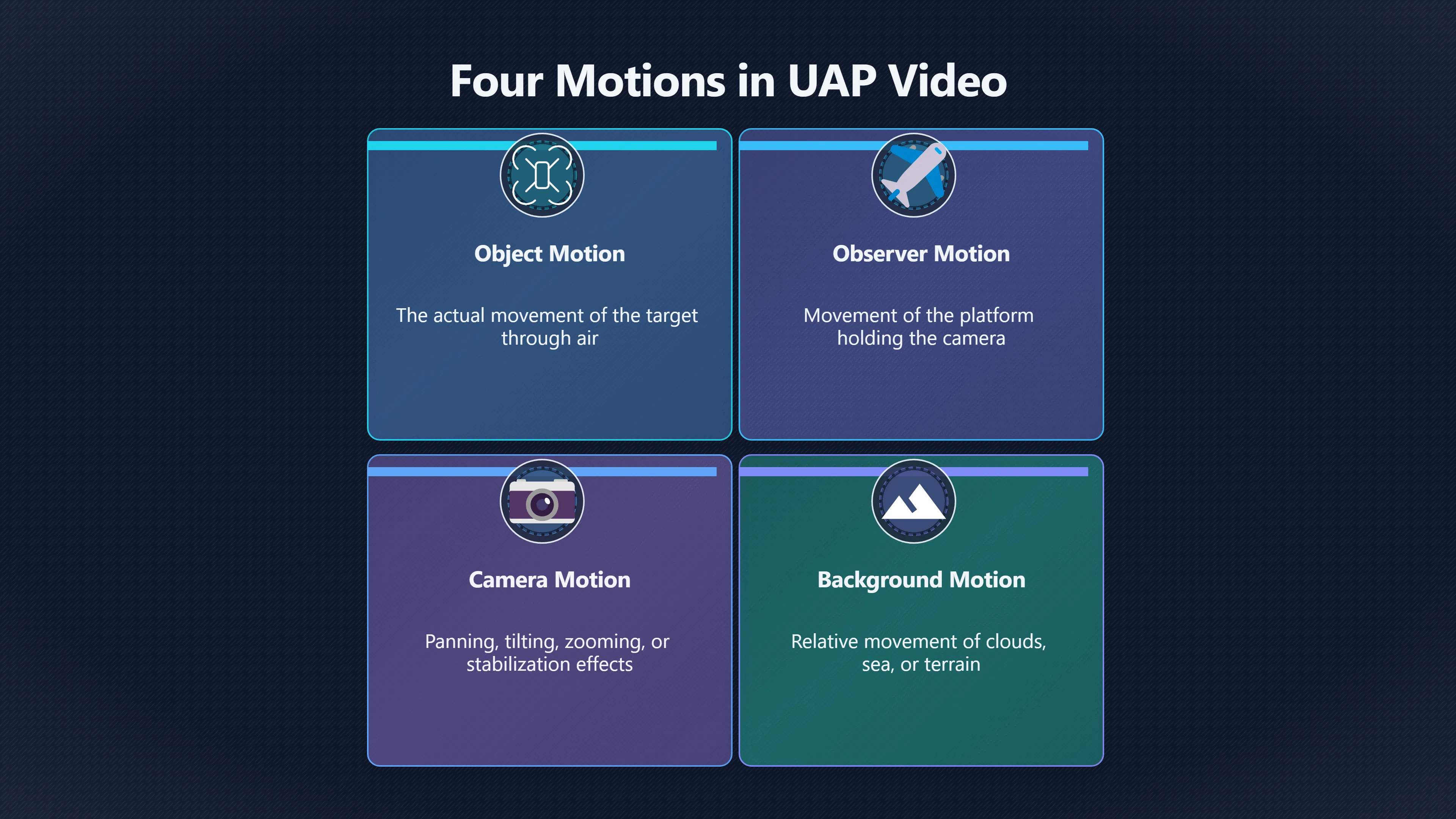
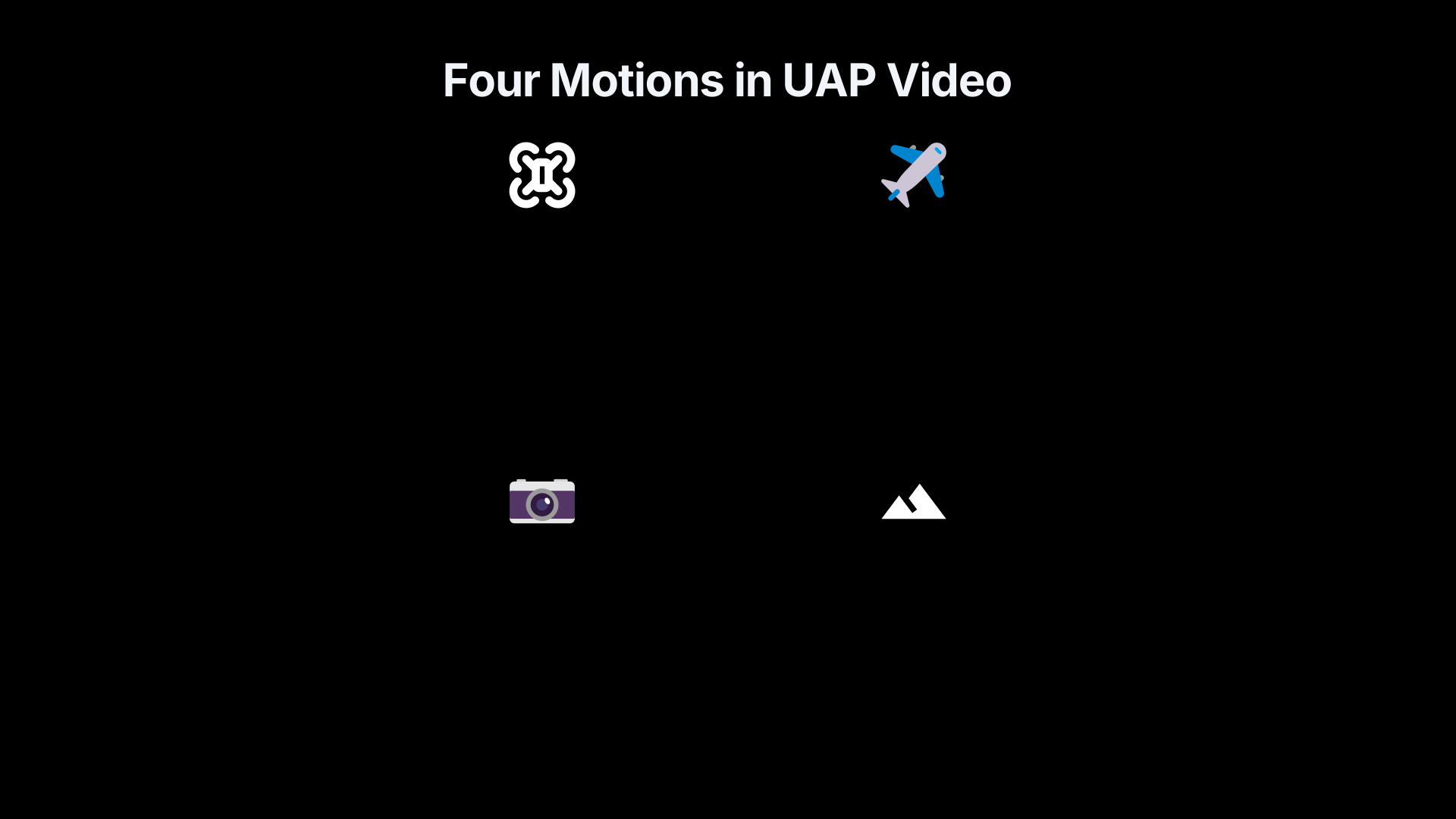
A practical first pass should separate four motions that viewers often blend together:
- Object motion: what the target itself is doing through the air.
- Observer motion: movement of the aircraft, drone, vehicle, boat, or person holding the camera.
- Camera motion: pan, tilt, zoom, stabilisation, tracking lock, or cropping.
- Background motion: clouds, sea surface, terrain, stars, buildings, or horizon features moving relative to the line of sight.
Only after those are separated should a speed estimate be attempted. A phone clip from a stationary garden, a dashcam clip from a moving car, and an infrared aircraft clip from a fast jet are not comparable evidence. The aircraft clip may contain useful telemetry, but it also contains the strongest parallax traps because the observer is moving rapidly while the sensor may be slewing and stabilising.
The “Go Fast” video is the clearest modern cautionary example. AARO assessed that the object was not near the ocean surface as widely assumed, but approximately 13,000 feet above the sea; its assessed speed was between 5 and 92 mph after accounting for wind, not anomalous high-speed flight. AARO attributed the apparent high speed to motion parallax and noted that the publicly available video still contained useful display information: sensor-to-target range, camera azimuth and elevation, aircraft altitude, speed, and bank angle. [AARO]aaro.milGo Fast Case Resolution Card Methodology FinalAAROAARO GoFast Case Resolution6 Feb 2025 — Motion parallax is an optical effect that induces an observer to perceive that a stationary o…
Evidence that can establish range independently
Range is the hinge of the whole problem. If range is unknown, a speed claim is usually only a speed-to-distance ratio dressed up as a speed. A useful review therefore asks what evidence fixes, constrains, or cross-checks distance before accepting any dramatic number.
The strongest range evidence usually comes from independent geometry or sensor data. In military or aviation footage, useful clues may include range readouts, camera elevation and azimuth, aircraft altitude, aircraft speed, radar tracks, GPS position, time stamps, and known sensor field of view. In civilian footage, the useful evidence may be more modest: a known camera location, identifiable landmarks, star positions, ADS-B aircraft tracks, multiple witnesses filming from separated locations, or an object passing behind or in front of clouds, buildings, hills, wires, or the Moon.
Good parallax checks often use a ladder of confidence:
- Direct range data: laser rangefinder, radar, stereo camera, or sensor range readout.
- Triangulation: two or more known observer positions viewing the same object at the same time.
- Scene constraints: the object passes behind a known feature or casts a shadow on a known surface.
- External correlation: aircraft tracking, balloon launch records, satellite passes, wind profiles, weather radar, or astronomical data.
- Weak visual inference: apparent size, brightness, blur, or “it looked low”, which can be badly misleading.
NASA’s UAP report argued for better calibrated, multi-sensor observation because single-source imagery is often insufficient. The report specifically highlighted missing sensor metadata, lack of multiple measurements, and lack of baseline data as barriers to analysis. That is directly relevant to parallax: a single striking video may show something real, but without range, camera geometry and timing it may not support a reliable claim about speed or acceleration. [NASA Science]science.nasa.govScience Independent Study Team ReportNASA ScienceIndependent Study Team ReportSeptember 13, 2023 — At present, analysis of UAP data is hampered by poor sensor calibration, th…
Warning signs of a parallax-driven claim
A parallax explanation becomes especially plausible when a clip depends heavily on an impression of speed but lacks independent range. This does not prove the object is mundane; it means the most dramatic interpretation has not yet earned its speed estimate.
Common warning signs include:
- The camera is moving quickly. Aircraft, drones, boats and cars create changing viewpoints that can make slow or stationary objects appear to race across a background.
- The object is tracked near the centre of the frame. A tracking camera can hide its own motion, making the target look more active than it is.
- The background is distant or featureless. Sea, clouds, haze and sky remove depth cues.
- The claim assumes low altitude. “Skimming the water” or “just above the trees” often turns out to be an assumption unless there is independent proof.
- The speed estimate starts from pixels, not angles and range. Pixel motion alone is not physical speed.
- The object never shows independent manoeuvre cues. No banking, no change in size consistent with approach, no shadow, no wake, no interaction with nearby objects.
AARO’s Puerto Rico case resolution illustrates the same general lesson beyond “Go Fast”. The widely discussed infrared video had been interpreted by some viewers as showing unusual speed and transmedium behaviour, but AARO assessed that the objects did not show anomalous speeds or transmedium capabilities and were likely two sky lanterns drifting with the wind. The important point for video review is not that every case has the same answer, but that path reconstruction and environmental checks can overturn the first visual impression. [AARO]aaro.milAAROUAP Case Resolution ReportsAARO assesses with high confidence that the objects did not demonstrate anomalous speeds or flight behavio…
A practical parallax check for UFO videos
A useful review can be simple without being casual. The aim is not to “debunk” by reflex, but to prevent a weak geometry claim from becoming an extraordinary speed claim.
Start by recording the basic facts of the clip: exact time, location, camera model if known, frame rate, lens setting, whether the video is cropped or stabilised, and whether the camera platform was moving. Then identify background references. A skyline, coastline, mountain ridge, cloud deck, star field or aircraft track can provide a geometry anchor. If there is no anchor, say so plainly; the clip may still be interesting, but it cannot carry a strong speed estimate by itself.
Next, measure angular movement rather than screen drama. If the field of view is known, the target’s movement across the frame can be converted into degrees per second. That still is not speed, but it is a cleaner intermediate value. Physical speed requires multiplying angular rate by distance, so reviewers should test a range of plausible distances rather than choosing the one that makes the object extraordinary.
Finally, ask whether a slow object plus observer motion reproduces the effect. In aircraft footage, this is often the decisive test. If the apparent motion can be produced by a distant balloon, bird, aircraft, or other ordinary object while the camera platform moves, then the video may not show anomalous performance even if the object remains unidentified. AARO’s “Go Fast” analysis followed this logic: it did not need to identify the object definitively to assess that it did not demonstrate anomalous speed. [AARO]aaro.milPuerto Rico UAP Case ResolutionPuerto Rico UAP Case Resolution

What a strong speed claim needs
A strong UFO speed claim needs more than a compelling clip. It needs a chain of measurements that survives alternative geometry. The best cases provide synchronised sensor data, independent range, known camera calibration, platform motion, environmental records, and enough original data to inspect frame timing and compression artefacts. AARO’s case pages repeatedly show the value of combining full-motion video analysis with contextual data such as geolocation, commercial flight tracks, wind data, and longer focal-length footage where available. [AARO]aaro.milOpen source on aaro.mil.
The most cautious conclusion is often the most accurate: a video may show a real object without showing extraordinary motion. Parallax checks do not make UFO videos uninteresting; they make them testable. In the study of identified flying objects, that distinction matters because many apparently impossible movements vanish once the observer’s movement, camera tracking and uncertain range are put back into the scene.
Amazon book picks
Further Reading
Books and field guides related to How to Check a UFO Speed Claim. Use these as the next step if you want deeper reading beyond the article.
The UFO Handbook
Directly addresses evaluating and reporting sightings rather than accepting impressions.
Understanding Exposure
Rating: 4.5/5 from 19 Google Books ratings
Useful for understanding camera, lens and motion artefacts in video evidence.
The Demon-Haunted World
Supports careful testing before accepting extraordinary speed claims.
eBay marketplace picks
Marketplace Samples
Example marketplace items related to this page. Use the search link to explore similar finds on eBay.



Endnotes
-
Source: science.nasa.gov
Title: Science Independent Study Team Report
Link: https://science.nasa.gov/wp-content/uploads/2023/09/uap-independent-study-team-final-report.pdfSource snippet
NASA ScienceIndependent Study Team ReportSeptember 13, 2023 — At present, analysis of UAP data is hampered by poor sensor calibration, th...
Published: September 13, 2023
-
Source: aaro.mil
Title: Go Fast Case Resolution Card Methodology Final
Link: https://www.aaro.mil/Portals/136/PDFs/case_resolution_reports/AARO_GoFast_Case_Resolution_Card_Methodology_Final.pdfSource snippet
AAROAARO [GoFast]({{ 'gofast/' | relative_url }}) Case Resolution6 Feb 2025 — Motion parallax is an optical effect that induces an observer to perceive that a stationary o...
-
Source: cnes-geipan.fr
Title: 08 COUSYN LOUANGE abs EN
Link: https://www.cnes-geipan.fr/sites/default/files/08_COUSYN_LOUANGE_abs_EN.pdfSource snippet
UAP PHOTO / VIDEO AUTHENTICATION AND ANALYSISMay 11, 2014 — Making use of associated metadata and/or manufacture characteristics allows m...
Published: May 11, 2014
-
Source: aaro.mil
Link: https://www.aaro.mil/UAP-Cases/UAP-Case-Resolution-Reports/Source snippet
AAROUAP Case Resolution ReportsAARO assesses with high confidence that the objects did not demonstrate anomalous speeds or flight behavio...
-
Source: aaro.mil
Title: Puerto Rico UAP Case Resolution
Link: https://www.aaro.mil/Portals/136/PDFs/case_resolution_reports/AARO_Puerto_Rico_UAP_Case_Resolution.pdf -
Source: aaro.mil
Link: https://www.aaro.mil/UAP-Cases/Official-UAP-Imagery/
Additional References
-
Source: youtube.com
Title: Mick West: Debunking the Navy UFO Videos
Link: https://www.youtube.com/watch?v=ciopi2r7j-kSource snippet
How to Analyze UAP Footage: A Scientific Approach...
-
Source: youtube.com
Title: Parallax and the “Fast Mover” UFO Explained
Link: https://www.youtube.com/watch?v=2v066sM4lF8Source snippet
Analyzing the Pentagon's "Go Fast" UAP Video...
-
Source: youtube.com
Title: Analyzing the Pentagon’s “Go Fast” UAP Video
Link: https://www.youtube.com/watch?v=R9V43K2d5eASource snippet
Mick West: Debunking the Navy UFO Videos...
-
Source: youtube.com
Title: The Physics of Parallax in UFO Videos
Link: https://www.youtube.com/watch?v=01eX1J4-5DkSource snippet
Parallax and the "Fast Mover" UFO Explained...
-
Source: youtube.com
Title: How to Analyze UAP Footage: A Scientific Approach
Link: https://www.youtube.com/watch?v=5-o3q56pD-M
Topic Tree