Within Stars
Why Planets Usually Twinkle Less Than Stars
Planets usually look steadier than stars, but bright low planets can still flash and confuse witnesses.
On this page
- Point sources versus small discs
- When Venus can still flash colours
- How the comparison helps UFO checks
Page outline Jump by section
Introduction
When people report a bright, flashing object in the night sky, one of the first questions is whether they were looking at a star or a planet. The distinction matters because stars are far more likely to produce dramatic twinkling and rapid colour changes, while planets usually appear steadier. Yet the rule is not absolute. Bright planets—especially Venus when it is low above the horizon—can also shimmer, flash colours and attract UFO reports. Understanding why stars and planets behave differently is a useful reality check when evaluating unexplained lights. [EarthSky]earthsky.orgEarth Sky Why do stars twinkle, but planets do not?planets are a steadier light Planets shine more steadily because they're closer to Earth…
Point Sources Versus Small Discs
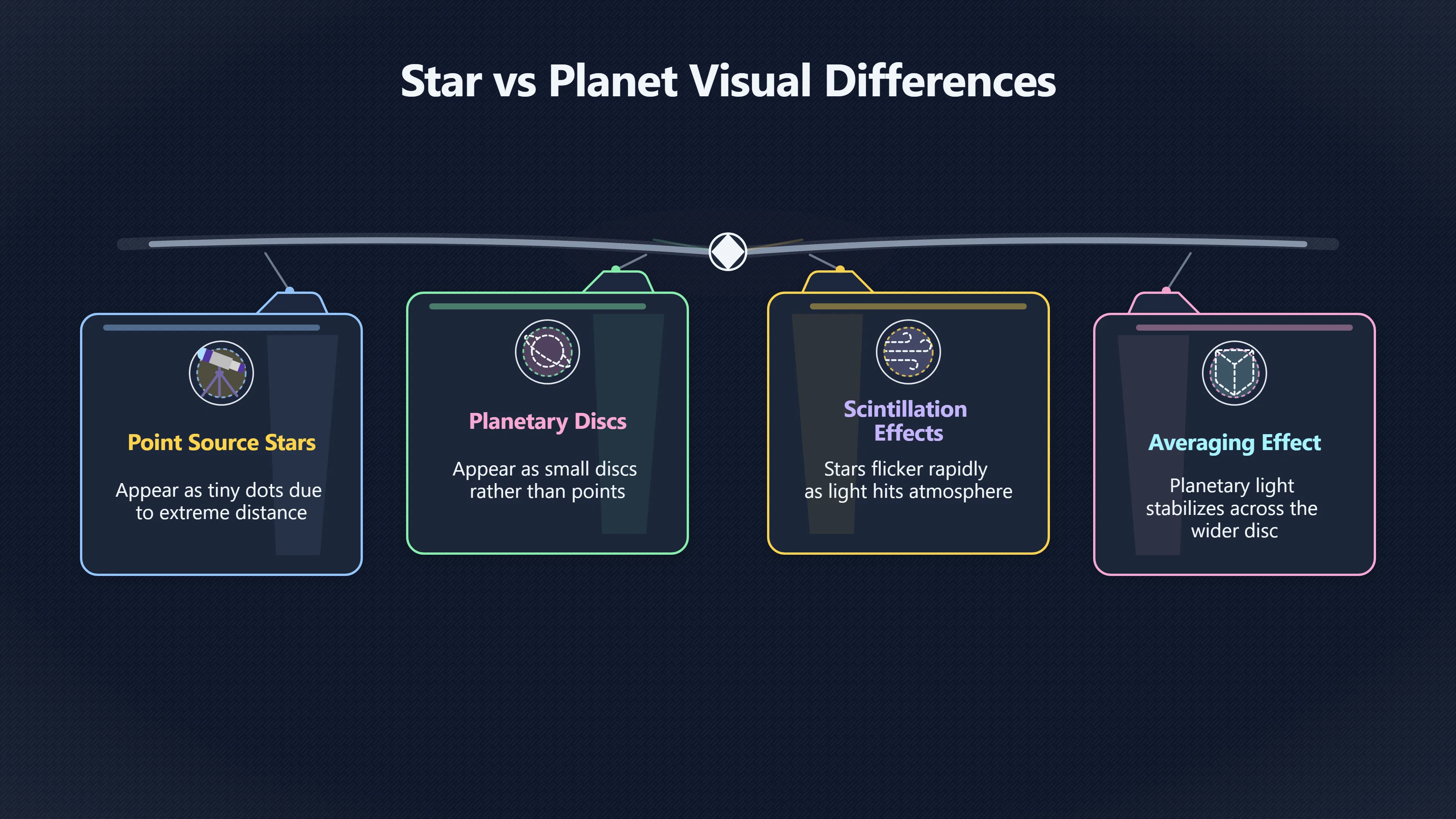
The key difference is not that planets are immune to atmospheric effects. Both stars and planets shine through the same turbulent atmosphere. The difference is apparent size.
Stars are so distant that they appear as tiny points of light, even through substantial telescopes. Small pockets of moving air can therefore affect most of the visible light from a star at once. The result is scintillation: rapid fluctuations in brightness, colour and apparent position. [EarthSky]earthsky.orgEarth Sky Why do stars twinkle, but planets do not?planets are a steadier light Planets shine more steadily because they're closer to Earth… [Sky at Night Magazine]skyatnightmagazine.comwhy do stars twinkleSky at Night MagazineWhy do stars twinkle?2 May 2025 — Stars appear to twinkle because their light passes through our atmosphere and is b…
Planets, by contrast, are much closer and appear as tiny discs rather than perfect points. Different parts of the planetary disc are distorted in slightly different ways by the atmosphere. These distortions tend to average out, making the planet look more stable to the naked eye. Astronomers often describe this as an averaging effect: one side of the disc may be momentarily brightened while another side is dimmed, reducing the overall flicker seen by the observer. [EarthSky]earthsky.orgEarth Sky Why do stars twinkle, but planets do not?planets are a steadier light Planets shine more steadily because they're closer to Earth… [SMU]demos.smu.caDemos Why Don't Planets Twinkle?SMU DemosWhy Don't Planets Twinkle? - Physics DemosWhen observing the planets in night sky, they do not appear to twinkle. This is due to…
For UFO investigations, this comparison is valuable because witnesses often describe a suspicious light as “not twinkling”. That observation may rule out some stars, but it does not automatically exclude a planet. Bright planets commonly appear steady enough to be mistaken for hovering aircraft, drones or distant craft. [EarthSky]earthsky.orgEarth Sky Why do stars twinkle, but planets do not?planets are a steadier light Planets shine more steadily because they're closer to Earth…
When Venus Can Still Flash Colours
Venus is the major exception that repeatedly confuses observers.
Although planets usually shine steadily, Venus can become a surprisingly dramatic object when viewed low in the sky. Near the horizon, its light must travel through a much thicker layer of atmosphere. Turbulence and atmospheric refraction become stronger, producing flashes of red, green, blue and white that resemble the colour-changing behaviour more commonly associated with bright stars. [EarthSky]earthsky.orgEarth Sky Why do stars twinkle, but planets do not?planets are a steadier light Planets shine more steadily because they're closer to Earth… EarthSky This can be especially misleading because Venus is extraordinarily bright. At certain points in its cycle it outshines every star in the sky. [earthsky.org]earthsky.orgEarth Sky Why do stars twinkle, but planets do not?planets are a steadier light Planets shine more steadily because they're closer to Earth… A witness who expects a planet to look calm may instead see a brilliant object flashing colours and conclude that it cannot be a natural astronomical object. [EarthSky]earthsky.orgEarth Sky Why do stars twinkle, but planets do not?planets are a steadier light Planets shine more steadily because they're closer to Earth…
Historical UFO report catalogues contain many examples in which Venus was initially reported as a hovering or slowly moving unidentified object. The combination of exceptional brightness, low altitude and occasional colour scintillation makes it one of the most persistent astronomical sources of misidentification. [EarthSky]earthsky.orgEarth Sky Why do stars twinkle, but planets do not?planets are a steadier light Planets shine more steadily because they're closer to Earth…
Why Witnesses Often Misjudge the Difference
The popular saying that “stars twinkle, planets do not” is useful but oversimplified. [skyatnightmagazine.com]skyatnightmagazine.comwhy do stars twinkleSky at Night MagazineWhy do stars twinkle?2 May 2025 — Stars appear to twinkle because their light passes through our atmosphere and is b…
Observers usually encounter celestial objects under imperfect conditions. City lights, haze, thin cloud, atmospheric turbulence and low viewing angles can all exaggerate scintillation. A bright star such as Sirius may flash intensely, while a nearby planet appears steady. On another night, a low Venus may shimmer enough to resemble the star. The difference becomes one of degree rather than an absolute yes-or-no test. [Sky at Night Magazine]skyatnightmagazine.comwhy do stars twinkleSky at Night MagazineWhy do stars twinkle?2 May 2025 — Stars appear to twinkle because their light passes through our atmosphere and is b… [astronomy]astronomy.comwhy do some stars appear to twinkle while others dontAstronomy MagazineWhy do some stars appear to twinkle while others don't?7 May 2026 — Stars twinkle and sometimes appear to move around d… Human perception adds another complication. Rapid colour changes are often interpreted as artificial lighting systems. Small atmospheric shifts can also create the impression that an object is moving, pulsing or changing shape. When observers already suspect aircraft, drones or unusual craft, atmospheric effects can reinforce that interpretation. [Sky at Night Magazine]skyatnightmagazine.comwhy do stars twinkleSky at Night MagazineWhy do stars twinkle?2 May 2025 — Stars appear to twinkle because their light passes through our atmosphere and is b… [Astronomy]astronomy.comwhy do some stars appear to twinkle while others dontAstronomy MagazineWhy do some stars appear to twinkle while others don't?7 May 2026 — Stars twinkle and sometimes appear to move around d…
How the Comparison Helps UFO Checks
A practical UFO assessment can use the star-versus-planet distinction as an initial filter.
Several clues favour a star:
- Strong, rapid colour changes.
- Pronounced twinkling or flickering.
- Greater instability when the object is low above the horizon.
-
A position that remains fixed relative to surrounding stars over time. [Sky at Night Magazine]skyatnightmagazine.comwhy do stars twinkleSky at Night MagazineWhy do stars twinkle?2 May 2025 — Stars appear to twinkle because their light passes through our atmosphere and is b… EarthSky Several clues favour a planet: [earthsky.org]earthsky.orgEarth Sky Why do stars twinkle, but planets do not?planets are a steadier light Planets shine more steadily because they're closer to Earth…
- A generally steadier appearance.
- Exceptional brightness without intense flickering.
- Visibility in the western evening sky or eastern morning sky during well-known Venus apparitions.
- A telescope revealing a tiny disc rather than a pinpoint. [EarthSky]earthsky.orgEarth Sky Why do stars twinkle, but planets do not?planets are a steadier light Planets shine more steadily because they're closer to Earth… [SMU]demos.smu.caDemos Why Don't Planets Twinkle?SMU DemosWhy Don't Planets Twinkle? - Physics DemosWhen observing the planets in night sky, they do not appear to twinkle. This is due to…
The important caution is that neither category provides certainty by itself. Bright low planets can scintillate, and bright stars can sometimes appear surprisingly steady. The comparison works best as a probability test: dramatic colour-flashing usually points toward a star, while a bright, comparatively stable light is more likely to be a planet. Recognising that both can be affected by the atmosphere helps prevent ordinary astronomical objects from being mistaken for extraordinary aerial phenomena. [EarthSky]earthsky.orgEarth Sky Why do stars twinkle, but planets do not?planets are a steadier light Planets shine more steadily because they're closer to Earth… [EarthSky]earthsky.orgEarth Sky Why do stars twinkle, but planets do not?planets are a steadier light Planets shine more steadily because they're closer to Earth…
Amazon book picks
Further Reading
Books and field guides related to Why Planets Usually Twinkle Less Than Stars. Use these as the next step if you want deeper reading beyond the article.
Turn Left at Orion
Explains what planets and stars look like through common observing setups.
eBay marketplace picks
Marketplace Samples
Example marketplace items related to this page. Use the search link to explore similar finds on eBay.


Endnotes
-
Source: earthsky.org
Title: Earth Sky Why do stars twinkle, but planets do not?
Link: https://earthsky.org/space/why-dont-planets-twinkle-as-stars-do/Source snippet
planets are a steadier light Planets shine more steadily because they're closer to Earth...
-
Source: earthsky.org
Title: colors scintillating venus mar 2017 photos
Link: https://earthsky.org/astronomy-essentials/colors-scintillating-venus-mar-2017-photos/Source snippet
EarthSkyColors of scintillating Venus | Astronomy Essentials25 Mar 2017 — Planets usually shine steadily. But [bright Venus]({{ 'bright-venus/' | relative_url }}) is twinkling n...
-
Source: demos.smu.ca
Title: Demos Why Don’t Planets Twinkle?
Link: https://demos.smu.ca/demos/astronomy/25-non-twinkling-planetsSource snippet
SMU DemosWhy Don't Planets Twinkle? - Physics DemosWhen observing the planets in night sky, they do not appear to twinkle. This is due to...
-
Source: astronomy.com
Title: why do some stars appear to twinkle while others dont
Link: https://www.astronomy.com/observing/why-do-some-stars-appear-to-twinkle-while-others-dont/Source snippet
Astronomy MagazineWhy do some stars appear to twinkle while others don't?7 May 2026 — Stars twinkle and sometimes appear to move around d...
Published: May 2026
-
Source: skyatnightmagazine.com
Title: why do stars twinkle
Link: https://www.skyatnightmagazine.com/space-science/why-do-stars-twinkleSource snippet
Sky at Night MagazineWhy do stars twinkle?2 May 2025 — Stars appear to twinkle because their light passes through our atmosphere and is b...
Published: May 2025
-
Source: Wikipedia
Link: https://en.wikipedia.org/wiki/Venus
Additional References
-
Source: cosmonova.org
Link: https://cosmonova.org/why-do-stars-twinkle/Source snippet
Why Do Stars Twinkle? | CosmoNovaWhy does it happen? The color of any star is a mix of different wavelengths of light. As atmospheric gas...
-
Source: reddit.com
Link: https://www.reddit.com/r/space/comments/r953t/star_twinkle_planets_dont/ -
Source: facebook.com
Link: https://www.facebook.com/MoonlitEarth/posts/venus-does-not-twinkle-like-stars-and-theres-a-reasonstars-appear-to-flicker-bec/122149176254970955/ -
Source: primitiveproton.com
Link: https://primitiveproton.com/atmospheric-scintillation-why-stars-twinkle-and-planets-dont/Source snippet
shine steadily as there is no atmospheric turbulence to cause them to twinkle.Read more...
-
Source: math.ucr.edu
Link: https://math.ucr.edu/home/baez/physics/General/twinkle.htmlSource snippet
far ones like nebulae, do not twinkle if they are sufficiently large.Read more...
-
Source: reddit.com
Link: https://www.reddit.com/r/AskPhysics/comments/ripgx5/why_do_some_astronomers_say_that_stars_twinkle/Source snippet
ut almost all say that stars twinkle whereas planets do not.Read more...
-
Source: khanacademy.org
Title: Why do stars twinkle (but planets don’t)?
Link: https://www.khanacademy.org/science/in-in-class10th-physics/in-in-the-human-eye-and-the-colourful-world/in-in-atmospheric-refraction/v/why-do-stars-twinkle-but-planets-dontSource snippet
(video)The stars only twinkle due to our atmosphere and we know this because if you look at the stars from outside our atmosphere like th...
-
Source: instagram.com
Link: https://www.instagram.com/reel/DRQGKHQEWGA/Source snippet
rature in the atmosphere causes the change of refractive index...
-
Source: spaceplacecanada.ca
Title: Space Place Why do stars twinkle?
Link: https://www.spaceplacecanada.ca/2020/01/25/twinklingstars/Source snippet
Why do stars twinkle? - Space Place25 Jan 2020 — Light from objects straight overhead (at zenith) travel through less air compared to sta...
-
Source: youtube.com
Title: Neil de Grasse Tyson Explains Why Stars Twinkle
Link: http://www.youtube.com/watch?v=nnBpnv2OH3cSource snippet
Why do stars twinkle but planets don't explained Why do stars twinkle (but planets don't)? | Human eye & colourful world | Khan Academy...
Topic Tree