Within Size Errors
Why Fireballs Look Closer Than They Are
Bright meteors can feel close to the ground even when they are tens or hundreds of miles away.
On this page
- Why meteors seem to fall nearby
- Altitude and distance traps in fireball reports
- Separating angular path from physical path
Page outline Jump by section
Introduction
Bright fireballs are among the most convincing sources of sincere UFO reports because they often look far closer to the ground than they really are. A witness may watch a blazing object streak across the sky, fragment into glowing pieces, and apparently disappear behind a nearby hill or tree line. The natural conclusion is that something has crashed just beyond the horizon. In reality, the object may still have been tens or even hundreds of kilometres away and dozens of kilometres above the Earth.
 This “nearby meteor illusion” arises from the same distance-estimation problem that affects many aerial sightings. The observer sees a bright object moving across an apparently flat sky but lacks reliable depth cues. Fireballs are especially prone to this effect because they are extraordinarily bright, can be visible over huge areas, and often appear to descend steeply toward the horizon even when their actual trajectory remains high in the atmosphere. Most visible meteors occur between roughly 80 and 120 kilometres altitude, and even exceptionally bright fireballs usually remain far above ordinary aircraft heights. [amsmeteors.org]amsmeteors.orgMeteor FAQsThis “meteoric region” lies between about 80 km and 120 km (50 to 75 miles) in altitude. This is a general guideline only, sin…
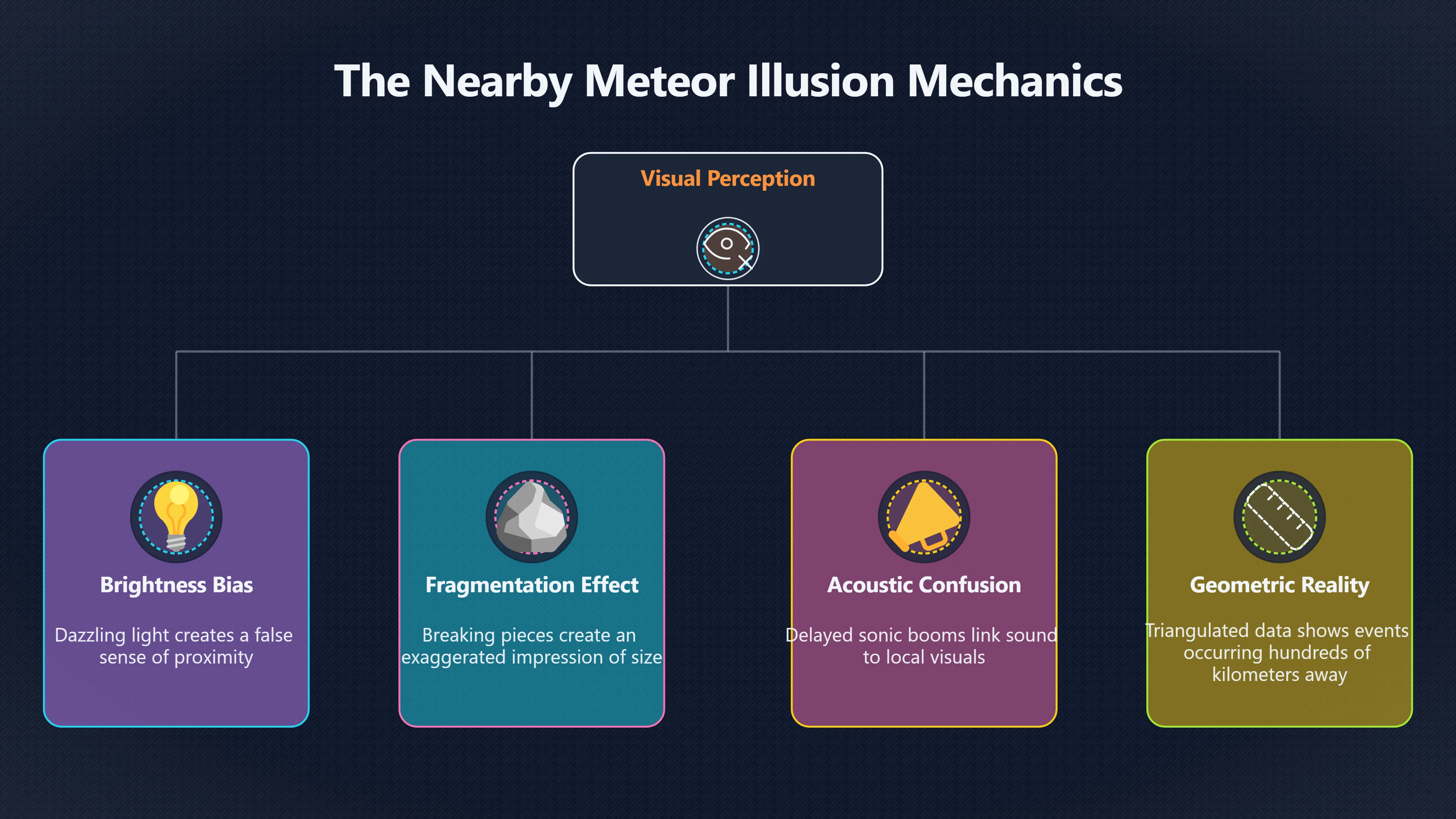
Why meteors seem to fall nearby
Human vision is much better at judging distance on the ground than in the sky. Roads, buildings, trees and familiar objects provide scale. A fireball provides almost none.
A bright meteor can cross a large angle of sky in only a few seconds. Because it appears to move downward, many observers instinctively interpret the event as a nearby object dropping toward the ground. Yet what the eye actually sees is angular motion, not physical distance.
A useful comparison is watching an aircraft approach a distant horizon. From one viewpoint it may seem to descend behind nearby hills even though it remains many kilometres away. Fireballs create the same effect on a much larger scale because they are brighter, faster and usually lack visible structure.
The phenomenon is so common that meteor organisations routinely receive reports claiming a fireball landed just beyond a local neighbourhood, while triangulated observations later show the event occurred hundreds of kilometres away. Fireballs are specifically known for being visible across very wide geographic regions, often spanning multiple states or countries. [CNEOS]cneos.jpl.nasa.govCNEOSFireballs and bolidesFireballs and bolides are astronomical terms for exceptionally bright meteors that are spectacular enough to to…
Brightness creates a false sense of proximity
People often associate brightness with nearness. A dazzling fireball can illuminate clouds, cast shadows, or appear larger than the Moon. The brain tends to interpret such intensity as evidence that the object must be close.
The relationship is misleading. Fireballs become bright because meteoroids enter the atmosphere at enormous speeds and convert kinetic energy into light. Even relatively small objects can produce spectacular displays while remaining tens of kilometres above the surface. NASA analyses of recent fireball events have repeatedly shown fragmentation heights around 30 to 50 miles (roughly 50 to 80 kilometres), despite widespread reports from observers who felt the objects were almost overhead or about to land nearby. [The Verge]theverge.comThe Verge NASA confirms exploding meteor caused the sonic boom over BostonThe event produced a sonic boom that shook houses across the region, prompting initial speculation of an earthquake. However, the US Geol… [NASA]cneos.jpl.nasa.govCNEOSFireballs and bolidesFireballs and bolides are astronomical terms for exceptionally bright meteors that are spectacular enough to to…
Altitude and distance traps in fireball reports
One reason fireballs generate UFO reports is that witnesses often transform an angular observation into a physical estimate without realising it.
A report might state:
“The object fell behind the woods.”
What was actually observed was that the luminous trail disappeared below the observer’s horizon line. The witness did not directly observe where the object was in three-dimensional space.
Similarly, statements such as:
- “It landed just beyond town.”
- “It crashed into the next valley.”
- “It came down behind the ridge.”
- “It was only a few hundred metres away.”
are often sincere interpretations rather than measured facts.
Meteor investigations frequently show that observers in widely separated locations all believed the same fireball landed nearby. This is geometrically impossible, yet entirely understandable. Each person is viewing the event from a different angle and unconsciously projecting it into local terrain.
A dramatic example comes from large bolides that generate hundreds of reports over broad regions. Recent fireballs over North America have been observed across multiple states and Canadian provinces simultaneously while fragmenting at altitudes around 40 miles (64 kilometres) or more. [The Guardian]theguardian.comAccording to NASA, the meteor was traveling at around 75,000 mph and fragmented about 40 miles above ground, releasing energy equivalent… [The Verge]theverge.comThe Verge NASA confirms exploding meteor caused the sonic boom over BostonThe event produced a sonic boom that shook houses across the region, prompting initial speculation of an earthquake. However, the US Geol…
Why fragmentation makes the illusion stronger
Many fireballs break apart during flight. To a witness, this can resemble an object exploding, ejecting pieces, changing direction, or deploying smaller craft.
In reality, fragmentation is a normal consequence of atmospheric stress. As the meteoroid encounters denser air, it can crack and shed material, creating multiple glowing fragments moving along similar trajectories.
Because the fragments spread apart visually, observers often gain an exaggerated impression of size. A small meteoroid producing a wide glowing debris field can appear enormous. The combination of fragmentation, brightness and uncertain distance sometimes leads witnesses to describe a “huge craft” when the original object was comparatively small. [NASA Science]science.nasa.govNASA ScienceMeteors and Meteorites: Facts14 Feb 2025 — In 2013 the world was startled by a brilliant fireball that streaked across the sk…
Why sound often confuses the picture
Sound can make a distant meteor feel even more local.
A large fireball may produce sonic booms or other acoustic effects. Unlike light, sound travels slowly. A witness may see the flash and then hear a boom tens of seconds or even minutes later.
Without careful timing, the brain tends to connect the sound with the apparent position of the fireball rather than its actual distance. In some cases people interpret delayed booms as evidence that the object exploded nearby, even though the source may have been dozens of kilometres away. Fireball reporting guides therefore encourage witnesses to record the delay between the visual event and any sound because the delay can help estimate distance. [popastro.com]popastro.comDetailed Fireball Reporting Guide - Meteor SectionJanuary 18, 2018 — In all cases, note down what sounds you heard, and what the approxim…
The 2013 Chelyabinsk event in Russia demonstrated this dramatically. The meteor exploded roughly 23 kilometres above the ground, yet the resulting shock wave affected a huge area and shattered windows far from the airburst location. [NASA Science]science.nasa.govNASA ScienceMeteors and Meteorites: Facts14 Feb 2025 — In 2013 the world was startled by a brilliant fireball that streaked across the sk…
More recent North American fireballs have likewise generated widespread reports of booms and shaking while fragmentation occurred around 30 to 40 miles above the surface. [The Guardian]theguardian.comAccording to NASA, the meteor was traveling at around 75,000 mph and fragmented about 40 miles above ground, releasing energy equivalent… [The Verge]theverge.comThe Verge NASA confirms exploding meteor caused the sonic boom over BostonThe event produced a sonic boom that shook houses across the region, prompting initial speculation of an earthquake. However, the US Geol…
Separating angular path from physical path
The most reliable way to avoid the nearby meteor illusion is to separate what was seen from what was inferred.
A witness can usually estimate:
- Where the meteor appeared in the sky.
- How long it remained visible.
- Its direction of travel.
- Whether it brightened, dimmed or fragmented.
- Its angular path relative to stars, the Moon or landmarks.
Those observations are valuable.
By contrast, estimates such as:
- its actual height,
- its physical size,
- where it landed,
- how far away it was,
usually require additional data from other observers, cameras, radar systems or satellite measurements.
Meteor researchers routinely reconstruct trajectories by combining many independent reports. Events that looked local from dozens of separate locations often turn out to have occurred high above the atmosphere over a completely different region. This is why modern investigations place much greater weight on triangulation and geometry than on individual impressions of distance. [CNEOS]cneos.jpl.nasa.govfollowing chart shows reported fireball events for which geographic location data are provided. Each event's calculated total impact ener…
What this means for UFO reports
Within the broader category of distance and size errors, fireballs illustrate an important point: an eyewitness can be completely honest and still be dramatically wrong about range.
The witness may accurately report a brilliant object, rapid motion, fragmentation and even accompanying sounds. The error enters when the brain converts those observations into a physical story about something descending nearby.
Many UFO reports that begin with descriptions such as “a glowing object dropped behind the trees” or “a bright craft crashed beyond the hills” eventually prove consistent with a distant meteor or fireball. The sighting itself was real. The mistaken element was the perceived distance.
For investigators, that distinction matters. The question is often not whether something was seen, but whether the sky provided enough information to judge how far away it actually was. Fireballs are among the clearest demonstrations that the answer is frequently no.
Amazon book picks
Further Reading
Books and field guides related to Why Fireballs Look Closer Than They Are. Use these as the next step if you want deeper reading beyond the article.
Turn Left at Orion
Supports skywatching literacy relevant to meteor and fireball reports.
The Backyard Astronomer's Guide
Provides broader context for interpreting bright transient sky events.
The Invisible Gorilla
Explains why dramatic events can produce confident but mistaken distance impressions.
eBay marketplace picks
Marketplace Samples
Example marketplace items related to this page. Use the search link to explore similar finds on eBay.



Endnotes
-
Source: amsmeteors.org
Link: https://www.amsmeteors.org/meteor-showers/meteor-faq/Source snippet
Meteor FAQsThis “meteoric region” lies between about 80 km and 120 km (50 to 75 miles) in altitude. This is a general guideline only, sin...
-
Source: cneos.jpl.nasa.gov
Link: https://cneos.jpl.nasa.gov/fireballs/intro.htmlSource snippet
CNEOSFireballs and bolidesFireballs and bolides are astronomical terms for exceptionally bright meteors that are spectacular enough to to...
-
Source: nasa.gov
Title: its fireball season answering your meteor questions
Link: https://www.nasa.gov/blogs/watch-the-skies/2026/03/26/its-fireball-season-answering-your-meteor-questions/Source snippet
NASAIt's Fireball Season! Answering Your Meteor Questions26 Mar 2026 — The fireball – caused by a small asteroid nearly 6 feet in diamete...
-
Source: science.nasa.gov
Link: https://science.nasa.gov/solar-system/meteors-meteorites/facts/Source snippet
NASA ScienceMeteors and Meteorites: Facts14 Feb 2025 — In 2013 the world was startled by a brilliant fireball that streaked across the sk...
-
Source: popastro.com
Link: https://www.popastro.com/meteor/detailed-fireball-reporting-guide/Source snippet
Detailed Fireball Reporting Guide - Meteor SectionJanuary 18, 2018 — In all cases, note down what sounds you heard, and what the approxim...
Published: January 18, 2018
-
Source: cneos.jpl.nasa.gov
Link: https://cneos.jpl.nasa.gov/fireballs/Source snippet
following chart shows reported fireball events for which geographic location data are provided. Each event's calculated total impact ener...
-
Source: nasa.gov
Link: https://www.nasa.gov/Source snippet
NASANASA explores the unknown in air and space, innovates for the benefit of humanity, and inspires the world through discovery. About NA...
-
Source: nasa.gov
Link: https://www.nasa.gov/blogs/watch-the-skies/page/17/Source snippet
Watch the Skies8 Sept 2014 — Last night at 8:38:30 PM CDT, a basketball size meteoroid entered the atmosphere 63 miles above Columbia, So...
-
Source: amsmeteors.org
Link: https://amsmeteors.org/fireballs/faqf/Source snippet
Fireball FAQsThis is more likely if the bolide occurs at an altitude angle of about 45 degrees or so for the observer, and is less likely...
-
Source: amsmeteors.org
Link: https://amsmeteors.org/ams-q1-2026-fireball-analysis.htmlSource snippet
Q1 2026: Has Something Changed in the Near-Earth...Mar 25, 2026 — Daytime Fireball & Meteorite Fall Over Houston, TX — 181 Reports...
-
Source: space.com
Link: https://www.space.com/stargazing/meteor-showers/fireball-sightings-are-surging-across-the-us-heres-whats-really-going-onSource snippet
Fireball sightings are surging across the USMar 27, 2026 — Many fireballs lasted a long time and were seen across wide areas. Some caused...
-
Source: youtube.com
Title: Why Meteors Seem to Fall Nearby
Link: https://www.youtube.com/watch?v=F07212F_S68Source snippet
The Illusion of Nearby Fireballs...
-
Source: ebsco.com
Link: https://www.ebsco.com/research-starters/astronomy-and-astrophysics/fireballSource snippet
About one in every thousand meteors is a fireball. Fireballs are generally...Read more...
-
Source: theverge.com
Title: The Verge NASA confirms exploding meteor caused the sonic boom over Boston
Link: https://www.theverge.com/science/940467/meteor-exploded-new-englandSource snippet
The event produced a sonic boom that shook houses across the region, prompting initial speculation of an earthquake. However, the US Geol...
-
Source: theguardian.com
Link: https://www.theguardian.com/science/2026/jun/01/meteor-massachusetts-sonic-boomSource snippet
According to NASA, the meteor was traveling at around 75,000 mph and fragmented about 40 miles above ground, releasing energy equivalent...
-
Source: abcnews.com
Link: https://abcnews.com/US/daylight-fireball-meteor-rattled-parts-new-york-city/story?id=112006023Source snippet
Daylight fireball meteor may have rattled parts of New York...Officials report that the fireball may have flown at 34000 miles per hour...
-
Source: Wikipedia
Link: https://en.wikipedia.org/wiki/MeteorSource snippet
MeteorMeteors become visible between about 75 to 120 km (47 to 75 mi) above Earth. They usually disintegrate at altitudes of 50 to 95...
Additional References
-
Source: facebook.com
Link: https://www.facebook.com/WorldNewsTonight/posts/a-bright-fireball-spotted-over-the-skies-of-texas-crashes-into-a-home-in-the-hou/1459588482501595/Source snippet
A bright fireball spotted over the skies of Texas crashes into...A fireball that made an entry near McAllen on Wednesday was a meteoroid...
-
Source: weather.com
Link: https://weather.com/science/space/video/fireball-washington-oregon-british-columbiaSource snippet
Bright Fireball Streaks Over Washington, Oregon | Weather.comA brilliant ball of light streaked across the sky early Wednesday in Washing...
-
Source: facebook.com
Link: https://www.facebook.com/JoeRaoWeather/posts/around-2-pm-saturday-afternoon-nearly-300-reports-came-in-across-eastern-massach/1579364043549177/Source snippet
Joe RaoOver 150 people reported the event on the American Meteor Society's fireball log—one person in Vermont reported hearing a rumbling...
-
Source: facebook.com
Link: https://www.facebook.com/mlive/posts/-did-you-see-this-monday-night-the-american-meteor-society-received-nearly-200-r/1457349826422483/Source snippet
🔗: [https://mlive.visitlink.me/eX6cjL](https://mlive.visitlink.me/eX6cjL) Did you see this Monday...The American Meteor Society received nearly 200 reports of a bright green...
-
Source: livescience.com
Link: https://www.livescience.com/space/meteoroids/nasa-confirms-meteor-exploded-over-northeastern-us-with-force-of-230-tons-of-tntSource snippet
The meteor, which measured around 5 feet (1.6 meters) in diameter and had a mass of about 5.6 metric tons, entered Earth's atmosphere at...
-
Source: ourmidland.com
Link: https://www.ourmidland.com/news/article/fireball-eight-states-us-canada-illinois-michigan-22287712.phpSource snippet
states and Ontario, Canada, prompting over 200 reports to the American Meteor Society. The fireball was captured on doorbell cameras and...
-
Source: facebook.com
Link: https://www.facebook.com/NASASpaceAlerts/posts/meteorsighting-a-fireball-was-observed-by-witnesses-early-this-morning-march-11-/1346366090858477/Source snippet
NASA Space AlertsA meteoroid entered Earth's atmosphere and burst into a fireball. The American Meteor Society lists over 280 eyewitness...
-
Source: instagram.com
Link: https://www.instagram.com/reel/DY_CqWcsulC/ -
Source: youtube.com
Link: https://www.youtube.com/watch?v=TuZ-TP0UN30Source snippet
American Meteor Society on rare 'bolide' fireball seen across...AMS Operations Manager Mike Hankey speaks with 11Alive Meteorologist Mel...
-
Source: instagram.com
Title: Multiple reports confirm a fireball lit up the sky at 4:50 a.m
Link: https://www.instagram.com/reel/DXhaWseAetH/Source snippet
According to NASA, the meteor first became visible at an altitude of 48 miles above the Atlantic Ocean, just off the shore of Mastic Beac...
Topic Tree