Within IFOs
Why Honest Witnesses Misjudge UFOs
Without reliable distance cues, sincere observers can badly misjudge an object's size, altitude and speed.
On this page
- Missing distance cues
- Silent objects and scale
- How investigators bound estimates
Page outline Jump by section
Introduction
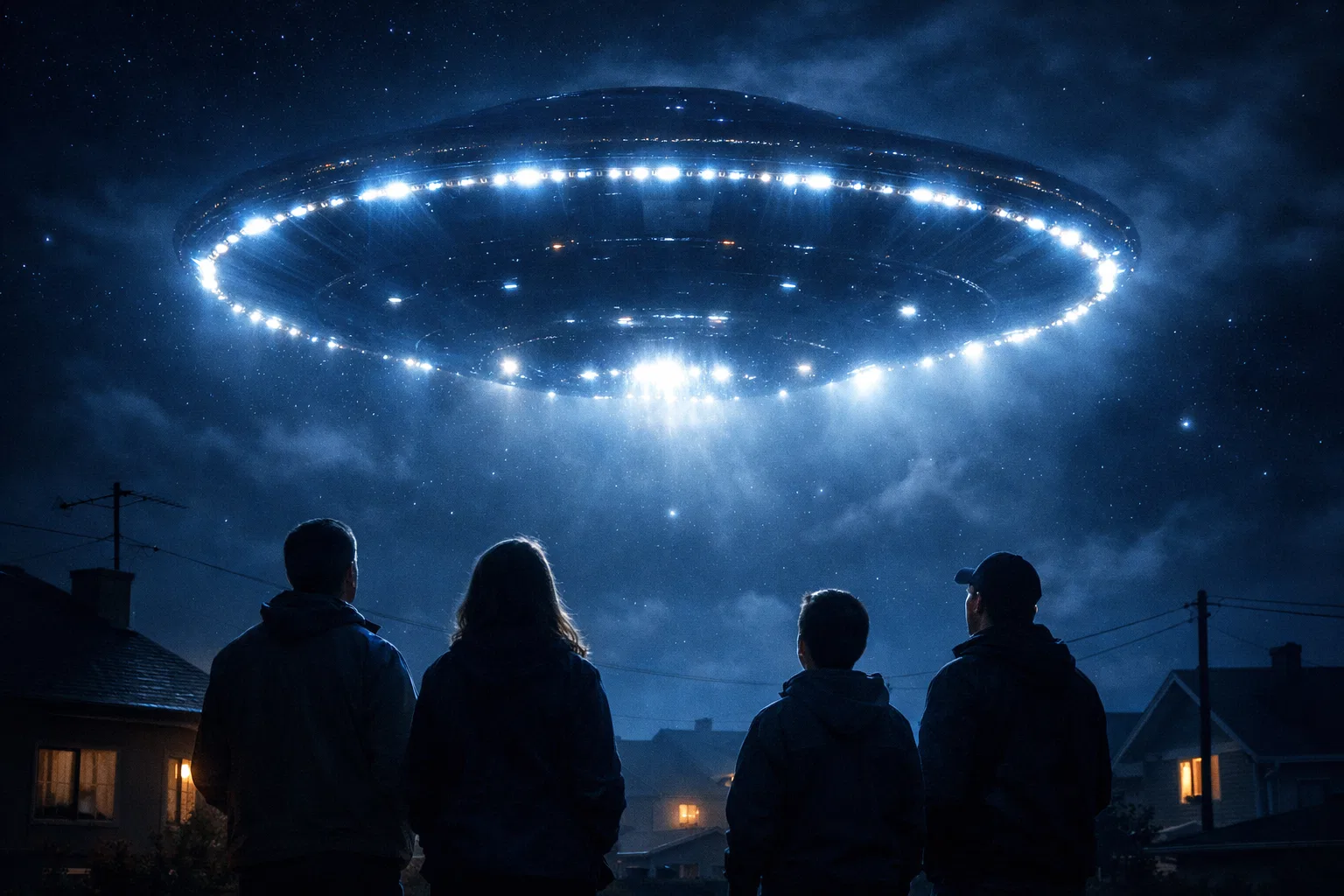
Sincere UFO witnesses can badly misjudge an object’s size, height and speed because the sky often removes the very cues people normally use to judge distance. A light with no visible wings, surface detail, sound, shadow or nearby reference point may be a small object close by, a large object far away, or something in between. Once the observer guesses the wrong distance, the estimated size and speed usually become wrong as well.
This is one of the most important IFO mechanisms: the witness may have seen a real object, described the appearance honestly, and still turned a balloon, aircraft, satellite, meteor or reflection into a “huge craft” or “impossible acceleration”. Modern UAP analysis treats this as a data problem, not simply a credibility problem. NASA’s independent UAP study warned that eyewitness reports can be compelling but often lack the reproducible information needed to determine a UAP’s origin, while AARO has specifically highlighted forced perspective and parallax as recurring causes of exaggerated size and speed reports. [NASA Science]science.nasa.govSource details in endnotes.
Why the sky defeats ordinary distance judgement
On the ground, distance is usually supported by many overlapping clues: familiar object sizes, texture, shadows, perspective lines, foreground objects, binocular depth, motion against the background and sounds arriving from known directions. A car on a road, a person beside a door, or a bird crossing a tree line gives the brain a set of checks. The open sky removes many of them.
That matters because a visual sighting is first of all an angular event. The witness sees something subtending an angle in the field of view and moving across some angle of sky. To convert that into a physical size or speed, distance has to be known or reliably inferred. The UFO Identification Process article in Skeptical Inquirer, drawing on Allan Hendry’s investigative work, states the central problem plainly: distance, size and speed cannot be estimated reliably unless at least one of them is known; if one estimate is wrong, the others follow it into error. It recommends recording angular size, angular speed and angular position before making physical claims. [Skeptical Inquirer]skepticalinquirer.orgSkeptical Inquirer UFO Identification Process | Skeptical InquirerSkeptical Inquirer UFO Identification Process | Skeptical Inquirer
A bright point at night is the hardest version of this problem. It may look close because it is vivid, “solid” because it is steady, or huge because the mind places it at aircraft distance. But a point of light has no intrinsic scale. A drone light, a landing aircraft, Venus, a balloon reflecting sunlight, a satellite, a meteor and a distant searchlight can all appear as small luminous marks without enough surface detail to settle the range.
The same mechanism can work in daylight. A featureless white sphere against a pale sky may be read as a large object far away if the witness assumes it is at aircraft altitude, or as a small nearby object if binoculars reveal it to be a balloon. The witness is not necessarily inventing the sighting; the interpretation is being built on an uncalibrated distance guess.
Missing distance cues
AARO’s 2024 paper on forced perspective and parallax explains why this problem appears so often in UAP observations. In ordinary forced-perspective photographs, a nearby person can appear to hold up a distant tower because the picture compresses depth. In the sky, the same depth compression becomes more serious because the unknown object may have no windows, propellers, wings, surface lines or other features that would help the observer estimate its true scale. AARO notes that observers often compare unknown sky objects with clouds, trees, buildings or other imperfect references, which can produce inaccurate distance and size estimates. [AARO]aaro.milEffect of Forced Perspective and Parallax View on UAP ObservationsEffect of Forced Perspective and Parallax View on UAP Observations
AARO’s simplified example is a ten-foot sphere at an unknown distance. If the observer places it mentally at the wrong range, the same angular image supports several different physical sizes. The farther the assumed distance, the larger the inferred object; the nearer the assumed distance, the smaller it becomes. This is why a report such as “it was the size of a house” is much weaker than a report such as “it covered about half the width of the Moon” unless the distance is independently known. [AARO]aaro.milAARO Historical Record Report Vol 1 2024AARO Historical Record Report Vol 1 2024
The most useful witness descriptions therefore separate what was seen from what was inferred:
- “A bright orange light crossed 30 degrees of sky in about ten seconds” is an angular observation.
- “It was the size of a car” is a physical inference unless the object passed near a known reference.
- “It was moving faster than any aircraft” is also an inference unless the range is known.
- “It made no sound, so it must have been very high and enormous” combines two uncertain assumptions.
This distinction is especially important in IFO analysis because many mundane objects become puzzling only after the witness assigns them a dramatic distance. A slow nearby balloon may seem like a hovering craft. A distant aircraft flying towards the observer may seem motionless. A satellite formation may seem like one rigid triangular object. A meteor may seem to fall “behind the trees” even though it is tens of miles high.
Silent objects and scale
Silence often makes witnesses more confident, but it can also mislead. People expect aircraft-sized objects to make aircraft-like sounds. If a bright object seems close and silent, the mind may treat that as strange: either the object must be using unusual propulsion, or it must be far larger and farther away than it first appeared. Yet sound is a poor ruler. Wind, traffic, insulation, engine direction, distance, temperature layers and the object’s actual type can all break the expected link between sight and sound.
This is why “silent and huge” is a common but fragile pair of claims. If the object’s distance is unknown, silence does not prove great size. A small balloon, lantern, drone, bird flock, aircraft seen through haze, or satellite has a very different sound profile from the imagined craft. In many night reports the sound may be absent because the object is genuinely far away; in others it may be absent because the object is small, quiet, nearby or not an aircraft at all.
Skywatching examples show how strongly scale can flip once range is corrected. Sky & Telescope describes fireballs as a classic distance trap: witnesses may feel a meteor is just beyond the next field or perhaps half a mile away, while bright fireballs are commonly 40–50 miles above the ground and, at low angles, may be 100–150 miles away. The same article gives balloon examples in which objects that initially looked like large distant craft turned out, with binoculars, to be small reflective balloons much closer to the observer. [Sky & Telescope]skyandtelescope.orgWhy Are There So Many UFOs? - Sky & Telescope…
This does not mean every silent light is a balloon or every dramatic witness is careless. It means that silence, brightness and apparent size form a weak chain unless one link is independently fixed. The witness may be accurate about colour, direction, duration and emotional impact, while still being wrong about the object’s physical scale.
How movement creates false speed
Speed errors are often distance errors in disguise. A nearby insect crossing a camera frame, a bird close to a vehicle, or a balloon seen from a moving aircraft can appear to race across the scene because the observer’s own movement creates parallax. Parallax is the apparent shift of an object against the background as the observer’s viewpoint changes. It is a normal effect, but it can make a slow or stationary object look fast when the observer is moving.
AARO explicitly connects parallax with reports of very large size or high speed. Its paper notes that if a reporter is far from an object while moving quickly relative to it, apparent motion can be misread as object motion. The result may be a UAP report in which the described acceleration belongs partly to the viewing geometry rather than to the object itself. [AARO]aaro.milEffect of Forced Perspective and Parallax View on UAP ObservationsEffect of Forced Perspective and Parallax View on UAP Observations
This is a major issue in aircraft and vehicle sightings. A pilot, passenger, dashcam or phone camera is not a neutral measuring instrument unless its position, direction, lens properties and motion are known. A distant object with little real movement may slide rapidly against the landscape if the observer is moving. Conversely, an aircraft heading almost directly towards the witness may appear to hover because its angular position changes slowly.
The same principle affects videos. A dot on screen can appear to streak, halt or reverse when the camera pans, zooms, stabilises, refocuses or tracks another object. Without range, angular movement and camera metadata, a claim such as “it crossed miles in seconds” may actually mean only “it crossed the frame quickly”.
Why honest witnesses still sound certain
Distance errors are not signs of dishonesty. They are often signs of normal perception operating outside its comfort zone. A witness may feel certain because the experience was vivid, surprising and emotionally charged. Memory then preserves the interpreted scene: not just “a light moved”, but “a large object moved”. Once the mind has assigned the light to a mental category, later size and speed estimates may be shaped by that category.
A recent civilian astronomer’s review of UAP research puts this in perceptual terms: human observers are not calibrated sensors, and when people think they know what kind of sky object they are seeing, they use assumed familiar size to infer distance. If the assumed object type is wrong — for example, mistaking a small drone or balloon for a larger aircraft — the distance estimate can be badly wrong. The review also notes that even angular size can be misperceived, as shown by the familiar Moon illusion near the horizon. [arXiv]arxiv.orgarXiv A Civilian Astronomer’s Guide to UAP ResearcharXiv A Civilian Astronomer’s Guide to UAP Research
This is why skilled, sober and sincere people can still produce IFO reports. Pilots, police officers, astronomers, soldiers and experienced outdoor observers may be better at noticing details, but no human observer can directly see distance to a featureless light in an empty sky. Expertise helps most when it brings disciplined reporting: time, direction, angular size, comparison stars, weather, flight paths and willingness to revise first impressions.
Project Blue Book’s own public summary reflected this practical reality. It defined a UFO as any aerial object the observer could not identify, received reports from pilots, weather observers, amateur astronomers and many ordinary citizens, and listed missiles, balloons, birds, kites, searchlights, aircraft lights, condensation trails, astronomical bodies and meteorological phenomena among common sources of mistaken reports. The programme’s “insufficient data” category also shows why missing basics such as time, position in the sky, weather and manner of appearance can prevent firm identification. [whs]esd.whs.milEnterprise Services DashboardEnterprise Services Dashboard
How investigators bound estimates
Good investigation does not ask witnesses to be perfect measuring instruments. It tries to turn uncertain impressions into bounded estimates. The key move is to preserve the observation while testing the interpretation.
The strongest distance and size constraints usually come from independent data:
- Angular measurements: Investigators ask where the object was relative to the horizon, Moon, stars, buildings or landmarks. A hand-span or finger-width estimate is imperfect, but it is better than “large”.
- Timing: Duration and time of day allow comparison with aircraft tracks, satellite passes, meteor reports, astronomical positions and wind data.
- Line of sight: The witness’s location and viewing direction can show whether an object was near an airport approach path, planet, launch plume, balloon trajectory or known landmark.
- Multiple observers: Separated witnesses can provide triangulation if their locations and sight lines are precise.
- Instrumental records: Radar, ADS-B flight data, satellite catalogues, weather balloons, meteor cameras, security cameras and phone metadata can fix or constrain range.
- Reconstruction: Returning to the site can test whether trees, hills, windows, roads or lights created a misleading reference frame.
GEIPAN, the French UAP investigation group within CNES, describes a similar discipline: it collects testimony, uses a multidisciplinary method combining physical sciences and human factors, and classifies cases partly by the consistency of available data and the remaining strangeness after comparison with known phenomena. It also uses trained investigators who can visit sighting locations, meet witnesses and organise reconstructions when needed. [geipan.fr]geipan.frFA Q | GEIPANFA Q | GEIPAN
A telling GEIPAN example involved witnesses who described a stationary flying saucer with a cone of light or a huge slow triangle. Radar analysis pointed to a C-130 Hercules transport aircraft, but GEIPAN emphasised that simply naming “a plane” was not enough; the investigation also had to explain why the ordinary aircraft looked so strange to the witnesses. That is the useful IFO approach: not dismissing the experience, but reconstructing the chain from real stimulus to mistaken scale. [cnes-geipan.fr]cnes-geipan.frMission & Geipan | GEIPANMission & Geipan | GEIPAN
What a stronger sighting report looks like
A report becomes more useful when it avoids premature physical claims and records the cues needed to test them. “It was enormous and impossible” is less useful than a careful description of where it appeared, how long it lasted, how far it moved across the sky, what references were visible, and what other records might exist.
For distance and size errors, the best witness habits are simple:
- Record the exact time, location and viewing direction.
- Note the object’s elevation above the horizon and angular size using the Moon, fingers at arm’s length, or known landmarks.
- Describe colour, shape, brightness and changes without immediately naming the object.
- Record whether the object passed in front of or behind clouds, trees, buildings, hills or wires.
- State uncertainty openly: “It seemed close” is better than “It was 200 metres away” when no range cue exists.
- Look for corroborating data quickly: flight trackers, satellite passes, weather, wind direction, local events, nearby cameras and other witnesses.
This does not make all UFO reports mundane. Some cases remain unresolved because data are missing, contradictory or genuinely puzzling. But in the specific branch of IFO causes, distance and size errors explain why honest reports can sound extraordinary without requiring extraordinary objects. The core lesson is not that witnesses are unreliable in every respect; it is that unaided human perception is poorly equipped to measure a featureless object in open sky. When range is unknown, size and speed are guesses wearing the clothes of observation.
Amazon book picks
Further Reading
Books and field guides related to Why Honest Witnesses Misjudge UFOs. Use these as the next step if you want deeper reading beyond the article.
The Invisible Gorilla
Directly relevant to observational mistakes and attention limits.
Mistakes Were Made (but Not by Me) Third Edition
Explains how sincere observers can reach incorrect conclusions.

Mistakes Were Made (But Not by Me)
First published 2007. Subjects: Fouten, Vergissingen, Cognitive dissonance, Self-deception, Rechtvaardiging.
eBay marketplace picks
Marketplace Samples
Example marketplace items related to this page. Use the search link to explore similar finds on eBay.



Endnotes
-
Source: science.nasa.gov
Link: https://science.nasa.gov/wp-content/uploads/2023/09/uap-independent-study-team-final-report.pdf -
Source: aaro.mil
Title: Effect of Forced Perspective and Parallax View on UAP Observations
Link: https://www.aaro.mil/Portals/136/PDFs/Information%20Papers/AARO_Effect_of_Forced_Perspective_and_Parallax_View_on_UAP_Observations_2024.pdf -
Source: skyandtelescope.org
Title: Sky & Telescope
Link: https://skyandtelescope.org/stargazing-and-observing/my-favorite-ufos/Source snippet
Why Are There So Many UFOs? - Sky & Telescope...
-
Source: arxiv.org
Title: arXiv A Civilian Astronomer’s Guide to UAP Research
Link: https://arxiv.org/html/2411.02401v1 -
Source: esd.whs.mil
Title: Enterprise Services Dashboard
Link: https://www.esd.whs.mil/Portals/54/Documents/FOID/Reading%20Room/UFOsandUAPs/proj_b1.pdf?ver=2017-05-22-113513-837 -
Source: geipan.fr
Title: FA Q | GEIPAN
Link: https://www.geipan.fr/en/faq-page -
Source: cnes-geipan.fr
Title: Mission & Geipan | GEIPAN
Link: https://www.cnes-geipan.fr/en/missions-methodes-et-resultats -
Source: cnes-geipan.fr
Link: https://www.cnes-geipan.fr/sites/default/files/Aids_to_identification_of_flying_objects_0.pdf -
Source: cnes-geipan.fr
Link: https://www.cnes-geipan.fr/en/node/58792 -
Source: aaro.mil
Title: AARO Historical Record Report Vol 1 2024
Link: https://www.aaro.mil/Portals/136/PDFs/AARO_Historical_Record_Report_Vol_1_2024.pdf -
Source: cnes.fr
Link: https://cnes.fr/en/projects/geipan -
Source: skepticalinquirer.org
Title: Skeptical Inquirer UFO Identification Process | Skeptical Inquirer
Link: https://skepticalinquirer.org/2018/11/ufo-identification-process/ -
Source: Wikipedia
Title: Allan Hendry
Link: https://en.wikipedia.org/wiki/Allan_Hendry -
Source: Wikipedia
Title: Project Blue Book
Link: https://en.wikipedia.org/wiki/Project_Blue_Book -
Source: quizlet.com
Link: https://quizlet.com/gb/361243788/perception-depth-and-size-flash-cards/ -
Source: ui.adsabs.harvard.edu
Link: https://ui.adsabs.harvard.edu/abs/arXiv%3A2208.11215
Additional References
-
Source: cia.gov
Link: https://www.cia.gov/readingroom/docs/CIA-RDP81R00560R000100060001-5.pdf -
Source: cia.gov
Link: https://www.cia.gov/readingroom/document/cia-rdp81r00560r000100010002-9 -
Source: war.gov
Link: https://www.war.gov/medialink/ufo/release_1/255_413270_ufo%27s_and_defense_what_should_we_prepare_for.pdf -
Source: cia.gov
Link: https://www.cia.gov/readingroom/document/cia-rdp81r00560r000100010001-0 -
Source: govinfo.gov
Link: https://www.govinfo.gov/content/pkg/CHRG-89hhrg50066O/pdf/CHRG-89hhrg50066O.pdf -
Source: researchgate.net
Link: https://www.researchgate.net/publication/277686506_Perceiving_Layout_and_Knowing_Distances -
Source: academia.edu
Link: https://www.academia.edu/7482584/Project_Blue_Book_Archive -
Source: researchgate.net
Link: https://www.researchgate.net/publication/395858774_Toward_a_Reliability_Scale_for_Assessing_Reports_of_Unidentified_Anomalous_Phenomena_UAP -
Source: facebook.com
Link: https://www.facebook.com/TheFrenchHistoryPodcast/posts/a-drawing-from-the-files-at-the-french-ufo-department/1337099231754482/ -
Source: skyandtelescope.org
Link: https://skyandtelescope.org/astronomy-news/astronomers-spot-first-known-interstellar-comet/
Topic Tree