Within Flight Tracking
Do the lights match the flight track?
Lights, glare, infrared shape, contrails and disappearance patterns can make or break a proposed aircraft explanation for a UFO report.
On this page
- Landing lights, navigation lights and apparent hovering
- Infrared blobs, glare and engine heat
- Contrails, haze and sudden disappearances
Page outline Jump by section
Introduction
When a flight track appears to line up with a UFO report, the next question is not simply whether an aircraft was nearby. The crucial test is whether the aircraft would have looked like the reported object from that specific viewing angle. Many proposed aircraft identifications succeed or fail on appearance clues: the brightness and colour of lights, the apparent lack of motion, infrared signatures, contrails, or the way an object suddenly vanishes. In practice, these visual characteristics often provide stronger evidence than proximity alone. A flight track that matches the timing but not the observed appearance is a weak correlation; a track that also predicts the reported lights, shape and disappearance behaviour is a much stronger one.
Do the lights match the flight track?
Landing lights, navigation lights and apparent hovering
One of the most common aircraft-related UFO reports involves a bright light that seems stationary for minutes or even longer. This effect frequently occurs when an aircraft is flying almost directly towards the observer. Because the aircraft’s forward motion is largely along the line of sight rather than across it, there is very little apparent sideways movement. To a witness, the light can appear to hover despite travelling at hundreds of kilometres per hour. Aviation and flight-safety literature has long documented how human observers can misjudge the motion and distance of lights seen at night or against sparse visual backgrounds. [Skybrary]skybrary.aeroVisual Illusions AwarenessSkybraryVisual Illusions AwarenessSeptember 22, 2005 — 30 % of approach-and-landing accidents occur during the conduct of visual approach… [Hangar Flying]inspire.eaa.orgthe magic of the night illusion and confusionThe Final Approach. The runway lights of an airport on an island, along the coast…Read more…
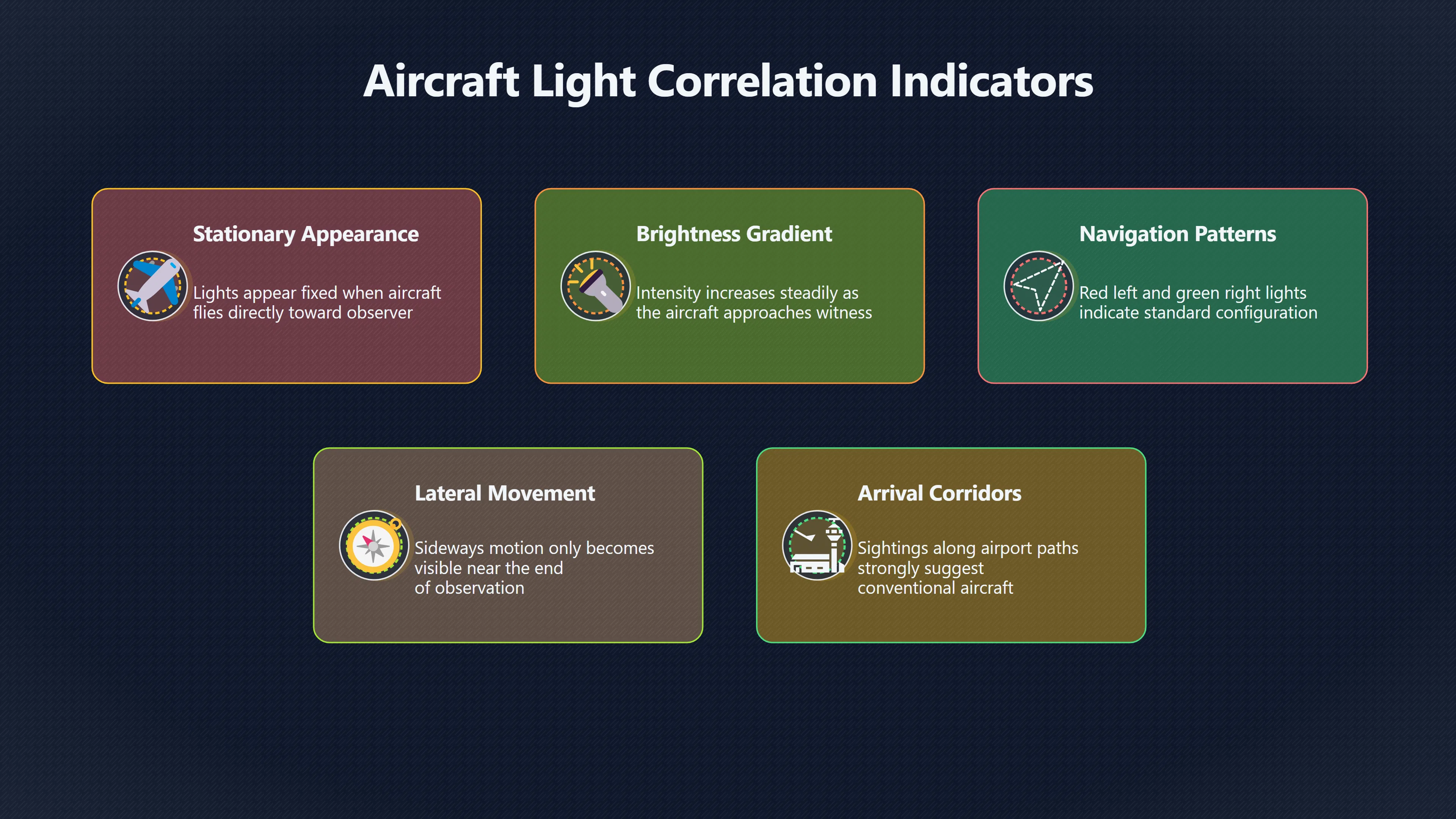
A strong aircraft correlation is supported when:
- The reported object remains nearly fixed in one position while a tracked aircraft is on a direct approach path.
- Brightness increases steadily as the aircraft approaches.
- The object begins to show lateral movement only near the end of the observation.
- The sighting occurs along an airport arrival corridor.
Landing lights are particularly important because they are designed to be visible from great distances. A witness may see the intense white light long before the aircraft’s fuselage or wings become visible. At night, this can create the impression of a brilliant orb rather than a conventional aircraft. [Hangar Flying]inspire.eaa.orgthe magic of the night illusion and confusionThe Final Approach. The runway lights of an airport on an island, along the coast…Read more…
Navigation lights provide another diagnostic clue. Aircraft normally display:
- A red light on the left wing.
- A green light on the right wing.
- White lights facing rearward.
- Flashing anti-collision beacons.
When witnesses report recurring red, green and white lights in a stable geometric arrangement, the observation tends to strengthen an aircraft explanation. By contrast, reports describing a structured object that remains clearly visible while lacking any lighting pattern consistent with aircraft operations may weaken a proposed match, although distance, atmospheric conditions and viewing angle can obscure expected lights.
A useful caution is that brightness can overwhelm colour perception. Extremely bright landing lights may wash out surrounding navigation lights, causing observers to perceive a single white object rather than a multi-light aircraft configuration.
When lights seem to move impossibly
Aircraft lights can create apparent accelerations and direction changes that do not correspond to the aircraft’s actual motion. A light emerging from haze, passing behind thin cloud, or changing intensity during a turn can appear to jump or dart across the sky. Witnesses often interpret these changes as manoeuvres by a solid object rather than changes in visibility or perspective.
For correlation purposes, investigators look for whether the apparent manoeuvre coincides with known track changes, banking turns or changing viewing geometry. If the reported movement is entirely inconsistent with the aircraft’s position and heading, the proposed identification becomes weaker.
Why infrared footage can be misleading
Infrared blobs, glare and engine heat
Many modern UFO cases involve infrared sensors rather than direct visual observation. In these cases, the apparent shape of the target can differ dramatically from the actual aircraft.
Infrared systems do not necessarily display an aircraft’s physical outline. Instead, they often highlight heat sources such as engines, exhaust plumes and heated air. Depending on range, atmospheric conditions and sensor settings, a conventional aircraft may appear as a glowing blob, a featureless oval or an elongated bright region. The visible shape in infrared imagery is therefore not always a reliable guide to the object’s true structure. [AARO]aaro.milAAROUAP ImageryThe United States European Command submitted a report of an unidentified anomalous phenomenon to the All-domain Anomaly Re…
A proposed aircraft correlation gains support when:
- The brightest area aligns with expected engine locations.
- The object’s thermal signature changes as the viewing angle changes.
- Apparent shape changes correspond to sensor zoom, focus or tracking adjustments.
- The target’s position matches known aircraft traffic.
Glare is another important factor. Infrared optics can generate blooming, halo effects and other artefacts around bright heat sources. In some debated military videos, researchers have argued that apparent object shapes and rotations may partly reflect sensor behaviour rather than the geometry of a physical craft. Competing analyses continue for some cases, but the broader point remains: infrared appearance alone is often insufficient to identify a target. [arXiv]arxiv.orgarXivReconstruction of Potential Flight Paths for the January 2015 Gimbal UAP…
What weakens an aircraft explanation in infrared data?
An aircraft correlation becomes less persuasive when multiple expected indicators are absent. Examples include:
- No detectable thermal concentration where engines should be visible.
- Motion inconsistent with any plausible aircraft trajectory at the estimated range.
- Simultaneous radar, visual and infrared evidence that contradicts the aircraft hypothesis.
- Timing conflicts between sensor observations and known flight activity.
Importantly, the absence of visible wings or control surfaces in infrared imagery is not, by itself, strong evidence against an aircraft. At long ranges, atmospheric distortion and sensor resolution can easily erase such details. [arXiv]arxiv.orgarXivReconstruction of Potential Flight Paths for the January 2015 Gimbal UAP…
Can contrails and disappearances verify a match?
Contrails as a positive clue
Contrails can provide one of the strongest appearance-based confirmations of an aircraft correlation. A high-altitude jet producing a visible condensation trail leaves a signature that can often be compared directly with the reported object.
When a witness reports:
- A bright object followed by a linear trail.
- A persistent white streak extending behind the object.
- Multiple parallel trails matching known traffic routes.
the presence of a tracked aircraft at the correct altitude strongly reinforces the identification. Contrail formation is a well-understood consequence of aircraft engine exhaust interacting with suitable atmospheric conditions. [arXiv]arxiv.orgarXivReconstruction of Potential Flight Paths for the January 2015 Gimbal UAP…
In some cases, witnesses focus on the bright leading object while failing to recognise the contrail as evidence of a conventional aircraft. Conversely, a claimed aircraft identification becomes weaker if the report specifically describes conditions where a prominent contrail should have been visible but was not.
Haze, cloud and sudden disappearance
Sudden disappearance is often interpreted as evidence of extraordinary behaviour, yet it can be consistent with ordinary aircraft under the right conditions.
Several mechanisms can produce this effect:
- An aircraft enters a thin cloud layer.
- A bright landing light is switched off or becomes obscured during a turn.
- Atmospheric haze blocks the light once the aircraft’s angle changes.
- The aircraft moves beyond the observer’s line of sight while remaining physically present.
The key clue is whether the disappearance occurs gradually or geometrically. Aircraft-related disappearances often coincide with predictable changes in heading, altitude or visibility conditions. A tracked aircraft that vanishes from view at the exact point where it enters cloud or turns away presents a strong appearance match. By contrast, a report of a sharply defined object remaining fully visible and then instantly disappearing in clear conditions may be harder to reconcile with a conventional aircraft explanation.
Appearance clues are often more decisive than proximity
The strongest aircraft correlations combine track data with appearance data. A nearby flight alone proves little. What matters is whether the aircraft’s lights, infrared signature, contrail behaviour and disappearance pattern match what the witness or sensor actually recorded.
For UFO investigations, appearance clues serve as a reality check on flight tracking. If a tracked aircraft would naturally produce the reported visual effects from that angle and under those atmospheric conditions, the identification becomes substantially stronger. If the appearance and the track cannot be reconciled, investigators must either look for a different aircraft or consider alternative explanations.
Amazon book picks
Further Reading
Books and field guides related to Do the lights match the flight track?. Use these as the next step if you want deeper reading beyond the article.
Stick and Rudder: An Explanation of the Art of Flying
Explains aircraft motion, approach geometry and visual appearance.
eBay marketplace picks
Marketplace Samples
Example marketplace items related to this page. Use the search link to explore similar finds on eBay.



Endnotes
-
Source: skybrary.aero
Title: Visual Illusions Awareness
Link: https://skybrary.aero/sites/default/files/bookshelf/177.pdfSource snippet
SkybraryVisual Illusions AwarenessSeptember 22, 2005 — 30 % of approach-and-landing accidents occur during the conduct of visual approach...
Published: September 22, 2005
-
Source: aaro.mil
Link: https://www.aaro.mil/UAP-Cases/Official-UAP-Imagery/Source snippet
AAROUAP ImageryThe United States European Command submitted a report of an unidentified anomalous phenomenon to the All-domain Anomaly Re...
-
Source: arxiv.org
Link: https://arxiv.org/abs/2306.08773Source snippet
arXivReconstruction of Potential Flight Paths for the January 2015 Gimbal UAP...
Published: January 2015
-
Source: arxiv.org
Title: arXiv Visual Analysis and Detection of Contrails in Aircraft Engine Simulations
Link: https://arxiv.org/abs/2208.02321Source snippet
arXivVisual Analysis and Detection of Contrails in Aircraft Engine SimulationsAugust 3, 2022...
Published: August 3, 2022
-
Source: arxiv.org
Link: https://arxiv.org/abs/2510.16891 -
Source: inspire.eaa.org
Title: the magic of the night illusion and confusion
Link: https://inspire.eaa.org/2019/10/30/the-magic-of-the-night-illusion-and-confusion/Source snippet
The Final Approach. The runway lights of an airport on an island, along the coast...Read more...
Additional References
-
Source: aerosociety.com
Title: the phantom horizon
Link: https://www.aerosociety.com/news/the-phantom-horizon/Source snippet
24 Feb 2026 — Visual illusions are a major hazard in flight, particularly during approach and landing. Black-hole approaches over dark te...
-
Source: boldmethod.com
Title: 8 optical illusions [pilots]({{ ‘pilots/’ | relative_url }}) should understand
Link: https://www.boldmethod.com/blog/lists/2025/04/8-optical-illusions-pilots-should-understand/Source snippet
And Know...19 Apr 2025 — 1) Runway Width A narrower-than-usual runway can create an illusion that the aircraft is higher than it actuall...
-
Source: facebook.com
Link: https://www.facebook.com/TheIndependentOnline/posts/a-video-showing-a-ufo-over-north-america-on-new-years-day-2026-was-included-in-t/1518186183670703/Source snippet
aircraft, atmospheric effects, balloons, or sensor errors...
-
Source: facebook.com
Link: https://www.facebook.com/News13/posts/among-the-new-files-was-footage-from-an-infrared-sensor-operated-by-the-us-coast/1290168619986535/Source snippet
oast Guard in April 2024 that appears to show an object flying...
Published: April 2024
-
Source: facebook.com
Link: https://www.facebook.com/WOKVNews/posts/military-officials-have-released-footage-of-what-they-say-show-unidentified-aeri/10163384929980109/Source snippet
tified aerial phenomena" that had previously been released by a private...
-
Source: facebook.com
Link: https://www.facebook.com/NewportBuzz/posts/-a-routine-flight-over-rhode-island-took-an-unsettling-turn-when-a-private-pilot/1452771090182410/Source snippet
pilot reported seeing a mysterious object hovering just feet from...
-
Source: hartzellprop.com
Title: watch out for night flight illusions
Link: https://hartzellprop.com/watch-out-for-night-flight-illusions/Source snippet
Watch Out for These 5 Night Flight Illusions24 Sept 2019 — For example, a sloping cloud formation, bright [stars]({{ 'stars/' | relative_url }}), or ground lights from a...
-
Source: instagram.com
Link: https://www.instagram.com/reel/DXhlZFyFBXr/Source snippet
DO YOU KNOW?? Pilots sometimes report strange lights...Some believe they are atmospheric reflections while others think they could be dr...
-
Source: migflug.com
Title: night landing traps what your eyes wont tell you
Link: https://migflug.com/jetflights/night-landing-traps-what-your-eyes-wont-tell-you/Source snippet
Night Landing Traps: Black Hole Approach Explained2 Apr 2026 — Night visual approaches kill experienced pilots every year. Here is how th...
-
Source: reddit.com
Link: https://www.reddit.com/r/ufo/comments/1hi3w09/why_would_nhi_ufos_use_lights_on_their_craft/Source snippet
id human aircraft that gets close, why do so many declared...
Topic Tree