Within IFOs
Why Short UFO Videos Are Hard to Trust
Short clips often omit the context needed to judge distance, direction, camera movement and ordinary explanations.
On this page
- Missing before and after context
- Compression and autofocus
- Questions a clip must answer
Page outline Jump by section
Introduction
Short UFO videos are hard to trust because they often show the least useful part of an event: a dot, glow, blur or silhouette after the observer has already become startled, without the wider scene that would reveal distance, direction, camera movement, wind, aircraft tracks, stars, clouds, nearby landmarks or what happened before and after. That does not mean every clip is fake. It means a clip can be genuine and still be weak evidence.
This matters for IFOs — identified flying objects — because many reports stay “unidentified” not because the object did anything extraordinary, but because the recording strips away the clues needed to identify it. NASA’s independent UAP study put the problem plainly: despite many accounts and visuals, there are “limited high-quality observations” and a lack of consistent, detailed, curated data for firm scientific conclusions. [NASA Science]science.nasa.govSource details in endnotes. AARO’s public case files show the same pattern in practice: short infrared and phone clips may be resolved as birds, balloons or aircraft, while other clips remain unresolved because the available footage is insufficient rather than because it proves an exotic explanation. [AARO]aaro.milOfficial UAP ImageryAARO UAP Imagery…
The missing minutes are often the evidence
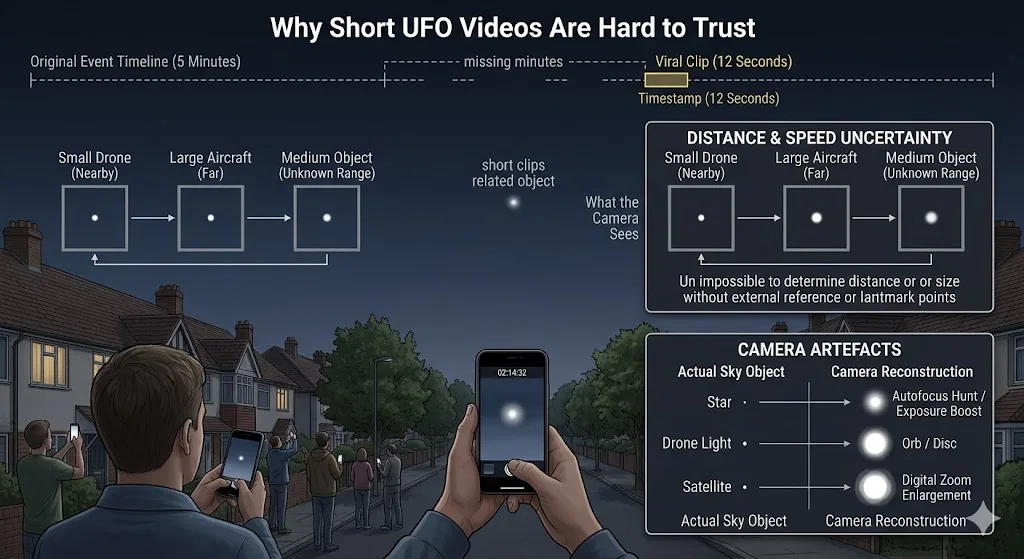
A short UFO clip usually begins too late. The witness has noticed something odd, taken out a phone, opened the camera, found the object, zoomed in, and recorded the most dramatic few seconds. By then, the quiet setup has disappeared: where the object first appeared, whether it rose from the horizon like an aircraft, whether it drifted with wind, whether it crossed a known flight path, whether it faded like a satellite, or whether the apparent “turn” was caused by the camera operator moving.
The most valuable evidence is often outside the viral extract. A longer recording can show whether the object keeps a steady path, changes brightness with viewing angle, passes behind a cloud, follows the wind, or resolves into an aircraft as it approaches. A wider shot can show the horizon, buildings, trees, Moon, stars or other reference points. Audio can record the witness’s real-time direction estimates, nearby aircraft noise or the moment the camera loses focus. Metadata can give time, device and sometimes location, although it can be stripped, altered or lost when media is uploaded through social platforms.
This is why investigators treat “unidentified” and “anomalous” as different claims. A clip may be impossible to identify from the available extract, yet still show no unusual behaviour. AARO’s imagery page includes cases where the footage shows a likely physical object, but the behaviour is described as unremarkable or the data is insufficient to assess performance characteristics. [AARO]aaro.milEffect of Forced Perspective and Parallax View on UAP ObservationsEffect of Forced Perspective and Parallax View on UAP Observations In its FY2024 annual report, AARO said 444 cases lacked enough data for analysis and were placed in an active archive for possible future review if additional data appears. [U.S. Department of War]media.defense.govFY24 CONSOLIDATED ANNUAL REPORT ON UAP 508FY24 CONSOLIDATED ANNUAL REPORT ON UAP 508
The key lesson is simple: a short clip is not just a shorter version of a full case. It is a different kind of evidence. It may preserve appearance while destroying context.
Why speed and distance are easy to misread
The central weakness of many short UFO clips is range uncertainty. A small object close to the camera, a large object far away, and a medium object at an unknown distance can look similar if the frame contains only sky. Without range, speed cannot be trusted either. A dot crossing the screen quickly may be a fast object, a nearby object, a slow object seen from a fast-moving platform, or an object made to appear fast by camera motion.
AARO’s information paper on forced perspective and parallax explains the problem directly. It notes that when an unknown object lacks recognisable features such as wings, windows or propellers, judging its size and distance becomes much harder; without known references, observers may inaccurately estimate both. It also explains that parallax can make a stationary or slow-moving object appear to move rapidly when the observer or sensor platform is moving. [AARO]aaro.milGo Fast Case ResolutionGo Fast Case Resolution
The “Go Fast” Navy video is a useful case because it looked, to many viewers, like an object racing just above the sea. AARO’s 2025 case-resolution report assessed the object as being about 13,000 feet above sea level, not near the ocean surface, and estimated its wind-compensated speed at about 5 to 92 mph rather than anomalous velocity. [AARO]aaro.milOpen source on aaro.mil. The report attributed the apparent high speed to motion parallax and stressed that the original file and full metadata were not available, meaning the public 34-second clip had to be analysed from limited displayed information. [AARO]aaro.milOfficial UAP ImageryAARO UAP Imagery…
That example does not prove all fast-looking UFO videos are parallax. It shows why “it crosses the screen quickly” is not enough. The camera’s motion, zoom level, sensor angle, target range and background all matter. A short clip often hides exactly those variables.
Compression, autofocus and camera artefacts
Modern cameras are excellent at making pleasing images, but they are not neutral measuring instruments. Phone cameras and military sensors both process images heavily. They stabilise, sharpen, compress, brighten, denoise, interpolate and sometimes lose focus. These operations can turn ordinary lights and distant objects into shapes that seem more structured or strange than they are.
Compression can invent structure
Video compression is designed to reduce file size, not preserve every pixel faithfully. It predicts motion, simplifies detail and can create smears, blocks, halos or false trails around small objects, especially in low contrast or infrared footage. AARO’s “Atmospheric Wake” case is a direct example: an MQ-9 infrared sensor recorded an apparent wake-like trail behind an object, but after analysis of the full-motion video, longer-focal-length footage and commercial flight data, AARO assessed the object as likely a commercial aircraft and the apparent trailing cavitation as a video-compression artefact. [AARO]aaro.milEffect of Forced Perspective and Parallax View on UAP ObservationsEffect of Forced Perspective and Parallax View on UAP Observations
This is important because “wake”, “trail”, “aura” and “field” are often treated online as physical features. Sometimes they are. But in compressed footage, especially cropped or re-uploaded footage, the trail may belong to the codec rather than the sky.
Autofocus can turn points into “orbs”
A distant star, planet, aircraft light, drone light or balloon reflection can become a soft disc if the camera fails to focus. Digital zoom then enlarges the blur. Stabilisation may make the blur seem to pulse or wobble. The result can look like a round object with a rim, centre, colour changes or even internal structure, when the underlying source is simply a point of light rendered out of focus.
This is especially common in night videos. The human eye can hold a bright point in a wider scene; a phone camera often cannot. It hunts for focus, raises exposure, reduces noise and tries to stabilise a tiny moving target against a dark background. The output is not a clean record of what the eye saw; it is a processed reconstruction under poor conditions.
Rolling shutter can distort motion
Many digital cameras do not expose the whole frame at exactly the same instant. They scan the image line by line, which can warp fast-moving objects or rapidly changing light. Science writer Phil Plait describes rolling shutter as an effect in which a detector scans row by row, producing warped distortions in fast-moving objects; combined with aliasing, it can make an aircraft propeller appear broken or detached from the plane. [SYFY]syfy.comRolling with the shutterRolling with the shutter In UFO clips, the same family of camera effects can make lights, aircraft parts, birds or insects appear to behave oddly, especially when footage is zoomed, stabilised or slowed down.
None of these artefacts automatically explains a given clip. They are risk factors. A careful viewer asks whether the odd feature belongs to the object or to the recording system.
A clip can be authentic and still misleading
One common mistake in UFO debates is to treat authenticity as the whole question. If a video is not fabricated, the argument goes, then the event must be extraordinary. That is not how visual evidence works. A real video can show a real object and still mislead about distance, speed, size, shape or motion.
The forensic distinction is useful. The European Network of Forensic Science Institutes describes image authentication as assessing the provenance and life cycle of digital image data, using context analysis, source analysis, integrity analysis, processing analysis and manipulation detection. [ENFSI]enfsi.euBPM Image Authentication ENFSI BPM DI 003 1BPM Image Authentication ENFSI BPM DI 003 1 Those are different questions from “what was in the sky?” A photo may pass basic manipulation checks yet still be a poor record of the event because it is cropped, over-compressed, stripped of metadata, missing context or taken with a lens setting that exaggerates an ordinary object.
Verification specialists make the same point for public media. First Draft’s guide to verifying online information warns that verification is rarely foolproof and usually involves collecting corroborating clues rather than reaching instant certainty. [First Draft]firstdraftnews.orgFirst Draft Verifying Online InformationFirst Draft Verifying Online Information For UFO clips, those clues include the original file, exact time, exact location, camera direction, weather, flight and satellite data, witness position, lens settings, and independent recordings from other angles.
The strongest short clips are therefore not the most dramatic ones. They are the ones that can be connected to outside data.
What a useful UFO clip must answer
A short video becomes more useful when it can answer basic reconstruction questions. These are not sceptical tricks; they are the same questions needed to separate an IFO from a genuinely unresolved case.
A clip should ideally establish:
- When and where it was recorded. Exact date, time zone, location and viewing direction allow comparison with aircraft, satellites, planets, launches, balloons and weather.
- What the camera was doing. Zoom, stabilisation, focus changes, panning and platform motion can all create apparent object motion.
- How far away the object might be. Range is the hinge on which size and speed depend.
- Whether the object passed behind or in front of anything. Clouds, trees, hills, buildings and the horizon can provide scale and distance clues.
- What happened before and after the extract. Entry and exit behaviour often reveal ordinary explanations.
- Whether independent data exists. Other videos, air-traffic data, satellite predictions, weather balloons, wind profiles and astronomical charts can test competing explanations.
- Whether the original file exists. Reposted, cropped, screen-recorded or edited clips are far weaker than original media with metadata and full resolution.
NASA’s UAP study recommended systematic data gathering, multiple well-calibrated sensors and better curation because future analysis depends on well-characterised data rather than isolated fragments. [NASA Science]science.nasa.govSource details in endnotes. It also noted the possible value of smartphone-based reporting systems that gather imaging data alongside other sensor metadata from multiple observers, because ordinary phone videos become far more useful when standardised and contextualised. [NASA Science]science.nasa.govSource details in endnotes.
How misleading clips become persuasive online
Short UFO clips spread well because they are easy to understand emotionally and hard to analyse quickly. A glowing object moves. A witness reacts. The caption supplies a location and a claim. The viewer fills in the missing scale, speed and intent.
Several features make this especially powerful:
The frame removes ordinary comparisons. A plane, balloon, bird or satellite can look strange when isolated against empty sky. The less context the frame contains, the more the caption controls interpretation.
The most dramatic seconds are selected. A long, slow drift may be clipped to the one moment when the camera jerks, autofocus shifts or the object brightens.
Re-uploading degrades evidence while increasing reach. Social platforms compress, crop and strip metadata. The version seen by millions may be several generations away from the original.
Witness sincerity is confused with measurement accuracy. A witness may be honest about seeing something startling while still being wrong about distance, speed or size.
“Unresolved” is treated as “extraordinary”. A clip can remain unresolved because the original file is missing, the direction is unknown or the object is too small to classify. That is not the same as demonstrating non-human technology, impossible acceleration or exotic physics.
AARO’s public imagery database illustrates the range: some short clips are resolved as balloons, birds or aircraft; some are described as physical but unremarkable; some remain unresolved because data is insufficient. [AARO]aaro.milGo Fast Case ResolutionGo Fast Case Resolution The category “unresolved” is therefore a data-status label, not a conclusion about origin.
Better habits for watching short UFO videos
The safest way to view a short UFO clip is to separate three questions: is the media genuine, what does it actually show, and what can be inferred from it? Those questions often have different answers. A genuine clip may show a real light. The light may be unidentified in the clip. But the clip may still be unable to support claims about speed, altitude, size, manoeuvring or origin.
A practical viewing sequence helps:
- Watch once without the caption. The caption often smuggles in assumptions such as “low over the sea”, “shot upward”, “entered the water” or “changed direction instantly”.
- Look for reference points. Horizon, clouds, buildings, stars, Moon, trees, aircraft lights and camera shake matter more than the object’s apparent shape.
- Ask what the camera is doing. Panning, zooming, stabilisation and focus hunting can create apparent movement or pulsing.
- Treat shape cautiously. In low light, “sphere”, “triangle”, “disc” or “cube” may describe blur, bokeh, glare, compression or sensor response rather than the object.
- Prefer boring metadata to dramatic narration. Time, place, direction, original file and independent corroboration are more valuable than excited commentary.
- Do not upgrade “unidentified” into “unexplainable”. A short clip may simply lack enough information to decide.
This approach does not dismiss witnesses. It protects the evidence. If an event is genuinely unusual, better context will strengthen it. If it is an IFO, better context will usually reveal the ordinary cause. The worst outcome is the middle ground: a compelling-looking fragment that is too stripped of information to test.
Why short clips mostly create leads, not conclusions
Short UFO videos are useful as leads. They can alert investigators to a time, place and possible event. They can preserve a witness’s first reaction. They can reveal whether a light was steady, blinking, drifting, rotating in the frame or moving relative to visible features. But by themselves, they are rarely enough to prove the high-stakes claims people attach to them.
The strongest evidence does not simply look strange. It survives reconstruction. It has original files, known camera position, known direction, timing, calibration, independent views and comparison with ordinary traffic, astronomy and weather. That is why NASA emphasises multiple well-calibrated sensors and standardised data, and why AARO’s case work often turns on geometry, wind, sensor metadata and full-motion context rather than the viral impression of a clip. [NASA Science]science.nasa.govSource details in endnotes.
For IFO analysis, misleading photos and short videos are not a side issue. They are one of the main ways ordinary things become extraordinary reports. The clip may be real, the witness may be sincere, and the object may still be a balloon, bird, aircraft, satellite, planet, reflection, sensor artefact or simply an unresolved dot with too little information attached.
Amazon book picks
Further Reading
Books and field guides related to Why Short UFO Videos Are Hard to Trust. Use these as the next step if you want deeper reading beyond the article.
Read This if You Want to Take Great Photographs
Helps readers understand image capture and interpretation.
The Visual Display of Quantitative Information
Useful for understanding how visual data can mislead.
eBay marketplace picks
Marketplace Samples
Example marketplace items related to this page. Use the search link to explore similar finds on eBay.



Endnotes
-
Source: science.nasa.gov
Link: https://science.nasa.gov/wp-content/uploads/2023/09/uap-independent-study-team-final-report.pdf -
Source: aaro.mil
Title: Official UAP Imagery
Link: https://www.aaro.mil/UAP-Cases/Official-UAP-Imagery/Source snippet
AARO UAP Imagery...
-
Source: aaro.mil
Title: Effect of Forced Perspective and Parallax View on UAP Observations
Link: https://www.aaro.mil/Portals/136/PDFs/Information%20Papers/AARO_Effect_of_Forced_Perspective_and_Parallax_View_on_UAP_Observations_2024.pdf -
Source: aaro.mil
Title: Go Fast Case Resolution
Link: https://www.aaro.mil/Portals/136/PDFs/case_resolution_reports/AARO_GoFast_Case_Resolution_Card_Methodology_Final.pdf -
Source: syfy.com
Title: Rolling with the shutter
Link: https://www.syfy.com/syfy-wire/rolling-with-the-shutter -
Source: enfsi.eu
Title: BPM Image Authentication ENFSI BPM DI 003 1
Link: https://enfsi.eu/wp-content/uploads/2021/10/BPM_Image-Authentication_ENFSI-BPM-DI-003-1.pdf -
Source: science.nasa.gov
Link: https://science.nasa.gov/uap/ -
Source: war.gov
Title: dr jon kosloski director aaro media roundtable on the fy24 consolidated annual
Link: https://www.war.gov/News/Transcripts/Transcript/Article/3965734/dr-jon-kosloski-director-aaro-media-roundtable-on-the-fy24-consolidated-annual/ -
Source: war.gov
Title: dod working to better understand resolve anomalous phenomena
Link: https://www.war.gov/News/News-Stories/Article/Article/3368109/dod-working-to-better-understand-resolve-anomalous-phenomena/ -
Source: aaro.mil
Link: https://www.aaro.mil/ -
Source: avi-loeb.medium.com
Title: exotic or mundane dfd9f0b92bca
Link: https://avi-loeb.medium.com/exotic-or-mundane-dfd9f0b92bca -
Source: medium.com
Title: Visual Verification Guide: Videos
Link: https://medium.com/1st-draft/visual-verification-guide-videos-e077cbdc363e -
Source: beinset.medium.com
Title: exif metadata a hidden door to cyber vulnerabilities 52b0dd2ff4de
Link: https://beinset.medium.com/exif-metadata-a-hidden-door-to-cyber-vulnerabilities-52b0dd2ff4de -
Source: medium.com
Link: https://medium.com/%40pdeglon/unveiling-the-mysteries-of-unidentified-aerial-phenomena-uap-a-comprehensive-exploration-acc1caa3ca4b -
Source: lab.witness.org
Link: https://lab.witness.org/portfolio_page/verification/ -
Source: media.defense.gov
Title: FY24 CONSOLIDATED ANNUAL REPORT ON UAP 508
Link: https://media.defense.gov/2024/Nov/14/2003583603/-1/-1/0/FY24-CONSOLIDATED-ANNUAL-REPORT-ON-UAP-508.PDF -
Source: firstdraftnews.org
Title: First Draft Verifying Online Information
Link: https://firstdraftnews.org/long-form-article/verifying-online-information/ -
Source: firstdraftnews.org
Title: are you a journalist download this free guide for verifying photos and videos
Link: https://firstdraftnews.org/articles/are-you-a-journalist-download-this-free-guide-for-verifying-photos-and-videos/ -
Source: Wikipedia
Title: Rolling shutter
Link: https://en.wikipedia.org/wiki/Rolling_shutter -
Source: zentalk.asus.com
Link: https://zentalk.asus.com/t5/zenfone-9/camera-focus-issue-all-modes/td-p/189036/page/4 -
Source: medialiteracynow.org
Title: first draft verification challenge
Link: https://medialiteracynow.org/document/first-draft-verification-challenge/ -
Source: poynter.org
Title: first draft news releases guide to eyewitness media and copyright law
Link: https://www.poynter.org/business-work/2016/first-draft-news-releases-guide-to-eyewitness-media-and-copyright-law/ -
Source: vault.fbi.gov
Link: https://vault.fbi.gov/Project%20Blue%20Book%20%28UFO%29%20/Project%20Blue%20Book%20%28UFO%29%20Part%2001%20%28Final%29/at_download/file
Additional References
-
Source: youtube.com
Title: Analyzing UAP footage: Sensors, artifacts, and camera limitations
Link: https://www.youtube.com/watch?v=yADLnhfvVg4Source snippet
How parallax and camera motion create fake UFO maneuvers...
-
Source: youtube.com
Title: Why UFO videos are often blurry and misleading
Link: https://www.youtube.com/watch?v=V7pC3V3-N5wSource snippet
Analyzing UAP footage: Sensors, artifacts, and camera limitations...
-
Source: youtube.com
Title: How parallax and camera motion create fake UFO maneuvers
Link: https://www.youtube.com/watch?v=3c_O4gWzS9ASource snippet
The science of identifying flying objects (IFOs)...
-
Source: boingboing.net
Link: https://boingboing.net/2022/03/14/navy-ufo-moves-with-camera-mechanisms-in-glaring-problem-for-alien-fans.html -
Source: facebook.com
Link: https://www.facebook.com/MilitaryMovies.Linh/posts/-mysterious-video-claims-ufo-flew-into-portal-like-opening-in-the-skya-viral-vid/936575839353788/ -
Source: researchgate.net
Link: https://www.researchgate.net/publication/23790877_Observers_cannot_accurately_estimate_the_speed_of_an_approaching_object_in_flight -
Source: ceur-ws.org
Link: https://ceur-ws.org/Vol-3142/PAPER_03.pdf -
Source: reddit.com
Link: https://www.reddit.com/r/UFOs/comments/1gv9kll/aaro_recycling_metabunk_analysis_of_resolved_ufos/ -
Source: reddit.com
Link: https://www.reddit.com/r/UFOs/comments/167nwhe/aaros_videos_the_us_government_cannot_identify/ -
Source: ianridpath.com
Link: https://www.ianridpath.com/ufo/astroufo1.html
Topic Tree
Follow this branch
Parent topic
IFOsRelated pages 39
- A Head On Aircraft Can Look Like A Stationary Light Because It The Stationary Light That Is Moving
- AARO What Modern UAP Reviews Resolve
- Aircraft Lights Why Ordinary Aircraft Look So Strange
- Atmosphere When Weather Makes Shapes in the Sky
- Balloons Why Balloons Become Flying Saucers
- +34 more in sidebar