Within IFOs
Why Groups Can Share One Mistake
Multiple witnesses can strengthen a case, but shared viewing conditions and social cues can also spread the same misinterpretation.
On this page
- Shared sky conditions
- Rumour and expectation
- Independent records matter
Page outline Jump by section
Introduction
Mass sightings can make a UFO report feel stronger, but they do not automatically make the interpretation stronger. A group may genuinely see the same light, shape, plume or radar return, yet still share the same mistake because they are looking from the same area, under the same sky conditions, with the same expectations and often after hearing the same rumours. In IFO cases, the key question is not simply “How many people saw it?” but “How independent were their observations?”
This matters because some of the most memorable UFO waves are not single-witness errors. They involve families, crowds, police officers, pilots, newsrooms, local authorities and online communities. Multiple witnesses can help confirm that something was really visible. They can also turn a confusing ordinary stimulus — a planet, aircraft, satellite train, rocket plume, balloon, drone or radar artefact — into a socially amplified event. Modern UAP investigators therefore place more value on independent records, precise timing, sensor metadata and reconstructable sightlines than on witness numbers alone. NASA’s UAP study stressed that many cases suffer from limited high-quality observations rather than from a lack of public interest, while AARO has resolved many reported cases as balloons, birds, drones, satellites and aircraft. [NASA Science]science.nasa.govScience Independent Study Team ReportScience Independent Study Team Report
Why many witnesses can still share one mistake
A mass sighting often begins with a real stimulus. People may see a bright point low in the sky, a line of moving lights, a slowly expanding cloud, a triangle-like arrangement, or an object that seems to hover. The problem is that distant sky objects give the human eye very little depth information. Without a known distance, witnesses cannot reliably estimate size or speed. A nearby small object and a distant large object can look similar; a stationary light can seem to move when seen through drifting cloud; a satellite train can look like a deliberate formation.
Group viewing adds a second layer. Once one person labels the sight as “a UFO”, other viewers may begin looking for the same features. This does not mean they are lying or foolish. It means perception is partly social. People borrow reference points from each other: “It’s moving fast”, “It’s triangular”, “It’s silent”, “There are three lights”, “It just changed direction.” Those claims can become part of the shared memory even if each person had only a brief or partial view.
That is why mass sightings are strongest when the accounts are separated before discussion, recorded quickly and tied to independent information such as photographs, radar, flight data, satellite ephemerides, weather records or astronomical positions. They are weaker when later accounts appear after publicity, when witnesses have compared stories, or when the report depends on a single community narrative.
The same principle appears outside UFO cases. The 1954 Seattle windshield pitting episode was not a sky sighting, but it is a useful warning about social amplification. Residents began noticing tiny marks on car windscreens and reports spread rapidly through news coverage and public concern; HistoryLink describes the panic reaching a “fever pitch” on 15 April 1954, with explanations ranging from vandals to cosmic rays and H-bomb fallout. The lesson for UFO analysis is not that every mass sighting is “hysteria”, but that attention can make people notice, report and interpret ambiguous stimuli in a newly shared way. [HistoryLink]historylink.orgSource details in endnotes.

Shared sky conditions create shared reports
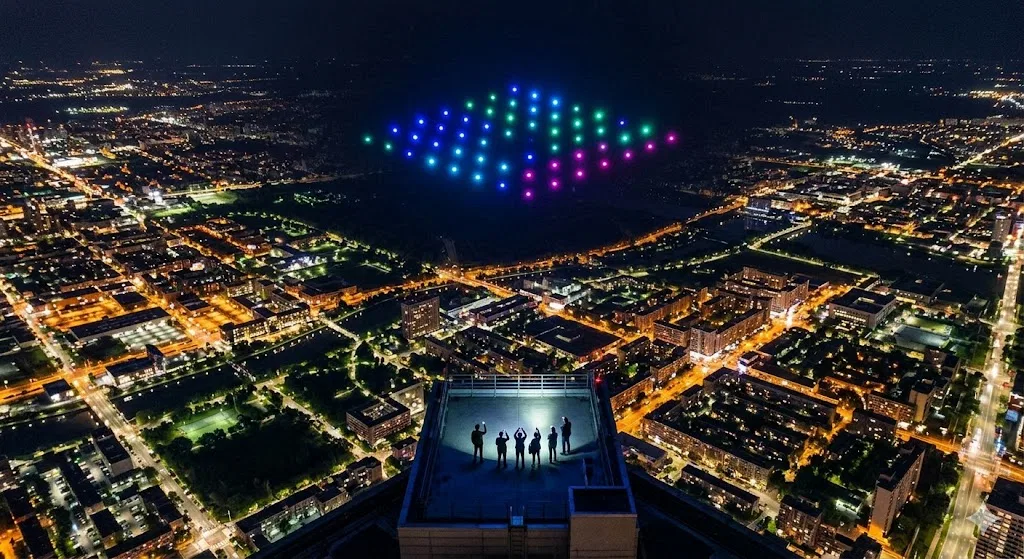
The simplest reason groups report the same unusual object is that they are all exposed to the same viewing geometry. A bright astronomical object low on the horizon can be seen by thousands of people across a region. A rocket plume can be visible over several countries. A satellite train can cross many towns in minutes. A weather balloon can drift slowly across a wide area. The witnesses are independent people, but the cause is not independent.
This is especially important for modern satellite and launch-related IFOs. Starlink satellite trains have repeatedly produced UFO reports because newly deployed satellites can appear as a striking line of lights moving across the sky. Space.com explains that these trains are most visible shortly after launch, especially after sunset or before sunrise, when satellites reflect sunlight while the ground below is dark. [Space]space.comStarlink satellite train: how to see and track it in the night skyBest viewing occurs just after sunset or before sunrise when satellites reflect sunlight while Earth’s surface is dark. Starlink orbits E… The effect is unfamiliar enough that local newsrooms and police forces often receive clusters of calls, even though the cause is predictable from orbital data.
Aviation cases show the same pattern at higher stakes. A 2024 technical case study reconstructed an August 2022 event in which five pilots on two commercial flights over the Pacific reported a UAP; the authors used Starlink orbital data and flight-tracking information to show how a recently launched satellite train could generate multiple corroborating reports from trained observers. Their point was not that pilots are unreliable, but that unusual illumination and poor space-situational awareness can make ordinary satellites look anomalous even to professionals. [arXiv]arxiv.orgSource details in endnotes.
Rocket plumes and fuel dumps can be even more dramatic because they change shape. In March 2025, a glowing spiral seen across the UK and parts of Europe prompted speculation online before being traced to a SpaceX Falcon 9 rocket effect: frozen or vaporised exhaust material reflecting sunlight high above a darkened ground. The Guardian reported that the display was visible for several minutes across Britain and Europe; the Washington Post described the same broad European sighting pattern and the physics of vented fuel forming a luminous spiral. [The Guardian]theguardian.comSource details in endnotes.
In all these cases, the number of witnesses confirms that something was visible. It does not, by itself, confirm that the object was close, huge, intelligently controlled or exotic.
Rumour and expectation shape what people notice
Mass UFO reports often grow after a first story enters circulation. The first witnesses may describe a puzzling light; the local paper reports “mysterious objects”; social media repeats the most dramatic clips; later observers go outside expecting to see something unusual. That expectation changes the reporting environment.
The Belgian UFO wave of 1989–1990 is a classic example because it contains both valuable and problematic evidence. There were many civilian reports, some police observations and a well-known F-16 scramble. Yet the case also shows how waves can accumulate reports after the fact. Accounts of the major 30 March 1990 night reportedly grew in the following days and weeks, and a famous triangular photograph associated with the wave was later admitted by Patrick Maréchal to have been a hoax. [Wikipedia]WikipediaBelgian UFO waveBelgian UFO wave
This does not reduce the entire Belgian wave to a single fake photograph. It shows why mass cases need careful sorting. Some witnesses may have seen aircraft, stars, helicopters, balloons, unusual atmospheric effects, or genuine unknowns. Others may have retrospectively fitted later details into earlier memories. A wave is not one case; it is a bundle of reports produced under shared public attention.
Social amplification also explains why reports cluster around cultural moments. During periods of intense UFO coverage, people are more likely to interpret ambiguous lights as UFOs and more likely to report them. Project Blue Book’s own historical material recognised that many UFO reports were eventually identified as ordinary things, including aircraft, astronomical bodies, meteorological phenomena and satellites; it also noted that satellite reports rose with both public interest and the increasing number of satellites in the sky. [Defense Security Service]esd.whs.milDefense Security Service Project Blue BookDefense Security Service Project Blue Book
The pattern is not “people imagine everything”. It is subtler: people see real things, but rumour supplies the frame. Once a community expects mystery in the sky, more ordinary sky events are collected under that label.

Mass sightings are not all the same
A useful investigation separates different kinds of “many witnesses” instead of treating them as one category.
A crowd watching together is vulnerable to immediate social cues. If one person points and says the object is accelerating, others may adopt that description. The accounts are not fully independent because the witnesses are effectively sharing one interpretive environment.
A regional wave of reports can be stronger if the reports are time-stamped and geographically separated. But it can also be weaker if the wave lasts weeks, receives heavy publicity and contains many vague sightings with different descriptions. A wave may be a mixture of causes, not one object seen repeatedly.
Professional witnesses can add useful observational discipline, especially when they record time, direction, altitude estimate and instrument data. But pilots, police officers and military personnel still face the same geometric limits as everyone else when looking at distant lights without range. The Starlink aviation case shows that trained observers can give sincere, corroborating accounts of an unfamiliar but conventional satellite configuration. [arXiv]arxiv.orgSource details in endnotes.
Sensor-linked sightings are potentially stronger, but only if the sensor record is interpretable. Radar returns, infrared video and camera footage need metadata: range, angle, calibration, platform movement, weather and possible artefacts. NASA’s UAP report emphasised that analysis is hampered when observations are not consistent, detailed and curated. [NASA Science]science.nasa.govScience Independent Study Team ReportScience Independent Study Team Report
The strongest mass-sighting evidence therefore comes from convergence without contamination: separate observers, separate locations, rapid recording, matching times, and independent records that point to the same physical stimulus.
Independent records matter more than witness counts
The practical test for a mass sighting is whether it can be reconstructed. A report becomes more useful when investigators can compare it with known objects and conditions. The most valuable records include:
- exact time, time zone and duration;
- observer location and viewing direction;
- angular elevation above the horizon;
- photographs or video with original metadata;
- aircraft tracking, satellite passes and launch data;
- weather, wind and cloud conditions;
- radar or infrared data with calibration details;
- independent witness accounts collected before discussion.
This is why “twenty people saw it” can be less useful than “three people in different places recorded it at 21:14, looking west-north-west, while a known rocket plume was sunlit at altitude”. Numbers are persuasive to readers, but geometry and timing are persuasive to investigators.
AARO’s recent public case material illustrates the same approach. Its official imagery page lists cases resolved as balloons, migratory birds or not anomalous alongside unresolved or still-analysed cases, showing that modern UAP work depends on matching reports to mundane candidates where the data allow it. [AARO]aaro.milOpen source on aaro.mil. Its 2024 public messaging likewise says that hundreds of cases have been resolved as commonplace objects, while a small percentage remain potentially anomalous and require more focused inquiry. [U.S. Department of War]war.govdod examining unidentified anomalous phenomenadod examining unidentified anomalous phenomena
That distinction is important. Social amplification does not prove a case false. It explains why witness numbers alone cannot carry the weight often placed on them.
What mass sightings can prove — and what they cannot
A well-documented mass sighting can prove that an event was visible, public and not merely an isolated hallucination. It can show that a conventional explanation must fit a wide area and multiple viewpoints. It can also reveal patterns that a single witness could not: direction of travel, approximate timing, or whether the stimulus was local or distant.
But mass sightings cannot automatically prove size, speed, altitude, shape or intent. Those are often inferred from assumptions about distance. If witnesses think a light is close, it may seem silent and impossibly fast. If it is actually a satellite, aircraft or distant plume, the same visual motion may be ordinary. If three lights are interpreted as corners of one triangular craft, the case changes completely depending on whether they were physically connected or merely aligned from one viewpoint.
The main risk is circular reasoning. A crowd sees lights; the lights are called a craft; later witnesses describe “the craft”; the number of witnesses is then used to prove the craft existed. A careful IFO analysis breaks that loop. It asks what the raw observations were before the label hardened.
How to read a mass UFO case fairly
The fair position is neither automatic dismissal nor automatic belief. Mass sightings deserve attention because they may contain better data than isolated reports, but they also deserve stricter handling because social contamination can spread quickly.
A strong case has early, independent, specific accounts that agree on measurable details. A weak case has many late, vague or mutually influenced accounts that agree mainly on a dramatic interpretation. A mixed case may contain a real event at the centre, surrounded by later additions, mistaken repeats and copycat reports.
The most useful reader habit is to separate three questions:
- Was something genuinely observed?
In many mass sightings, yes. The stimulus may have been real and widely visible.
- Were the witnesses independent?
Not always. Shared viewing, discussion, media coverage and social media can merge separate memories into a common story.
- Can the event be checked against independent records?
This is the decisive step. If flight data, satellite data, launch records, weather and sensor metadata fit the sighting, an IFO explanation becomes much stronger. If they do not, the case may remain unresolved — but unresolved is not the same as extraordinary.
Mass sightings sit at the boundary between evidence and amplification. They can strengthen a UFO report when they provide independent, checkable observations. They can weaken it when they multiply the same perceptual error through a crowd, a town, a newsroom or a social feed. Understanding that difference is central to explaining how ordinary objects become some of the most memorable UFO reports.
Amazon book picks
Further Reading
Books and field guides related to Why Groups Can Share One Mistake. Use these as the next step if you want deeper reading beyond the article.
Extraordinary Popular Delusions and the Madness of Crowds
Rating: 4.0/5 from 5 Google Books ratings
Explores how beliefs can spread through groups.
Mistakes Were Made (but Not by Me) Third Edition
Explains confirmation and memory effects.
eBay marketplace picks
Marketplace Samples
Example marketplace items related to this page. Use the search link to explore similar finds on eBay.

Endnotes
-
Source: science.nasa.gov
Title: Science Independent Study Team Report
Link: https://science.nasa.gov/wp-content/uploads/2023/09/uap-independent-study-team-final-report.pdf -
Source: war.gov
Title: dod examining unidentified anomalous phenomena
Link: https://www.war.gov/News/News-Stories/Article/Article/3965403/dod-examining-unidentified-anomalous-phenomena/ -
Source: historylink.org
Link: https://www.historylink.org/File/5136 -
Source: space.com
Title: Starlink satellite train: how to see and track it in the night sky
Link: https://www.space.com/starlink-satellite-train-how-to-see-and-track-itSource snippet
Best viewing occurs just after sunset or before sunrise when satellites reflect sunlight while Earth’s surface is dark. Starlink orbits E...
-
Source: arxiv.org
Link: https://arxiv.org/abs/2403.08155 -
Source: Wikipedia
Title: Belgian UFO wave
Link: https://en.wikipedia.org/wiki/Belgian_UFO_wave -
Source: aaro.mil
Link: https://www.aaro.mil/UAP-Cases/Official-UAP-Imagery/ -
Source: Wikipedia
Title: Psychosocial UFO hypothesis
Link: https://en.wikipedia.org/wiki/Psychosocial_UFO_hypothesis -
Source: Wikipedia
Title: Psychological perspectives on UFO claims
Link: https://en.wikipedia.org/wiki/Psychological_perspectives_on_UFO_claims -
Source: Wikipedia
Title: Project Blue Book
Link: https://en.wikipedia.org/wiki/Project_Blue_Book -
Source: Wikipedia
Title: Seattle windshield pitting epidemic
Link: https://en.wikipedia.org/wiki/Seattle_windshield_pitting_epidemic -
Source: Wikipedia
Title: List of mass panic cases
Link: https://en.wikipedia.org/wiki/List_of_mass_panic_cases -
Source: Wikipedia
Title: Condon Committee
Link: https://en.wikipedia.org/wiki/Condon_Committee -
Source: Wikipedia
Title: Mass psychogenic illness
Link: https://en.wikipedia.org/wiki/Mass_psychogenic_illness -
Source: media.defense.gov
Title: FY24 CONSOLIDATED ANNUAL REPORT ON UAP 508
Link: https://media.defense.gov/2024/Nov/14/2003583603/-1/-1/0/FY24-CONSOLIDATED-ANNUAL-REPORT-ON-UAP-508.PDF -
Source: aaro.mil
Link: https://www.aaro.mil/ -
Source: content.time.com
Link: https://content.time.com/time/specials/packages/article/0%2C28804%2C2072479_2072478_2072515%2C00.html -
Source: theguardian.com
Link: https://www.theguardian.com/world/2025/mar/25/alien-hopes-crash-to-earth-glowing-spiral-uk-spacex-rocket -
Source: esd.whs.mil
Title: Defense Security Service Project Blue Book
Link: https://www.esd.whs.mil/Portals/54/Documents/FOID/Reading%20Room/UFOsandUAPs/proj_b1.pdf?ver=2017-05-22-113513-837 -
Source: syfy.com
Title: spacex satellites are now being mistaken for ufos and making astronomers rage
Link: https://www.syfy.com/syfy-wire/spacex-satellites-are-now-being-mistaken-for-ufos-and-making-astronomers-rage -
Source: futurism.com
Title: spacex starlink satellites ufos
Link: https://futurism.com/the-byte/spacex-starlink-satellites-ufos -
Source: history.com
Title: mysterious illnesses mass hysteria
Link: https://www.history.com/articles/mysterious-illnesses-mass-hysteria -
Source: independent.co.uk
Link: https://www.independent.co.uk/tech/spacex-satellite-ufo-internet-elon-musk-starlink-a9473896.html -
Source: britannica.com
Title: Project Blue Book
Link: https://www.britannica.com/topic/Project-Blue-Book -
Source: unsolved.com
Title: Belgian UFO
Link: https://unsolved.com/gallery/belgian-ufo/ -
Source: foxnews.com
Link: https://www.foxnews.com/science/spacex-starlink-satellites-not-ufos-spotted-in-night-sky-over-washington-state-report
Additional References
-
Source: cia.gov
Link: https://www.cia.gov/readingroom/docs/CIA-RDP90-00552R000303250001-9.pdf -
Source: researchgate.net
Link: https://www.researchgate.net/publication/376441474_Psychological_aspects_in_unidentified_anomalous_phenomena_UAP_witnesses -
Source: archive.org
Link: https://archive.org/download/aliensinskies00unit/aliensinskies00unit.pdf -
Source: facebook.com
Link: https://www.facebook.com/WiltshireBBC/posts/do-you-remember-the-warminster-thing-the-sightings-well-known-among-locals-and-u/1350532837072946/ -
Source: cobeps.org
Link: https://www.cobeps.org/pdf/belgian_wave_130310.pdf -
Source: facebook.com
Link: https://www.facebook.com/groups/2365809903441367/posts/27187048340890846/ -
Source: reddit.com
Link: https://www.reddit.com/r/space/comments/15n15b1/its_starlink/ -
Source: ebsco.com
Link: https://www.ebsco.com/research-starters/social-sciences-and-humanities/mass-hysteria -
Source: facebook.com
Link: https://www.facebook.com/ThaiPBSWorld/posts/members-of-an-independent-nasa-panel-studying-ufos-or-what-the-us-government-now/6692013127510627/ -
Source: facebook.com
Link: [https://www.facebook.com/NewsNationNow/posts/mysterious-sightings-in-the-sky-are-likely-drones
Topic Tree
Follow this branch
Parent topic
IFOsRelated pages 39
- A Head On Aircraft Can Look Like A Stationary Light Because It The Stationary Light That Is Moving
- AARO What Modern UAP Reviews Resolve
- Aircraft Lights Why Ordinary Aircraft Look So Strange
- Atmosphere When Weather Makes Shapes in the Sky
- Balloons Why Balloons Become Flying Saucers
- +34 more in sidebar